
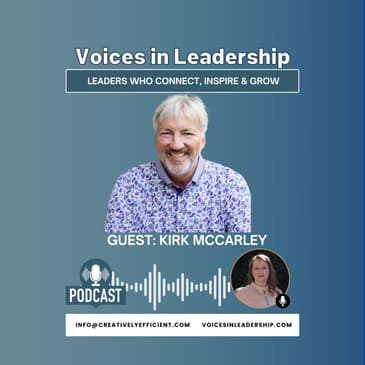
Discover the essence of authentic leadership with Kirk McCarley, a dynamic career and life coach who left behind a successful 35-year run in human resources to inspire others. Kirk's journey is a testament to the power of pursuing passions and realizing dreams, no matter the stage of life. From spinning classes to cycling adventures across Iowa and Georgia, Kirk's story is filled with invigorating pursuits and unexpected twists that underscore the beauty of stepping outside one's comfort zone. Alongside my own escapades as a triathlete, our discussion is enriched with humor and relatable incidents, offering a fresh perspective on how athletic endeavors mirror the challenges and joys of the leadership journey.
Kirk and I explore the profound impact of perspective in leadership, sharing insights from our transitions from established careers to life coaching. Embracing momentum, shunning victim mentalities, and leveraging new technologies like AI not only shape personal development but also drive professional growth. Kirk's experiences, detailed in his book, reveal the importance of being present and expanding one's horizons to effectively navigate life's obstacles. This conversation invites listeners to reflect on their own paths, encouraging them to find value in diverse perspectives and to use these insights as a catalyst for their own growth.
Our discussion takes a deeper dive into the transformative power of mentorship and the resilience required to maintain integrity in leadership. Inspired by mentors like Alan, who played a pivotal role in Kirk's pursuit of a higher coaching certification, we uncover the importance of pushing past comfort zones. The spirit method of acknowledgment and active listening are highlighted as crucial tools for fostering genuine relationships and authentic coaching experiences. This enlightening episode promises to inspire listeners to embrace challenges, find grounding truths, and pursue their own journey of self-discovery with renewed vigor and clarity.
00:03 - Dr. Angela J. Buckley (Host)
Welcome to Voices in Leadership, where leaders who connect, inspire and grow come to share their stories live. I'm your host, dr Angela J Buckley. Join us as we explore authentic leadership, gratitude and the power of connection through powerful conversations with inspiring voices. Let's inspire, uplift and elevate leadership that truly makes a difference together. Hello Kirk, how are you?
00:42 - Kirk McCarley (Guest)
I am well, angela, and how are you doing today? Fine thank you. Thanks for joining, thank you for having me.
00:50 - Dr. Angela J. Buckley (Host)
I'm watching the little bit of lag over here as we get started today, so apparently maybe some of the storms have been playing havoc with some of the electrical systems around here.
01:02 - Kirk McCarley (Guest)
Let's hope not. Let's hope you guys are safe from that.
01:05 - Dr. Angela J. Buckley (Host)
So, kurt, I'm very, very much excited. I'm just playing with my setup over here for a second, I apologize. I'm very excited to have you here. There is so much to be said for seeding leadership and how do we drop and develop and build leadership so that organizations grow and sustain themselves, and so I am very much excited to hear your thoughts on that. And if you will give me a hot second, I get to read your bio for a second, and you have to sit there and smile for the audience.
01:52
So Kirk McCarley is here joining us today. Following a 35 year career as a human resource executive, he's launched his business as a career and life coach, taking a unique approach to helping clients first consider and then act upon the dreams that make their passions a reality. Kurt has done that himself, also through a part-time career as a production assistant with ESPN, taking advantage of cycling and leading spin classes. He's an author of the book Thoughts for my Kids and Other People's Kids. The audience will learn that it is never too late to discover what we were made for. Kurt, I love your bio and I'm so excited to hear more about cycling. I don't know if we chatted about that, but I'm an avid triathlete myself, and so my legs are actually a little sore from my ride on Tuesday. Still, I might have overdone it.
02:56 - Kirk McCarley (Guest)
How far did you go?
03:01 - Dr. Angela J. Buckley (Host)
Not far, it was only 25, but I was supposed to be in like zone two. It was supposed to be a long kind of right long slow ride. But some truck picked me up out in the cornfields and they followed me, respectfully, thankfully, but they followed me four or five miles. But they followed me four or five miles and I thought they were just being respectful and I tried to sprint to get to a spot where they could pass me safely. But as I got into town the turkeys were still following me and I say turkeys in hindsight because they followed me, went around one of the we have Euro circles in this area, went around the Euro circle and went back out Like they were just following me for the fun of it, and then waved at me as they went by.
03:52
I was not wearing a Team USA kit, but I was wearing a lot of red, white and blue. I don't know if they think they were following some Olympic cyclist. I trust, trust me, I was not at that pace, but it wasn't part of my training plan to sprint for five miles yet on Tuesday. And then I did my weightlifting and honestly, it's the combination of unplanned sprint, like I didn't have the fuel for that and lifting weights that I am still paying for.
04:23 - Kirk McCarley (Guest)
It's rare that I hear stories about trucks drafting bikes.
04:27 - Dr. Angela J. Buckley (Host)
I don't think they were drafting, I think they were looking so. But I will tell you they were respectful from the distance perspective, which is far better than some of the things I've experienced, where they've run me off the road intentionally, tried to do things right Like they were safe. I just didn't realize their intent.
04:49 - Kirk McCarley (Guest)
That can be annoying, but I'm glad you're here to share that story and talk about it.
04:55 - Dr. Angela J. Buckley (Host)
It was an okay day. So, kirk, what got you into cycling?
05:03 - Kirk McCarley (Guest)
I got into cycling via spinning, angela. As I crept up in the years running became more difficult, particularly for my lower back. So there was a guy I worked with and Tommy said you ought to come join a spinning class. And I did that and found it to be a wonderful form of aerobic and anaerobic exercise and it fulfilled a lot of the things that I was hoping to do through running. And so I'd been spinning for a few years and shortly thereafter Tom said there's this bike ride across Iowa that I think you'd really enjoy, called Rack Bride, the Registrar's Annual Great Bike Ride Across Iowa. So I tried that in 2008 and got hooked, and I did nine more Rack Brides and I've now done seven Braggs, which is the bike ride across Georgia All thanks to Tommy having a couple of episodes with me. So it's kind of these obscure people that come into your life that have great influence, and he is one of them.
06:16 - Dr. Angela J. Buckley (Host)
So I don't, it's a friend of a friend, but the person who coordinates and originally coordinated the RACRA. I've been to their house. It's a small community so, um, interesting that's. That's a great ride and there's some nice hills, like it's so rolling hills in iowa I. I love riding out there love I, I.
06:39 - Kirk McCarley (Guest)
I was not flat, contrary to popular belief. No, but what's even less flat is northern Georgia, as I discovered this past year.
06:48 - Dr. Angela J. Buckley (Host)
And, I'll have to admit, especially if you go west, right. Yeah, there were a couple of times Get away from the coast and, yeah, there's some hills that you're going to be climbing out there.
06:58 - Kirk McCarley (Guest)
And we did, and I'll have to admit there were a couple or three times I had to get off the bike and walk at 15, 16 percent grades.
07:08 - Dr. Angela J. Buckley (Host)
Back in the day, like now I have GPS right, but back in the day when it tested your, it just measured the spin on your wheel. I was going up the hill and it was pretty aggressive and it literally turned off on me as if I was at a stop. I did not unclip, but it turned off. Didn't just like cause usually get the stop sign pause. They had those built in mine actually went bleep, bleep, bleep and turned off. I was so mad. Um, but there was a hill right outside my backyard. Basically, when I was insylvania that was a 14.8 percent grade and I rode that every saturday good for you so I can do those climbs.
07:52
It's just when it's that climb comes up at mile 68 of an 80 mile day, they get a little slower.
08:00 - Kirk McCarley (Guest)
I'm not gonna lie, they're not as fast as they were in the morning, and the climb up ever so wobbly.
08:08 - Dr. Angela J. Buckley (Host)
Yes, weebles wobble, but we try not to fall down.
08:12 - Kirk McCarley (Guest)
That's right.
08:13 - Dr. Angela J. Buckley (Host)
So all right, Kirk. Well, we're going to have some fun today. Please tell me how you got started in the leadership and the life coaching. How are you capitalizing on all of the lessons you've learned throughout HR corporate and bringing that forward in your coaching practice now?
08:37 - Kirk McCarley (Guest)
I was an HR person executive for 30 some odd years and late in that career I one had aspirations. I want to do something different. I don't have designs on on retirement, so to speak, what that would be. I don't know exactly. So I hired a coach and in visiting with him over several sessions there came a point where I hit that intersection that spoke to me and I said I want to do what you do.
09:14
I didn't have all the details about what was involved in coaching. I thought it would be similar to what had happened or what was happening late in that HR career where more and more people would come to me not to ask about a policy or compensation or benefit, but more from the standpoint of I'm at an intersection, I'm stuck in my career. How do I get unstuck? And that has become a reoccurring theme in coaching. So, carrying that forward, my coach inspired me to pursue that. I went back to school, got some education, eventually got certified through the International Coaching Federation, and here I am applying not only what I learned as a coach from my clients, but this vast history in HR and all the observations and stories and things that I've had the opportunity to take part in.
10:16 - Dr. Angela J. Buckley (Host)
I love it. The ICF certification is well worth the work to put into it. So congratulations for getting that, Kurt. Where are you going next and how are you taking some of the lessons and putting that into writing? So you've written your book. What are the top three things we need to know about your book today?
10:46 - Kirk McCarley (Guest)
Number one and it's a recurring theme, and I was coaching a client yesterday and shared this with him move. I talk to so many people now who are stuck, they feel stuck, they feel stagnated, are stuck, they feel stuck, they feel stagnated. And it's as simple as which is not simple for some people just getting out of your bed in the morning, making your bed, splashing some water in your face, brushing your teeth, unloading the dishwasher, checking some email, because what you've done is created some momentum, and with momentum can come some creativity. So, number one move. Number two be careful with the victim mentality and victimization.
11:38
Oh, this has been done to me and that leads to stagnation, waiting for conditions to change. They may change, but more often than not, you're living in a new reality, so don't allow yourself to get drawn into that. Instead. This is what I'm dealt with. These are the cards I have right now. What I'm dealt with. These are the cards I have right now. How do I look at that? Thirdly, from a different perspective, what am I missing? And many of us now, myself included with uncertainty and tariffs and chaos. A lot of times it's like oh, we're mad, we're angry about it, and we are, but there comes a point we have to get beyond that. And okay, what am I missing now? What do I need to see in order to be successful in these times and for ages, people have been successful under hardship. They just need to figure out another way of doing that, and so many of us have that capacity.
12:50 - Dr. Angela J. Buckley (Host)
So number one is move. Number two beware the victim mentality, so ground yourself in now. And then number three perspective, perspective how do I see things gain perspective.
13:10 - Kirk McCarley (Guest)
What am I seeing? A broader view, asking ourselves what am I missing here? Uh, I don't like ai. Okay, that's fine, but I need to learn about it in order to really make an informed decision. And it can be our friend rather than a threat. How can I allow that to happen, for example, that is perspective.
13:37 - Dr. Angela J. Buckley (Host)
Yes, got it. Hey, we have five people that are watching live right now on LinkedIn. If they have any questions, what's the best way for them to contact you?
13:53 - Kirk McCarley (Guest)
Kirk at the seedsewercoachcom, seedsewercoach, seedsewercoach. I've also got that website which is theseedsewercoachcom. I'm on LinkedIn, which send me a message. I'd love to connect with you one and second, address your question, and that should have my contact information as well. So I'd say the best resource, angela, linkedin, go there, let's connect.
14:25 - Dr. Angela J. Buckley (Host)
Certainly, linkedin is my preferred social media. I guess if we're going to call that social but connection tool, for sure Great. And if you are listening live, if you go over to the networking tab, you can also add in there and add comments or if you have any questions for us today. Please be aware that there is a slight lag. I will keep my eye on the comments section, but it does not come directly in very quickly. So but if you have questions specifically that you would like to pose to Kirk, please drop those in the comments and we will address them as we go through today.
15:06 - Kirk McCarley (Guest)
Wonderful.
15:07 - Dr. Angela J. Buckley (Host)
Kirk, thank you for that. Where does one go to gain perspective? We're going to work backwards with your three points. What is the most effective way of gaining perspective?
15:30 - Kirk McCarley (Guest)
Observation one, awareness of what's going on around us, seeking understanding of the time, times that we live in, the history that we have, what's taken us to this point, and as we get older, that becomes actually a greater advantage. I remember the 60s. I remember the turn of the millennium that we're in right now, a sense of what was happening, a sense of what the moods, the attitudes were, because I lived through that. So that is a gift that I have Not everybody does when I figured that I'm older than five out of every six people that are out there. So, number one, that Stop now, that is not true.
16:18
No, it really is. I looked at the actuarial tables and that is where I am in life at this point. But you know what? I don't fear getting old. I celebrate it because I've had the blessing of getting to this point that I'm at now.
16:34 - Dr. Angela J. Buckley (Host)
Absolutely. If we're not underground, we're still living.
16:36 - Kirk McCarley (Guest)
Let's keep going, that's right. Still sucking air, so it's all good. So, number one, that perspective. Number two read a lot. Expose yourself to a lot of literature that's out there Fiction, nonfiction, things that are going to inspire your creativity. Number three and for a coach, this is so important curiosity. How does this work? How do you think the way that you do? I hear you saying that. Tell me more about that. Again, not accusatory, but I'm looking for information.
17:23
My wife and I had the opportunity to travel last week. We went to Nantucket Island wonderful place to be had a wonderful time there and we went to a brewery that was there and happened to connect with a couple of people who are half our ages. They live in the DC area, they do things different than what we do and it was just a delightful conversation, having the opportunity, the chance to pick their brains, learn their perspective, what's going on in the beltway as opposed to what's happening in the bubble we live in in northwest Florida. Sometimes and that's what I love so much about the work that I do is very little of my business comes from the area in which I reside. It's from places all over the country, sometimes all over the world, and so I get that perspective of other areas which is really a secret sauce for me.
18:25 - Dr. Angela J. Buckley (Host)
I love having the international perspective. I think it's a powerful grounding activity for all of us Traveling right, I think Mark Twain had some quotes on traveling as well, on gaining perspective and getting outside of our little town. So I think all the world is your oyster.
18:48 - Kirk McCarley (Guest)
That it is, and I always relish the time with a former client who was in Riyadh in Saudi and it would be 10 at night for him and it would be two in the afternoon for me and he was usually driving but he would take me on a tour of downtown Saudi Arabia and I was just fascinated to hear his philosophies, to see where he was living, his background, and really helped me from the perspective of being broadened and more well-rounded.
19:27 - Dr. Angela J. Buckley (Host)
So I recently joined a global hub of coaches and speakers and it is so fantastic to hear leadership worded differently and yet coming together on very similar points. But then everybody highlights a little bit differently and there's so much value in that. So I do. I love your, the approach to perspective, and so now we're going to step backwards. We said one was move and two was beware the victim mentality or ground yourself. I was recently reading Fierce Conversations by Susan Scott and she talks about ground truth, right, and so how do you ground yourself and get away from that victim mentality? What are some steps that you see are useful for people to move through on that mentality? What are some steps?
20:24 - Kirk McCarley (Guest)
that you see are useful for people to move throughout that. I heard that word truth from you and we're always seeking that. What is the truth? And again, in the era in which we live of alternative facts and facts that becomes ever more difficult to decipher. For example, the bombings in iran what really happened? What are the conditions there? Depending on what you read, you're uncertain, and a lot of that is a result of the time that we're in.
21:03
We have many news sources. Which one is accurate? But it becomes. Which one aligns with what our values and our beliefs are, instead of, maybe, what is truth? We don't have Walter Cronkite or the other two news networks anymore. That's giving us all that information. So weeding that out, discerning it again, that's educational. Exposing yourself to a number of different viewpoints, measuring that against your own values, to discern. Okay, where is the accuracy that exists on that? Okay, where is the accuracy that exists on that?
21:51
I, as much as anyone, have that tendency to start slipping into victimhood. A disappointment has occurred, Someone has done something that I don't particularly like. We've had a decision that's been made which is not favorable towards us and the immediate reaction is darn it, they've got me again. Why am I always being picked on and that's usually a bike ride or workout at the gym to go clear my head, to take a breath, to assess that and to recenter myself. And it may not be an immediate fix but I can process it. So for me, I coach myself a lot and it's kind of in terms of OK son, let's take a look at this. When I got out of HR and moved into my own business, as I have now, I don't have a staff. My staff is the dog that sits at my feet often. It's at my feet often, but from technology standpoint I don't know it. I've had to learn, but when I had a computer breakdown I couldn't call the IT staff.
23:19 - Dr. Angela J. Buckley (Host)
I looked at the person in the mirror in the morning as I do now and said son, you better figure this out, Okay, so a little bit of grit and resilience associated with that then as well, right? Yes, and if I'm coaching people on that, I better darn well be practicing it as well.
23:41 - Kirk McCarley (Guest)
There is a lot to be said for role modeling, our leadership values.
23:48 - Dr. Angela J. Buckley (Host)
Do as I do, not as I say, as the saying goes, something like that. But in our case, we want to do as we say. That's right, and that is the challenge right. That's the challenge of integrity, it's the challenge of authenticity making sure that we're saying what we want to be doing and then doing what we're saying, like it's really. It's not as straightforward as it seems, it's hard. We're humans.
24:13 - Kirk McCarley (Guest)
That we are and we sometimes think or we speak quicker than we think and we find ourselves getting into trouble as a result of that. A discipline that I have taken up, and I've learned it through coaching, is this pause and hesitation in speaking and saying things. In the US, it's about a half a second. You'll say something, angela, and about a half a second later I'm responding to it. And what's happening? I'm not really listening to you. I'm getting ready for what I'm going to say next, because it's important.
24:56
In the northeastern US they talk faster, it's even less than that, and you go to some European countries it's like minus a second because they're talking over each other. Think of a family dinner in Italy, let's say Lots of conversation all at once. Some of the Asian cultures. There can be pause and hesitation of five, six, eight seconds, which we grow uncomfortable with here, because did I say something wrong? No, what they're doing over there? They're giving the other individual an opportunity to process and to speak thoughtfully to what's been said and maybe begin with. I hear what you're saying and this is what I'm thinking in response to that.
25:49 - Dr. Angela J. Buckley (Host)
The active listening skill set is underdeveloped and highly needed in leadership settings.
25:57 - Kirk McCarley (Guest)
That it is.
25:59 - Dr. Angela J. Buckley (Host)
And I am also guilty, so let me not poke or point at anyone else. I have opportunities for improving as well. So, kirk, where does fear fall into that victim mentality?
26:18 - Kirk McCarley (Guest)
There is a symbiotic relationship between fear and anger. We tend to get angry and lash out at the things we most fear, and again that goes back to the victimization. Darn it. Look what's been done to me. I'm going to get them. I'm so mad about that. What I'm really saying is I'm fearful that this is going to affect my livelihood, my pocketbook, my ability to do something. So that's how that manifests out and, as I've had counseling in the past at some rough spots in my life, which I can't say enough about the counselors I've had, one of the first questions they'll ask is what are you afraid of today? Because it's typically what you're mad about.
27:19 - Dr. Angela J. Buckley (Host)
Oh, that's a great question. That's a good leading question. I haven't heard that Interesting, nice. Yeah, that's a. That's a great question. That's a good leading question. I haven't heard that interesting, nice, yeah. So, and then we're going to move on to what number one and we were working backwards move. So how does movement help you? What is that? What's it look like? So a lot of times we talk about movement, we talk about momentum and in your case, you're talking about the physical and the emotional part of moving, getting things done, doing what you're doing. So what is that? How do you break that up for people?
28:08 - Kirk McCarley (Guest)
for some people just, and people who have had deep depression, which fortunately I've never had get this, just getting out of bed in the morning can be a chore, it can't be done. And so therapists will maybe start from the standpoint of can you at least change your position and get into an inclined rather than a reclined position? Just something as small as that. Can you pick up something to read? So really little baby steps to get you to that point. Once you've surpassed that, it's like the book begin by making your bed. Make your bed. You've achieved something that day. You have made your bed. Brush your teeth. You've cleaned your oral crevices, splash some water in your face, take a shower. You've cleaned yourself. What you're starting to do is gather some momentum, and what I have found is rhythm and cadence can impact our ability to communicate, to produce creativity, to accomplish some things.
29:20
I'll give an example and I'll advise some of my clients to take a look at this movie. It's called Akilah and the Bee and the premise is an 11-year-old girl who is gifted at spelling and she's going to participate in the spelling bee. She eventually gets a coach, who's played by Lawrence Fishburne, who coaches her, but what he gets her into in order to spell is a rhythm, a visualization exercise of she likes jumping rope and there's a one, two a three that goes with that, two a three that goes with that, and she begins to spell C-A-T-D-O-G and it gets her into a rhythm and a way of thinking that relaxes her, stimulates the endorphins in her mind, allows her creativity and her thought process to emerge to become a better speller. So when I coach people, let's say, for example, on interviewing, I will look to get them into a rhythm and I'll assign them that movie to watch, sometimes the King's Speech as well Academy Award winner there of where King George's coach got him, who had a stutter, into a sync, into a rhythm, and we can feel that.
30:53
It's why we have an attraction towards music, particularly some of us that are audio-minded. It makes us feel good, it takes us to a time that felt good or created a certain emotion and that is your move, part of it. For me often it's out on the bike. I wrote a book. Most of my writing of the book was while I was cycling, because I would think of things and I jot, jot them down, an idea and then expand upon it.
31:26 - Dr. Angela J. Buckley (Host)
How did you jot them down when you were on the bike?
31:30 - Kirk McCarley (Guest)
I am blessed with a good memory, so I would maybe memorize three key points of the subject.
31:39
When I got to a stable place and I had something to write with, I would jot those down and then the story would just naturally come to mind. For instance and not to dredge up tragedy at this point, but I was in Kerrville, texas, for 12 years, kerrville, texas, for 12 years, and I was there on July 17th 1987, when the flood of 38 years ago occurred. I'm going to write about that eventually when the time is right, but the point of it is, all I needed to do was jot down somewhere, kerrville, and the story is going to come and the perspective that's important, from then applying to now, is going to come up as well.
32:32 - Dr. Angela J. Buckley (Host)
I'm a fan of notes on my phone, so I was curious See, no, I can't do that when I'm on the bike, I'm too sweaty. So, kirk, what other? What other point do we need to take away from your book? So we've taken away movement, we've taken away grounding ourselves and getting out of that victim mentality and really looking at fundamental truths, and we've looked at active listening as part of that to gain those perspectives and travel. How does that seed the? How does that sow the seeds of leadership?
33:19 - Kirk McCarley (Guest)
for me the experiences that I'm able to relate from the book and we all have those experiences applying the perspective that we get those and how we apply them going forward. My best lessons have been learned really when I screw up, and I've done a lot of that through my career. So there will be stories. The first one is about when I was eight years old going door to door as a Cub Scout selling thin mints, I think Probably popcorn.
33:58 - Dr. Angela J. Buckley (Host)
As a Scoutmaster, you probably sold popcorn.
34:02 - Kirk McCarley (Guest)
I think as old as I was popcorn may not have been invented by then, but the kind that you couldn't fresh pop. We were all chiffy pop back then. So that was uh king of the hill. But this was his little thin mitts, and so I still remember going door to door. I'd gone to the 31st house and been told no, and I was pretty downcast my cub scout cap pulled over my head, hiding my eyelids, and the box that I was carrying around broke. I sat down on the curb and just started bawling my eyes out and, oh you know, you look so cute in that outfit. It's so sad what you're going through. But I came home and I told my mom. I said and she comforted me I said I never want to go into sales. I hate it, I hate it, I hate it. I didn't pursue a sales career, but I've learned later in life we are all in sales. We are selling ourselves, selling our idea. It may just not be a product going door to door to do that with.
35:18 - Dr. Angela J. Buckley (Host)
Yeah, yeah, and that is, that is a real part of leadership. Is that selling of the idea, selling the vision, mission, values and aligning the organization.
35:29 - Kirk McCarley (Guest)
Exactly.
35:31 - Dr. Angela J. Buckley (Host)
Yep, hey, kirk. It is now time to move to our gratitude section of the hour.
35:46 - Kirk McCarley (Guest)
Did you bring a person that you would like to thank, as I've entered coaching and he coached me after I decided to become a coach. So those of us that are coaches, it becomes, I think, extremely important to have somebody else as an accountability partner Alan Young. I talked to him on Monday. He fits the ingredients of what I'm looking for in a coach ingredients of what I'm looking for in a coach. He's older than me, which gets more challenging. His level of certification was beyond mine. I've since come to his level.
36:24
He has an interesting history. He was a therapist before he became a coach and he was a retired military veteran serving in special ops in Southeast Asia. He has modeled for me what I want to be as a coach a good listener, questions indicates interest, challenges me to become a better version of who I am, and I think that last one in leadership, is really what fits the description of an effective leader someone who causes another person to become better than they think they can be because they have the encouragement and don't have the preconceived notions of the limiting beliefs that we tend to have in ourselves. I think of sports. One of the great examples of that was Michael Jordan Six championships in eight seasons. He had a good supporting cast that were probably better, but of the supporting cast that was there, he brought them along. He was so intensive on winning. They caught that fever too, and if he's going to work this hard as a superstar, let's take our game to the next level as well, and quite successful with that. So mine is Alan.
38:09 - Dr. Angela J. Buckley (Host)
Okay, so how did Alan specifically Alan? So how did Alan specifically Alan? So how exactly? What exactly does Alan do or has Alan done specifically to help you?
38:30 - Kirk McCarley (Guest)
When I was young in the coaching journey. When I was young in the coaching journey, he would challenge me to take things to a different level. One example of that was with the book. As I was formulating the idea I was an associate certified coach and he made a statement to me that really got under my skin but it wouldn't leave and he said the legitimacy of your book is going to be enhanced if you become a PCC, which is the next level, professional certified coach. I didn't want to do it. I didn't want to do it and I said to myself I'm not going to do it. But what he said for me continued to resonate and it was like a dog certified coach. He got me in contact with an organization with mentor coaching coaches that were beyond what his capabilities were.
40:07 - Dr. Angela J. Buckley (Host)
And so what did that from his perspective? What did that take for him to be like a dog with a bone in getting you to that PCC? What kind of energy.
40:16 - Kirk McCarley (Guest)
Energy.
40:21 - Dr. Angela J. Buckley (Host)
What kind of energy did?
40:23 - Kirk McCarley (Guest)
he exude, or did I get?
40:24 - Dr. Angela J. Buckley (Host)
from that. For me this is on for the P, for the spirit method. We start with specific and then we talk about personal, how the actions he took probably took some time.
40:42 - Kirk McCarley (Guest)
There may have been some obstacles, energy or reflect his personal, their personal characteristics, values. Number one he had legitimacy for me because of who he was, the criteria that he met. He got to know me well enough and that was a key that he recognized my athletic background and what coaches would do to inspire me. And it bothered me but it did so in a healthy way when he said go for that PCC as an example. He was intentional about doing that. Yet he was comfortable, he was relaxed, he had done this before. He was experienced. I respected that experience that he brought to the table. He had legitimacy because of what his credentials were and also that he represented where I wanted my coaching business to come.
41:47 - Dr. Angela J. Buckley (Host)
P is like personal characteristics that were reflected in his activities. And then I what was the impact truly like metrics that that would have had on your business and your leadership journey?
42:02 - Kirk McCarley (Guest)
So personal? What characteristics and values were in his specific actions?
42:09 - Dr. Angela J. Buckley (Host)
Yes.
42:12 - Kirk McCarley (Guest)
Questioning me what is it going to take in order for you to get there? Okay, causing me to respond to that.
42:25 - Dr. Angela J. Buckley (Host)
Wait, that's not the question. Okay, and then impact. What is the impact on your journey?
42:35 - Kirk McCarley (Guest)
For me the impact on the journey. I eventually got it. It was not easy for me and there were times that I was about to say I'm investing too much money in this. The coach that I did have for that process took me to the limit of things and it was almost a cathartic process that went to the very end of what I could tolerate, to where I had to say I don't want to go there anymore. Let's get back to coaching. So what it demonstrated to me was how much to push my clients as I get them in the future. I learned that from that process and again getting back to this thing of perseverance, how does that impact your business now.
43:31 - Dr. Angela J. Buckley (Host)
Do you get more clients as a result of that? Was your book a better sell because of that? Literally metrics.
43:43 - Kirk McCarley (Guest)
My metrics are maybe not measured numerically as a result of that, in other words, quantity, but rather quality. That's fine fine my responses from people that I coached were more positive okay, that's a real you uh, listen to me more effectively.
44:10
I appreciate you challenging me to the degree that you have done that. You're more solution oriented than other coaches that I've had in the past. You got me to where I wanted to be and what I had dreamt this coaching relationship was going to look like. Okay, got a job as a result of the interview so positive outcome with your clients.
44:40 - Dr. Angela J. Buckley (Host)
Do you think you have a higher positive outcome with your clients as a result of his push?
44:45 - Kirk McCarley (Guest)
Yes, I got a job. I was better at interviewing. I learned more about myself that I'm able to apply in my career development, in my workplace experience.
44:59 - Dr. Angela J. Buckley (Host)
Okay, so we're continuing down the path of the spirit method of acknowledgement. So we have specifically what he did, the personal characteristics, some of the impact, and then how does that reflect on the relevance of the values of your business?
45:29 - Kirk McCarley (Guest)
Clients will discover my authenticity through that.
45:36 - Dr. Angela J. Buckley (Host)
Nice.
45:39 - Kirk McCarley (Guest)
My wanting to build relationship first of all, which is the key to having any kind of connection with someone I can work with, this person I can trust them to share what I want to share. I get these comments a lot from people. Again, I'm not a therapist, but I have not shared this with anyone. People will say that I've not been comfortable sharing that. So, there is a cathartic element that comes out of it.
46:17 - Dr. Angela J. Buckley (Host)
Okay. So when we talk about the spirit method of acknowledgement, we talk about specific what the actions were they took. We talk about personal what are the characteristics that they demonstrated, what are the obstacles that may have been overcome or the energy that they would have had to put in? Then we talk about the impact. Truly, what are the measurable? And quality of response is a measurable metric. We can talk about that offline sometime. And R stands for relevance, and it's relevance to the values of the organization or the business, in your case your coaching career. And then we talk about inclusive and timely for rounding out the word spirit, and that just means making it public so other people can see the importance of it. And timely ideally we give thanks, recognition and gratitude as close to the event as possible, right, so that there is a way of using that as an influence to continue that. So is it okay with you if I reword everything you've told me in just two or three sentences to sort of summarize your recognition statement for Alan.
47:31 - Kirk McCarley (Guest)
Please do.
47:33 - Dr. Angela J. Buckley (Host)
Okay.
47:33 - Kirk McCarley (Guest)
And I'll share with Alan.
47:36 - Dr. Angela J. Buckley (Host)
Please do Correct me if I'm off base on any of this, so I'm just trying to capture your words as we go through this process.
47:46
So thank you, alan, for your support and your challenging of Kirk in his leadership career and development.
47:56
As he was preparing to write his book, you encouraged him to step outside his comfort zone and get this PCC certification. I recognize that you had to put a lot of time and rigor into chasing him down and encouraging him to do that, because it was something that was uncomfortable and a growth edge for him, and it speaks to your tenacity in your support of him as you continue to encourage him through this growth process. It's had a positive impact on Kirk's career and the sales of his book, because you can see the quality of statements that are coming back as clients refer to his authenticity, to his openness, to the comfort that they have as they approach their developments, or even being able to say I got a job as a result of the work that you put in. It directly reflects both your values and Kirk's values in his career of grit, resilience, movement, keeping that momentum, finding that grounding truth and making sure that we are listening to hear and not listening to respond, sure that we are listening to hear and not listening to respond.
49:22 - Kirk McCarley (Guest)
Does that sound about right? That sounds like a wonderful affirmation statement. Did I miss anything from?
49:31 - Dr. Angela J. Buckley (Host)
what you said.
49:36 - Kirk McCarley (Guest)
He became a friend, nice Good, and that's who we are now.
49:40 - Dr. Angela J. Buckley (Host)
Well, can we ask for more? Kirk, I have really enjoyed speaking with you today. Do you have any other nuggets that you want to share before we sign off?
49:57 - Kirk McCarley (Guest)
that you want to share before we sign off. I'm thinking of something that I talked about this morning. I talked a little bit about it with a client last night and it goes back to the times that we're in. And it goes back to the times that we're in and this idea of movement, doing things and victimization and perspective.
50:27
In the Old Testament, lesson of Jeremiah we know the story, you know my ways, lord, and there are ways to give me peace and prosperity, and that's paraphrasing it very poorly. But the times that the Israelites were in were a period of exile. At that time, we're in Persia, we don't want to be here, we're frozen, but God speaks to those people and says to them go and have your families plant your gardens, build your houses. It's like I don't know how long this is going to last, but you can't stay frozen. You need to move forward, and I think that's a good lesson for all of us right now to follow. That is, you can always apologize or ask forgiveness for doing something. It may be wrong, but you can't ask for forgiveness for standing still and doing nothing. So move forward, take your steps, live your life. And that would be my closing thoughts.
51:44 - Dr. Angela J. Buckley (Host)
Great. Thank you so much, kirk, for joining us today. If you would like to hear more about Kirk's lessons and writings, you can find his blog post that will be coming up in this following weekend at voicesinleadershiplive, and also all the connections, the show notes etc. Will be going up next Tuesday. So feel free to swing on over there, join our free membership and I look forward to talking to you Until next time. Thank you for joining us on Voices in Leadership, where leaders who connect, inspire and grow share their stories. I look forward to welcoming you back to our next conversation. In the meantime, visit wwwvoicesinleadershiplive to access show notes links and to subscribe and stay connected. And, in the spirit of gratitude, let's remember to thank one person near you Until next time. This is Dr Angela J Buckley signing off.