
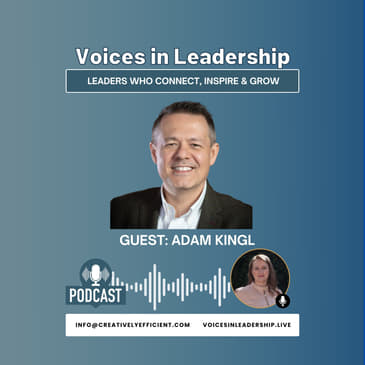


Unlock the secrets to thriving in a multigenerational workplace as we welcome the insightful Adam Kingl to Voices in Leadership. Discover how to bridge the gap between Millennials, Gen Z, Baby Boomers, and Gen X, aligning their diverse expectations to foster a harmonious and productive environment. We promise that by understanding these dynamics, you can empower your organization to thrive, with managers who ask the right questions to unlock the potential in their teams.
Journey with us as we dissect the essence of career purpose and its pivotal role in shaping meaningful professional paths. We explore the benefits of using a Venn diagram to map out personal and professional values, setting young and emerging leaders on a path to realizing their "golden thread." With insights on proactive planning and setting clear milestones, this episode is a must-listen for individuals and managers aiming to cultivate a purpose-driven workforce, ensuring that dreams are not only chased but achieved.
Finally, be inspired by the enduring influence of mentors, as we share a heartfelt story of how a high school teacher's encouragement led to a lifetime of striving for excellence. We explore the importance of cultural alignment within organizations and how creative initiatives can bridge generational gaps and fortify company values. This episode is not just about understanding the present workforce; it's a guide to crafting a legacy that aligns purpose, culture, and meaning in the workplace.
Authentic and Insightful Leadership Conversations
Dr. Angela Buckley has a gift for drawing out meaningful stories and practical lessons from each guest. The conversations feel real, not scripted, and cover everything from decision-making to gratitude in leadership. I always walk away with fresh ideas and a renewed perspective.
Kirk McCarley Podcast
Angela is a stimulative host. She asks thoughtful questions and challenges her guests. This podcast is professionally done and provides the audience practical and applicable insight into effective leadership approaches.
Highly recommend
Dr Buckley is a true voice in leadership. Listening to this interview with her son is a must listen. So relatable! Likeable leadership and the spirit of acknowledgement explained clearly. Well done!
00:03 - Dr. Angela J. Buckley (Host)
Welcome to Voices in Leadership, where leaders who connect, inspire and grow come to share their stories. Live. I'm your host, Dr Angela J Buckley. Join us as we explore authentic leadership, gratitude and the power of connection through powerful conversations with inspiring voices. Let's inspire, uplift and elevate leadership that truly makes a difference together. Well, hello and welcome back to another episode of Voices in Leadership. I am here today in the studio with my guest, Adam Kingl, and I am so excited to hear his take on the future of work and what the next generation is asking of us as leaders. Adam, thank you for joining us.
00:51 - Adam Kingl (Guest)
Thanks very much for having me Very much appreciated.
00:54 - Dr. Angela J. Buckley (Host)
So, Adam, one of the things when you reached out to me and said, hey, I'd like to be on the podcast that really interested me is the research that you've been doing with the next gen and really talking about what do they want from us? What are they looking for? How are they going to shape the next generation, the next future of work? What's the office going to look like?
01:19 - Adam Kingl (Guest)
Yeah, it is fascinating and sometimes I get pushback to say, well, these are just the differences between generations we've always experienced and that's always going to be like that, and we just have to wait for the younger generation to sort of grow up or get married or have kids and they'll be just like us. However, I think the differences between, say, the older generations in the workforce, which we'll broadly call baby boomers and gen x, and the younger generations in the workforce, which we'll call gens y and zed, or millennials and gen z's um, is actually more dramatically different than the gaps ever have been between older generations and younger generations um and and organizations are really suffering, but because they haven't yet managed to bridge those gaps.
02:09
Sometimes HR directors come to me and they say could you? When they asked me to do a talk, they might say could you help us to fix them, fix the youngins?
02:18
which is, of course, ridiculous because I said well, look, if we think about a generational paradigm, as sort of the ideas and the dynamics in which they grew up or in which they first entered the workforce, then we sort of have to look to ourselves, the organization, organizational culture, our incentives, our processes, and look at what are people reacting to or, more accurately, what are they reacting against. And once we understand that, then we can understand what might be contributing to the gap, because people don't sort of act out or be supportive in a void. There's something that they are responding to, there's a dynamic that's been created and if people are new entering a workplace, they aren't responsible for the workplace.
03:05
We're responsible for the workplace, we who have been there for however many years, and we can't assume that what new people want, new generations want, from us is exactly the same thing that we wanted. That, often, is what contributes to this frustration, is leaders, senior leaders, managers conflate what their people might need or want from the organization with what they want or wanted when they were that age.
03:33
But of course things change, things evolve, the environment changes and so that's probably the biggest understanding. You know that I hope people take away that you have to look at yourselves in order to understand the gaps. And then to your question, which we can get into in terms of like so what are sort of young, what are young talent looking for? I'm happy to go into that.
04:01 - Dr. Angela J. Buckley (Host)
You know, I've heard so many managers say to me if they would just get out of their own way, and it is. It is real right. Like our managers don't understand what other people are what our youngsters are looking for and I say youngsters kindly, because it is a little unfair to call an 18 or 22 year old, depending on when they're entering the workforce. They are fully matured adults at this point and we deserve to treat them as such, and that doesn't always happen. But we also have to recognize that there's experience that you continue to gain all the way up until you walk out the office door when you retire, to gain all the way up until you walk out the office door when you retire. So how do we help managers pose that question and how do we close the gap? How do we help those younger, new to the marketplace employees advocate for themselves as well?
05:02 - Adam Kingl (Guest)
Well. So starting with the manager side of the equation is certainly enhance curi their curiosity, like ask your people why, are you here, and I don't mean that in aggressive way why did you get into this industry?
05:19
and then of all the companies in this industry, why did you join this company out of all the possible companies? What are you hoping to get from us and what do you think we can reasonably expect from you? How are we going to grow together? Another way to think about this is sometimes what I call the golden thread, and the golden thread is merely saying what is your purpose? What do you?
05:42
want to get out of work your career and specifically working here. Get out of work your career and specifically working here, and let's see if we can connect that to our mission and purpose and ethos and community and stakeholders and if we can make that connection, in other words, every time you come to work, if you're achieving what you set out to do personally and that helps you collectively and if we every day, are setting out to do what we want to do collectively.
06:05
That helps you personally. That is very powerful. And it just starts with asking rather than assuming or saying, well, you should be grateful to be here, which is just such a rather patronizing attitude, isn't it?
06:21 - Dr. Angela J. Buckley (Host)
A little bit.
06:24 - Adam Kingl (Guest)
A little bit. It's a two-way street so it kind of starts with that, but there are additional benefits if you have answers to those kinds of questions of, say, your direct reports. Then you can be very specific and clear about why, for example, you might be, what development initiatives you might be giving them. Right you can say this is what I want you to do now, or project, or I want you to shadow this person because I know that you've said that you want to grow in these areas.
06:53 - Dr. Angela J. Buckley (Host)
Abc and you will get.
06:54 - Adam Kingl (Guest)
ABC by working on this project or shadowing that person or accepting that you know International one-year assignment or whatever it might be. So then they know that you are intensely interested and invested in their career growth and development and what they want to achieve from their careers as well. Now, often many companies would probably do many of these things anyway, but because they don't make that connection, because they don't draw the golden thread, no one else makes the connection, either makes the connection either, and so that investment is kind of lost.
07:31
Which is why I say it all comes back to being a little more curious and being able to make the connections, and I think part of it too is that organizations assume that their primary lever for attracting, retaining and engaging their people are rest in the realm of the material, like salary, bonuses, equity, et cetera.
07:55 - Dr. Angela J. Buckley (Host)
And I'm not saying those things aren't important.
07:57 - Adam Kingl (Guest)
Okay, clearly there's a Maslow's hierarchy of needs at play, but I've been researching this and surveying young employees for 15 years and there's one thing that I know is true, and that is that the intangible benefits are actually of supreme importance. So I've talked about purpose briefly, but three other really important things that are important to note are development opportunities. I've alluded to that Culture, and particularly does the culture you describe at all resemble the culture that I experience? Right, if there's a disconnect, that's a fast route for people to exit and work-life balance.
08:48
Now on, that last point of work-life balance. That's a very emotional and emotive topic in lots of workplaces and it's, for lots of reasons, Pre-pandemic a lot of organizations, for example, wouldn't allow people to work anywhere outside the office. What they'd say is well, if you worked outside the office, you won't be as productive. That was the kind of governing assumption.
09:12
What we learned during the pandemic is in many organizations and industries and I've seen the surveys in the US and the UK in particular, both governmental and from the private sector is that during the pandemic, employees on average were equally or more productive. So now we put that to rest, that it's not an issue of productivity. So then we come to the question of what do we mean when we say work-life balance? And that is actually the bigger issue which I think is primarily responsible for the emotion around the topic, the anger, the frustration, when I ask people of all generations.
09:52
What do you mean when you say work-life balance? I get markedly different answers. For some people it has to do with number of hours worked. For some people it has to do with where work happens. For some people it just has to do with flexibility. Like you know, on Friday afternoons I have to be at home to do ABC, or at my kid's school to do XYZ, whatever it might be.
10:22
And so the best advice that I give companies, clients, et cetera, about work-life balance is, if someone comes to you and they want to have a work-life balance conversation, please, before you get into anything, just ask Okay, great, what do you mean when you say work-life balance? Just so I make sure that we're on the same page, because people make assumptions and then we're just off and running. And what I observe when I'm coaching teams and managers is that we get into semantic discord and you can have a conversation for an hour on this topic between, say, a manager and a direct report, and neither side realizes you are not even talking about the same thing. You are not on the same page, even about what the topic is.
11:01 - Dr. Angela J. Buckley (Host)
Listen, I am in a multi-ethnic relationship, right? So I said I was going to make potato salad. He did not want potato salad. And then I made potato salad and it was a completely different potato salad than he expected. And, in fairness, like in Germany, we have so many different potato salads, but we say potato salad for everything and it's really up to you to know the region and the dish to know which potato salad you're going to be having. And the short story is he loved the potato salad that I made, but if you asked him, he will claim that he doesn't like potato salad.
11:37 - Adam Kingl (Guest)
And then he said what are you?
11:38 - Dr. Angela J. Buckley (Host)
going to make that potato salad again Right. So we just were going in circles with the same words but a completely different explanation. And you're seeing the same thing when we're talking about work-life balance.
11:51 - Adam Kingl (Guest)
Yes, I like that. I'm going to write this down. Work-life balance is the potato salad of the workplace. That's a good one.
11:57 - Dr. Angela J. Buckley (Host)
It's kind of real. I mean we said the same words, but do you know how many recipes are available.
12:04 - Adam Kingl (Guest)
Yeah, exactly, exactly yeah. And what's kind of funny is and yes, there are going to be differences from person to person. But I frequently ask well, what do you mean when you say work-life balance? And what I generally find is often and of course you know I can't say always often older generations, boomers, exes, silent generation work-life balance for them is kind of total hours worked.
12:26
So, work-life balance is sort of saying I need to kind of work less so I don't burn out. When I often ask millennials and Gen Zs, what do you mean when you say work-life balance? What they often say is it relates to location of work, the flexibility of where work happens, and of course I know that that is either feasible or infeasible depending on the industry and the function of the person. Okay, but that aside, if flexibility is possible, more often than not, when younger generations are seeing work-life balance, frequently that's what they're referring to. So you can see right away. You know that where that semantic discord could occur, because one party thinks this is a when question and the other party assumes it's a where question.
13:05 - Dr. Angela J. Buckley (Host)
Correct, correct. So, and how do they, how do we help them walk through some of that? So I really want to take a step back. I had a thought when you were talking about the golden thread, because one of the things I talk about with, in particular, young, or I'll say, emerging leaders right, so your high schoolers, as primarily high school and college age, whatever that is, so 16 to 22, I asked them to do a Venn diagram of themselves and from that is where they learn how to start articulating that golden thread that you're talking about. What are your values, what do you like, what do you dislike, and where are the overlaps and what are the things that you absolutely want to avoid. And when you start doing the Venn diagram, then you are able to help yourself go in a given direction, able to help yourself go in a given direction. So I use that in a specific example, but I think few people start at a young age trying to understand what that golden thread is for themselves.
14:20 - Adam Kingl (Guest)
Yes, you're absolutely right. I mean, the tragedy is, I started asking people when I when I've been at retirement parties. I don't want to sort of get anyone down at a retirement party, but I kind of tried gently to ask the retiring person you know what was your purpose? You know what was your professional purpose? Looking back, the sad part is frequently they look at they go, huh, I never thought about that. And of course, of course, then you know, I just toast them for their accomplishment. But but deep down I'm thinking, well, that's kind of tragic. Yes, you know, yes, um, and so it's start. You're right, it starts as early as possible, ideally even before you enter the workforce. You know as you start to get a sense of where you want to go.
15:09
Yeah, and for the rest of your you know, of your, of your mature life, what do you want to accomplish professionally, personally and I mentioned the word personally because often you know, we know we're really cooking if we can achieve personal goals, objectives, fulfillment in our profession Correct. You know it's kind of sort of nonsense to say you have your personal life and you have your professional life, and they never shall between meet.
15:31
You said yourself Venn diagram, right, and so similar work that I sometimes do when I'm lucky enough to get people who aren't at the cusp of retirement saying great, help me articulate my purpose is we literally try to answer those big questions and it starts with just who am I, how would you describe yourself, how would others describe you? Which is kind of getting people to start to articulate what is the value that you kind of bring to the world? When do people kind of when are people energized by being with you or working with you, and can we kind of achieve that more often and absolutely? If you're hearing that I'm drawing from positive psychology, of course I am, you know. I think that's critical when we do purpose work, you can't separate that from the field of positive psychology.
16:25
So we're job crafting in identifying when am I at my best and then what can I be doing where I can be my best more often? Surely that's a win-win for you, your customers, whether they be internal or external, your family because of your fulfillment, et cetera, et cetera. But the other part is how are you going to get there? I think too often we kind of sleepwalk through our careers and we just sort of think, well, somehow it'll just happen, or if I work hard, I'll get everything I sort of ever wanted. Well, but let's take a step back. What do you want? Are you clear about that? And how do you know that you're even on the right track to get there? Or are you assuming that other people will answer that question for you?
17:13 - Dr. Angela J. Buckley (Host)
Because if you have, an ultimate goal.
17:15 - Adam Kingl (Guest)
oh, I want to be here in 30 years time. Then what are the midterm goals? Okay, well, how do you know you're on the right path to get that, achieve that dream in 30 years? So what would be the milestone you achieve in, say, five years that would tell you that you're following that trail? Or are we just kind of throwing a wish out in the world and hoping that somehow, organically, it will all just happen, which is, of course, dramatically reducing the probability that it actually will, of course, dramatically reducing the probability that it actually will, so that's another part of of of the work.
17:50
We map it out. You know, we sort of say first start in the past, like let's map everything up to now and then let's talk about the future, where you want to be. What are the milestones, how are you going to get there? How would you know? Is it measurable? You know, let's just let's be objective about it, etc. Etc. And then and then we get into all those hows on sort of a daily basis. You know, literally.
18:10
So what would you have to tell yourself? What would be your mantra, what would be the baby steps that you want to take every day that would increase your confidence that you would achieve, say, that three-year goal, five-year goal, et cetera. And then, of course, ultimately, particularly when I'm working with mid-career managers, anyone who's a manager of others I encourage them to do that work with their people. I cascade this because then what you're doing is you're helping you and them create that golden thread. So that's one major piece of work that I do, which is, in sort of in answering your question about kind of what are things you can practically do.
18:55
And yes it's an investment of time, but goodness have I seen, you know, the return on that investment.
19:01 - Dr. Angela J. Buckley (Host)
Correct. And so you also mentioned culture, and I always, I often think so. What we were just talking about is a little more one-on-one, and culture, I see, is that alignment or that overall behavior that you see at more industrial, psych, org psych level. So how are you measuring that?
19:31 - Adam Kingl (Guest)
measuring that? Well it. It starts by before we even get into like what have we achieved the objective of getting of achieving a certain culture is are we?
19:34
doing the things on a daily basis that tell us that this is that we're, that we are creating the culture that we need right now. And that starts with the leadership community agreeing the behaviors we want a little bit more of and the behaviors that maybe aren't historic, that don't help us anymore, and we want a little bit less of Correct those behaviors, enough that we will hold one another to account. In particular, if I'm a senior leader, you're a senior leader and I see a behavior that we agreed we're not gonna do anymore. Do we trust one another enough? Have we agreed strongly enough with one another on those new cultural norms that you know you? We wouldn't be offended if I were to say you know what? In that meeting yesterday I think you were doing abc. Remember I thought we said we weren't be offended if I were to say you know what? In that meeting yesterday I think you were doing ABC. Remember I thought we said we weren't going to do that anymore.
20:30 - Dr. Angela J. Buckley (Host)
Yeah, and it's not personal you know, Right.
20:33 - Adam Kingl (Guest)
Because, unless the bellwethers in the organization, the role models, are actually, you know, behaving in the way they want everyone else to behave forget about it. This is again that huge difference between putting values and behaviors and norms on the wall and in the lift, and in the employee handbook and in the shareholder report, et cetera. And then if I show up as a new employee on day one and I see people not following those things, in fact doing the opposite of those things- and particularly the senior people doing the opposite of those things immediately.
21:08
Okay, well, all that I'll just discount that's. I don't know what that is, because it apparently isn't even an aspiration. We're all just kind of ignoring that. So, and then, of course, inevitably subconsciously, what I'm telling myself is oh, this organization is inauthentic.
21:31
It's behaving in countercultural ways. They're false. It's a false culture. And boy, there's no. You know, it's just like in any realm of life if we see people saying one thing and doing the opposite. How quickly and negatively we think about professional athletes, say, oh, I don't dope, for example, and then a year later we see that they did. Our disappointment knows no bounds. And the same is true for companies. When Enron said integrity is our primary value, and the CEO saying if you see anyone behaving in a way which is not displaying integrity, I want you to email me personally because it's so important.
22:17
And then, of course, we know that in fact, the senior leadership we're doing exactly the opposite. Right, these values are for thee but not for me. So, actually, funny enough, you're absolutely right that ultimately, there's an organizational psychology going on here. However, the way that that's crafted are the collective choices of each person. So actually I find culture work to be very retail, very one on one. That collective culture is the sum of all those choices and discussions and clarity and alignment and rigor and willingness not to compromise on those things, and I think it is worth exploring. Ok, a culture is not static. As one's environment changes being the market, being competitors, being regulatory changes, socio-political, economic changes, et cetera, an organization might have to think about how its culture is, what vectors its culture needs to pursue, rather than, well, it's just this and it's going to be that forever. So I think leaders constantly have to think about culture and if they're on the right cultural track.
23:35 - Dr. Angela J. Buckley (Host)
And if the key leaders have different values from the organization, you will see a culture float in a given direction. Whether you're aligned or not aligned, it actually doesn't even matter. You usually pick five and the person has one that's more closely aligned to their personal value and then you see that floating in that direction. You still have to prioritize and that's what I personally see. Is that prioritization impacting the cultural right To your point? It shifts, it floats, it's going to go in a given direction because of that alignment.
24:21 - Adam Kingl (Guest)
Yeah, yeah, that's right, that's right, and I always think culture is, if anything, culture work for me is more sociological actually, than anything. In other words, it's what I experience and observe yes less. So what I read uh oh yeah, you know, often, unfortunately, culture exercises are expensive initiatives commissioned to an external marketing agency that creates really great flyers and cards and wonderful, wonderful graphics on the wall, et cetera. But, but, but actually, if I can't observe it and experience it, it's it's not, it's wasted effort and money.
25:04 - Dr. Angela J. Buckley (Host)
Having been a part of those, that is a very, very helpful tool If the leaders are on board and involved. It is helpful to have the cards and the memory and the visuals that are aligning. But, if there is no alignment and there's no action, then it's just wallpaper, right. So the difference is in the action, yeah, but having done culture shifts with and without that visual support, I can tell you that it is easier with the visual support.
25:41 - Adam Kingl (Guest)
But I mean you need to know right without the people yeah yeah, you need to know what the norms are, otherwise I can't behave according to the norms. You know.
25:48 - Dr. Angela J. Buckley (Host)
You're absolutely right, um and as a quality engineer. Unfortunately, many of my roles have been to write it all down on the paper.
25:59 - Adam Kingl (Guest)
Yeah.
25:59 - Dr. Angela J. Buckley (Host)
Yeah, yeah, yeah.
26:02 - Adam Kingl (Guest)
Well, sometimes, when I talk to Sorry, go ahead Sorry.
26:05 - Dr. Angela J. Buckley (Host)
I say I both cringe and I both celebrate the set the sentences at the same time. Right, as a quality engineer, we have to have all those things documented. Right, as a quality engineer, we have to have all those things documented and then on the other side, now is the person that really does focus on the culture shift, I'm like. But just because it's on paper doesn't mean it happens.
26:23 - Adam Kingl (Guest)
Yeah.
26:23 - Dr. Angela J. Buckley (Host)
Yeah, yeah Right.
26:24 - Adam Kingl (Guest)
Right, my cringe moments with companies are, if I say so, have you done a culture change initiative recently?
26:30 - Dr. Angela J. Buckley (Host)
Oh yes.
26:31 - Adam Kingl (Guest)
Yeah, we've done a culture change. Ok, was it successful? Oh, yes, yes, how do you know it was successful? Well, adam, we did a survey where we tested, uh, recollection of our cultural norms and values. Like you know, can you site quote them from memory? And how did you do? Oh, oh, adam, everyone, 85 of the employees could name at least 70% of the list of values and norms.
26:59 - Dr. Angela J. Buckley (Host)
Oh, okay, great. So what else did you do?
27:02 - Adam Kingl (Guest)
What do you mean? What else did you do? Oh no, that told us it was successful, but that's only step one, as you're right to your point. Not unimportant, but it's step one.
27:14 - Dr. Angela J. Buckley (Host)
Yep. I worked for an organization when they were back in the days when we were first launching the environmental audits, the ISO standards, 14,000s, et cetera. Our teams, team members, had a difficult time remembering some of the values that were associated with that. So part of our change initiative was to print those values on all of the coffee cups the paper coffee cups that came out of the coffee machine, of which we sold thousands, or the vendors sold thousands, but we provided the cups for them and no one failed that audit because they could all answer the values, because it was on every coffee cup. 4 000 people were buying one or two cups of coffee a day for sure, so easily identifiable. Right here we are. Everyone could answer that question. Whether that happened at 3am questionable sometimes. I will say absolutely yes and I'll say sometimes there is probably some work to do.
28:19 - Adam Kingl (Guest)
Yeah.
28:19 - Dr. Angela J. Buckley (Host)
But they pass the questions right Because they're at wills right there. Yeah, yeah, so change comes hard sometimes.
28:28 - Adam Kingl (Guest)
It is, and it takes time and it takes persistence. You know, as I say, leaders have to kind of constantly be on. It takes persistence, you know, as I say, leaders have to kind of constantly be on it. If, ultimately, that culture work, the follow through, the behaviors, is about how we manage our people hold one another to count, et cetera, and that kind of means that you sort of always have to have your antenna alert to that, be talking about it, be observing it, be discussing it, et cetera. Again, time and energy. But if we think that culture is important and my own research says it's one of the top four things that particularly your young people are looking for, but I would argue probably most people are looking for just a matter of degree then it's time well spent if we think that engaging and keeping top talent is important keep engaging and keeping top talent is important and not to mention that.
29:24 - Dr. Angela J. Buckley (Host)
So I think that that is an important part of it.
29:28 - Adam Kingl (Guest)
Yes, yeah, yeah indeed.
29:33 - Dr. Angela J. Buckley (Host)
And you were going to mention what else in addition to that?
29:36 - Adam Kingl (Guest)
So yes, so the the. The second piece, of course, is that, I think, where companies are really cooking with gas is when they are thinking about the alignment of culture to strategy.
29:50 - Dr. Angela J. Buckley (Host)
So what are?
29:51 - Adam Kingl (Guest)
our core competencies. Okay, great If it's these things and often we just talk about assets like the tangible. We have these technologies and this IP and those patents, but we don't think about our culture as an inimitable cultural competitive advantage and because that's difficult for competitors to imitate or if it's at all possible.
30:16
It will take them years, decades to do it, to imitate us, and by then we'll have moved on anyway. But unfortunately I often don't hear that in the conversation and I know that often organizations either have one approach to strategy or the other. One is like the Michael Porter approach, which is well, find market needs, achieve that better than anyone else Great.
30:41
And the other is the Hamil Prahalad approach, which is what are your core competencies? Create your niche? Do that better than anyone and that's great? I think probably the answer is both and core competencies, as I say also, have you have to look at your people? If you don't because other, there's? No, I haven't met a company that says our people aren't are important or most important resource, but I don't often hear them talking about it specifically as a competitive advantage as it relates to how they compete strategically in the marketplace.
31:17 - Dr. Angela J. Buckley (Host)
I think if you participate in some of the private director association meetings there are occasionally in that middle market size I feel like those conversations are had by a select few and they are the people that are amazing and fun to work with. So they're not not there, they just are not as vocal, they're not on the main stage. They're not the people you see in the headlines. They are the people that have 30-year employees. I've met employees that were older than me. They had worked for the company longer than I had been alive and I'm always impressed. I don't think I have the fortitude to do that, especially someone who focuses on change. Right Like people generally bring me in for the change, not for years and years of the same thing. So I am always impressed by these people who have that fortitude to stick through, stick with it for so long.
32:20 - Adam Kingl (Guest)
Yeah, gosh, it's so rare now, isn't it? Yeah, and gosh, it's so rare now, isn't it? But it is a pattern that I've observed of the dramatic acceleration of the number of employers that we'll have in a career I think about in most of our.
32:37
I'm Gen X. In most cases, when I speak to Gen X colleagues, friends, et cetera and I ask them about their grandparents, how many employers did they have? Generally the answer I get is one or two. Right, both my grandfathers had one employer their whole careers. To your point, they stuck with that employer.
32:55 - Dr. Angela J. Buckley (Host)
And three was considered a failure. Yeah, that's right, Three. What was wrong with them?
33:01 - Adam Kingl (Guest)
Something went dramatically wrong, if you had three employers, our parents.
33:06
When I talk to Jen, how many employers did your parents have? It was generally three or four. At the rate at which Gen X are changing jobs, they will, on average, they will have about seven to eight employers in a lifetime. At the rate at which Gen Ys or millennials are changing employers, they will have about 15 to 16 employers in a lifetime. At the rate at which Gen Zs are changing jobs, they will have about 32 employers in a lifetime. Now, if you think about those numbers I just gave you 2, 4, 8, 16, 32, with every generation, the number of employers on average is doubling and yes, I'm sure every listener can think of exceptions. I'm looking at broad trends and if it's accelerating that quickly over just a few generations, this is a seismic shift in how we have to think about the employer landscape.
34:07 - Dr. Angela J. Buckley (Host)
It's more than just the employer landscape. When you put it in that perspective it is. It has a lot also to do with how you're tying benefits and all the other things Right Like. In the United States, almost everybody's health care is tied to their employer in some way.
34:21 - Adam Kingl (Guest)
Yeah.
34:22 - Dr. Angela J. Buckley (Host)
And so if you're shifting every year, having an employer provide is really a challenge.
34:29 - Adam Kingl (Guest)
Yeah, for sure, for sure. And if you're in an industry where you have a partnership structure professional services, law firm, consulting firm how does your organizational design? How is that sustainable If you can't steward employees from graduate to partner, if they're going to leave every, say, two to five years? That is an existential threat to your business model.
34:59 - Dr. Angela J. Buckley (Host)
It would be interesting to see that breakdown by types of business. To your to your point, my experience is that those people aren't changing as frequently as engineering leaders or and also I feel like engineers stick around a little longer than managers managers like there's. There's a crowd that pops every two or three years, regardless of generation. Right To your point, you're talking averages.
35:31 - Adam Kingl (Guest)
Yeah, yeah, yeah, yeah. For sure. I know that, for example, at least in the UK, the law industry is really worried and threatened by this trend even if the numbers I've just cited aren't exactly what they're observing. I can tell you the number of law firms and law conferences I've spoken at about this very topic. So they're absolutely seeing it and they're very worried about it, yeah.
35:59 - Dr. Angela J. Buckley (Host)
It is. It's all the way across, right? All the different industries, they're experiencing it in a different way and yet, to your point, it is a challenge and every industry is facing it in a new way than in a way they've never faced before, and it will drive public policy as well as the private sense of work. So, okay, so, new manager, two minutes. What's the like bullet point things that they need to look at relative to their workforce?
36:37 - Adam Kingl (Guest)
So ask your people why they came here, create the golden thread. That's one. Two often people say, as a first time manager, I only wish I knew kind of how to work with others, like what's important to them. To which a really simple trick that I, or tip that I, give them is have you asked your team to write an instruction manual? So what do you mean? Ask each person in your team to write their own instruction manual how to with me. What gets me excited, what do I hate? You know what are my triggers like. When you notice me getting upset, it's often because one page.
37:14
That's it. You're not asking them to write war and peace. You know just one page. Write an instruction manual. Ask every person in your team to do that. Make your job easier for you and for them right to figure out just how to work with me. You know everyone's IKEA manual, IKEA set of instructions. That's one. Another is asking people right at the very beginning when they join you know, what do you most want to get from us? What do you want to achieve here and how can I help you do that? Often, orientation initiatives for new employees are very one way. In other words, we're going to tell you everything about the company, all of our processes, all of our history, very, very little about tell us about you and, yeah, maybe you think, well, we learned all that in the interviews for them to get to that point.
38:04
However, they don't know one another and they maybe haven't been able to, other than impressing the person on the other side of the table. They haven't really had an opportunity to say here's where I want to go in my career, here's, here's what I need from you as my manager you know things they probably wouldn't really get into in a classic traditional employer-employee recruitment interview. And that's why I hate the term onboarding. I think it's a very loaded term because it makes me think get on board right. Get with the program.
38:35 - Dr. Angela J. Buckley (Host)
Well, that is traditionally what it meant.
38:38 - Adam Kingl (Guest)
That's what it was intended to mean yes. And then, of course, the problem is we know that often companies are very, you know, brag about how they hire for diversity of all kinds of different lenses diversity of education, majors, degrees, all and all the standard criteria. But then you know, then, that very first day, that onboarding process, what are you telling people? Conform, yes, be exactly like everyone else, and I'm not saying you don't have a diverse workforce, but you aren't getting any of the benefits of it if you're also not being inclusive.
39:14 - Dr. Angela J. Buckley (Host)
I will add one more comment to that. I have had managers say but everybody here needs to own the business and think like an entrepreneur. And my pushback is often but are they empowered? Do they have the freedom to think like an entrepreneur? You want all the benefits without any of the risk right.
39:35
And it simply doesn't work that way. We learn through failure. First attempt in learning right, and entrepreneurs take their own risks and live with the consequences. You don't do that in corporate and so, as a result, you do get corporate think. So you need to create those systems for safe failure if that's what you want.
39:58 - Adam Kingl (Guest)
Yeah, absolutely the ethos, the direction of travel is absolutely right. I want everyone to think like they're an owner of the company. I want them to think like an entrepreneur or an entrepreneur, Sure for sure, and I'm sure you get this all the time. So then the next question is a client asked me okay, well, how?
40:12 - Dr. Angela J. Buckley (Host)
would I know?
40:13 - Adam Kingl (Guest)
that we're doing the right things to help people think like entrepreneurs. To which I would give a few things for them to consider. One is how easy is it, measured in days, for someone to get a little bit of resource, be it help. Like you know a couple of hours from a colleague.
40:31 - Dr. Angela J. Buckley (Host)
Oh, I have documentation for that. Okay, yeah, amazing.
40:34 - Adam Kingl (Guest)
Right To be able to pursue an idea. How many people do they have to ask for permission to do that before they can actually do it? And third, is every manager personally incentivized? Is it in their objectives to demonstrate that they have encouraged entrepreneurship and initiative in their people? Simple things, but this is changing the fertilizer in the soil to actually maybe get the saplings that you're actually looking for.
41:16 - Dr. Angela J. Buckley (Host)
Sure, and not everyone will grow to fruition, but you need to have a few seeds in the ground before you can start weeding out.
41:24
Absolutely Of course, you need to have a few seeds in the ground before you can start weeding out Absolutely. Hey, Adam,
41:30
it is time for us to move over to the spirit of acknowledgement, and so if you are a person who has been following along in the Voices of Leadership episodes, then you know that it is time for us to talk about the spirit method. Spirit Method, and if you are interested in ever being a guest, then you can see across the bottom how to join PodMatch and reach out to Creatively Efficient to be a member or a guest on this podcast. So, spirit of acknowledgement, Adam, if you recall, we discussed having a person who would be you would like to thank for supporting you in your leadership journey and just to where you've gotten so far in your career. Who would you like to acknowledge?
42:15 - Adam Kingl (Guest)
Many of us have been fortunate enough to have had, at some point in our education, that teacher teacher Capitalize the word, that right that teacher who encouraged us, who helped us to feel that we had a unique voice that pushed us, that made us think that we could be more than we thought we were. For me, that was a teacher in high school. His initials were TA and he encouraged, actually, even his students to call him that. So we didn't say Mr, but we just called him TA. Students to call him that. So we didn't say Mr, but we just called him TA.
42:49 - Dr. Angela J. Buckley (Host)
And he has had the most profound influence on my life. Okay, so we are going to ask specifically. The spirit is an acronym and so, specifically, what did he do that really impacted your life or your journey?
43:09 - Adam Kingl (Guest)
your life or your journey. He helped me to acknowledge and to start to practice, pushing myself to not be content with simply being enough, like okay, but to be exceptional.
43:21 - Dr. Angela J. Buckley (Host)
I love that for you. Congratulations, really. And how was that reflecting back on his personal values, or what did it cost him to put that kind of energy and acknowledgement or intensity into?
43:38 - Adam Kingl (Guest)
you cost him his time and attention right, because he had dozens, hundreds of students right that were in his classes For him to have that kind of effect on me. There is no doubt that he had to put in far more than what you would expect from someone in that position to look at the person that you know, not just that student, that student ID number that one would see in a class you know for two hours a week.
44:14 - Dr. Angela J. Buckley (Host)
So looking beyond the grade, yeah. And how did that impact you? So when I talk about impact, the next two is impact and relevance. Impact is truly sort of metrics, and relevance talks more about your personal values, how that influenced it.
44:34 - Adam Kingl (Guest)
I still hear his voice saying something he often said is that's great, like I do a piece of work. Or he was also the drama director know, director of the school plays, whether it was a paper or a play, that's great, but I'm holding you to a higher standard. That is a mantra that I still have in my head and he has unfortunately passed away a few years ago. But that, that spirit, that his voice is absolutely saying that of me, with almost every output that I do, whether it's a book or an article or a keynote, that's what I'm asking myself before and after. So that influence on him, that influence that he's had on me, that alone is profound.
45:18 - Dr. Angela J. Buckley (Host)
Repeat the phrase.
45:20 - Adam Kingl (Guest)
That was great, but I'm holding you to a higher standard. Okay, in other words, what more could? You have done or could you give?
45:27 - Dr. Angela J. Buckley (Host)
Yep, but I'm holding you to a higher standard. Okay, and then the relevance to you.
45:36 - Adam Kingl (Guest)
I think what it helped me is actually in reflecting on the influence he had on me. It started as I matured in my life and my career, thinking about where and how could I have that impact on others, where could I help acknowledge people's potential and humanity and fulfillment? That's why so much of my work today is on purpose, culture and meaning in work, and I could probably trace it all the way back. If I really worked hard. I could probably trace it all the way back to that relationship.
46:11 - Dr. Angela J. Buckley (Host)
Okay, and then the final two letters are I and T from the spirit, and I stands for inclusive, so really making it public, sharing that in front of other team members, and t is timely. So this is a retrospective, not as um impactful here right now. So do you mind if I summarize?
46:35
I would love that in a few sentences, what you you shared with me. So, ta, and family members by extension, Adam would like to thank you for the influence that you had on his life and his career, because you saw in him more than a grade, but a person who was able to achieve excellence, and you encouraged him, and you are still with him today in your voice. That said, that's great, but I'm holding you to a higher standard. This has had an impact on him as he chased excellence in his own career, but has also held relevance as he has moved forward and applies this to the research and encouragement in others, as they are going forward as well. So thank you for your time, thank you for the energy that it costs to be a teacher of young students and leading developing leaders. The impact will continue generations down.
47:47 - Adam Kingl (Guest)
What an amazing legacy for him. It is an amazing legacy, yes.
47:50 - Dr. Angela J. Buckley (Host)
So maybe you can share that with friends and family.
47:54 - Adam Kingl (Guest)
Yes, I will Thank you.
47:57 - Dr. Angela J. Buckley (Host)
Well, Adam, it has been a pleasure talking to you today. Thank you so much for sharing your expertise, how you're helping organizations help themselves and help the young employees as they're coming into the workforce. I really appreciate the work you're doing. If people want to get a hold of you, how do they do so?
48:15 - Adam Kingl (Guest)
They can just go to my website, which is just my name, www.adamkingl.com. And of course, I'm happy also for people to connect with me on LinkedIn, and would love it if people wanted to hear my voice also just by reading my books. That would make me very happy.
48:30 - Dr. Angela J. Buckley (Host)
And I will make sure that all of those links get in the show notes. There is always a podcast that comes and a blog that comes out with the podcast as well, so all the links will be immediately available. And if you are watching this on YouTube, wherever as it comes out in its video format, you can also see it rolling across the screen in the ticker. So thank you very much once again. I look forward to having you sometime down the future. We'll ask more questions and till next week we are signing off. Thank you, we are signing off Thank you.
49:06
Thank you for joining us on Voices in Leadership, where leaders who connect, inspire and grow share their stories. I look forward to welcoming you back to our next conversation. In the meantime, visit www.voicesinleadership.live to access show notes, links and to subscribe and stay connected, and in the spirit of gratitude, let's remember to thank one person near you Until next time. This is Dr Angela J Buckley. Signing off.