
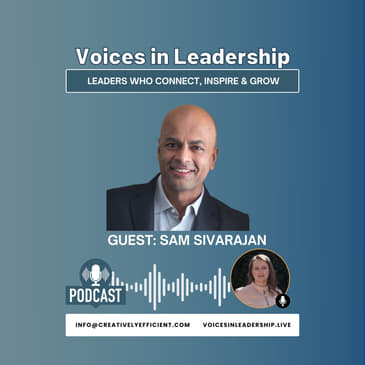
Sam Sivarajan joins Dr. Angela J. Buckley to discuss navigating genuine uncertainty in leadership and life. As a corporate lawyer, investment banker, and former wealth management executive who was restructured out at the height of his career, Sam brings hard-won wisdom about preparing for what we cannot predict. Author of The Uncertainty Edge, Sam shares practical frameworks for building resilience before crisis strikes and adapting effectively when uncertainty hits.
Sam Sivarajan is a corporate lawyer, former investment banker, and wealth management executive who has led teams across multiple countries and industries. After being restructured out of his position following his best years of performance, Sam channeled his experience into researching and writing about uncertainty, leadership, and behavioral finance. He holds a doctorate in behavioral finance and brings together stoic philosophy and practical business experience in his work.
The Million Job Problem
Over one million white-collar jobs lost in the US last year
The looming AI bubble and its potential broader economic impact
Why traditional career planning tools no longer work
Risk vs. Uncertainty: A Critical Distinction
Risk: Calculable probabilities (retirement planning, chess, dice)
Uncertainty: Unknown outcomes you can't even map (pandemics, infrastructure failures, AI disruption)
Why we need different tools for each
The EDGE Framework
Establish (Build Your Foundation)
Control
Align
Span
Track
Diagnose
Cut through noise and bias to assess situations objectively
Go
Move smartly—avoiding both blind rushing and paralysis
Evolve
Adapt continuously as circumstances change
Leadership Through a Human Lens
Why technology will never replace genuine human connection
The power of bringing your whole self to leadership
The Barbell Strategy
Balancing extreme safety (steady income, secure foundations) with calculated risk-taking
How to maintain stability while pursuing innovation
Practical applications for individuals and organizations
Sam honored two influential mentors:
Mike: His first manager who taught him to bring his whole self to work, leading to five consecutive years as #1 in their segment nationwide. Mike demonstrated authentic, heart-first leadership and transparent communication.
Rick: A leader who profoundly invested in people as individuals, building trust through genuine relationships. Rick's leadership style—spending significant time discussing shared passions like biking before addressing business—created the foundation for solving contentious issues efficiently and amicably.
"We use the terms risk and uncertainty interchangeably, but there's a critical difference between the two."
"Measure what you value, not what's easy to measure."
Assess Your Foundation: Use the Establish framework to evaluate whether your actions align with your stated priorities
Identify Your Controllables: Make a list of what's truly within your control vs. external uncertainty
Practice Authentic Connection: Take time in your next one-on-one to discuss something personal before diving into business
Implement the Barbell Strategy: Evaluate how you're balancing stability with calculated risk-taking
Acknowledge a Mentor: Use the SPIRIT method to thank someone who's shaped your leadership journey
Book: The Uncertainty Edge by Sam Sivarajan
The Good Human Practice (launching January) - combining stoic philosophy and behavioral finance
Sam's newsletter: The Uncertainty Edge
Website: samsivarajan.com
The Good Human Practice: thegoodhumanpractice.com
LinkedIn: Sam Sivarajan
Voices in Leadership is hosted by Dr. Angela J. Buckley, where leaders who connect, inspire, and grow share their stories.
Subscribe and Connect:
Website: www.voicesinleadership.live
Leave feedback and reviews to help us reach more leaders
#VoicesinLeadership #Leadership #UncertaintyEdge #Resilience #AuthenticLeadership #CareerDevelopment #AIDisruption #PeopleFirst #SpiritOfAcknowledgment #podmatch
Welcome to Voices in Leadership, where leaders who connect, inspire and grow come to share their stories live. I'm your host, Dr. Angela J. Buckley. Join us as we explore authentic leadership, gratitude and the power of connection through powerful conversations with inspiring voices. Let's inspire, uplift and elevate leadership that truly makes a difference together. Good morning or good afternoon, depending on where you are in the world. Welcome back to Voices in Leadership. I'm here today in the studio with Sam Sivarajan, and he has recently released a book called The Uncertainty Edge. Sam, welcome today. Thank you so much for joining. I'm really excited to have this conversation. Angela, pleasure to be here and me as well. So Sam, I love to start off with just asking the question of what brought you here? Tell us a little bit about your leadership journey. Yeah, so I've been a corporate lawyer in Canada. I was an investment banker in the UK. I ran three different wealth management firms in Canada. So I think I've lived in different countries, worked in different industries, managed different teams of people, et cetera. And I think so in that whole process, I think I've learned a lot about leadership. both of what to do and what not to do, including, I would say, that maybe many of your listeners can relate. At the height of my career at one point, after one of the best couple of years that I had, I was restructured out of a job, which came completely out of left field. But I also think that taught me a lot about leadership and planning. and what you can't plan about your career or other journeys. And I think, you know, I was looking at the numbers just recently. I think we lost about a million white-collar jobs last year in the United States alone. And so that's a pretty incredible number as the industries are shifting to try to accommodate new technologies and new policies that impact the way business is being done? Yeah, a hundred percent. I think that, and sad to say, I fear that those numbers are only going to get worse as technology continues to ramp up or adoption of technology continues to ramp up. But another part of my big concern, Angela, is really that I think that we are on the cusp of what I would call an AI bubble in the stock market and bubbles burst. I think there's a lot of talk about bubbles bursting, and I think past history has shown us that the impact isn't just on these industries that were perhaps in the AI companies or the tech sector. It has broader impact. If you think about the fact that the magnificent seven stocks, the Facebooks of the world, the amazons of the world account for forty percent or so of the u.s stock market i think the implications on a stock market bubble bursting from ai is going to have impact jobs it's going to impact economic security it's going to impact people's livelihoods and i think that is going to add to the problems that you talked about, the million white collar jobs that have been lost in just the last year alone. And so how are we using the concepts that you've identified in your book for the uncertainty edge to manage through these very difficult times for people? Yeah, and I think maybe that the key thing I can start for your audience is talk about the fact that I think we use the terms risk and uncertainty interchangeably. And there is a difference between the two. Risk... for the most part has calculable probabilities. So think about rolling dice, think about playing chess, think about building a retirement portfolio. These aren't easy decisions to make, but you kind of can map out the scenarios and you can estimate the likelihood of A happening or B happening or C happening and being able to take decisions accordingly. Uncertainty is where you don't even know all the possible outcomes. So think about the pandemic that we had just five years ago. Nobody anticipated the entire world being shut down for as long as it was. Think about the fact that just about a year and a half ago, the container ship, the Dally, crashed into the Francis Scott Key Bridge in Baltimore and shut down trade. These are things that nobody had anticipated, nobody could have planned for. And so we currently have decision tools that we use that are built for risk. We operate, whether as a leader of a business, big or small, whether as a white-collar worker, as you alluded to, that may be facing job threats, we operate in a world of genuine uncertainty. So that means that you can't necessarily hedge or plan for it. What you can do is build the tools and the frameworks and the thinking process to be able to get ready for things that you can't anticipate, but at the same time have the skills and the mindset necessary to kind of adapt in the moment. And that's really what the book talks about. It's kind of identifying real life stories, whether it's companies or individuals, how they dealt with situations of uncertainty and some tools or frameworks that they might've used or that the readers can use if they find themselves in similar situations to say, what is it that I know? What is it that I can do? And how can I track progress or adapt in the moment? And so you have an acronym, EDGE, associated with that. How do those letters help us? Yeah. So the EDGE is an acronym, as you say, for the tools and the kind of the pillars of where the book outlines the framework. So EDGE stands for Establish, Diagnose, Go, Establish. and evolve. And I can walk through each of those. So the idea is the premise starts with this whole concept that you don't fix a leaky roof in the middle of a storm. And so EDGE starts with that idea in mind. So you have established that is you build your foundation before you're faced with uncertainty or having to deal with uncertainty. And so establishing your foundation actually involves four steps in the process. So the first is control. So clarify what's actually within your control and what is not. So we talked about technology. We talked about the stock market bubble. Whether that happens or not is in no one's control. So we need to get comfortable with that. The next is that align. So we have to make sure that our actions match our stated priorities. The example I will use from a company perspective is if you're a big business and you say that innovation is critical, but you're cutting all of your money spent on research and development, you're not actually aligning your actions with your priorities. Correct. span and this applies for leaders or individuals we have to balance today's urgency with tomorrow's vision so we have to walk and chew gum at the same time i think you can't just sit there and think about oh this is what uh i need for five years five years from now without thinking about what is it that i have to do to survive tomorrow or adapt for tomorrow pay the bills for tomorrow so but you need to do both And the last element of establish is tracking. So measure what you value, not what's easy to measure. So we hear all the time, Angela, I'm sure you hear that we all want to be happy in our lives, but the measures that most people want to use are the ones that are easy. So what does your bank balance say? How big is your house? What car do you drive? And the question becomes whether that is measuring what actually we value or whether that just happens to be the easy things to measure. Once you've got your foundation, then you're in a position to be able to adapt or deal with uncertainty when it hits. And that's the next three steps. So it's diagnose. So cut through the noise and bias objectively. So assess the situation or the problem that you're facing with objectively, not with your feelings or emotions at play. once you've done that and understood and defined the problem that you're trying to solve then you can go and that idea there is to move smartly without hesitation or uh haste and that's the tension that most people are trying to navigate so between rushing in uh blindly and analysis paralysis The final element, and I think is perhaps the most important, is evolve. And it means pivot with purpose, not panic. And it brings to mind to me the famous saying by the boxer Mike Tyson, which is that everybody has a plan until they get punched in the mouth. And the point of Evolve in this framework is that we're all going to get punched in the mouth. And the question becomes, how do we choose to respond? So that's the framework in a nutshell, Angela. And I think the key that the book talks about is not just stories, but practical tools, whether it's checklists or diagnostic tools that readers can use. to apply each of these steps in their own situations, as I said, whether it's managing large teams or in their own professional careers. So it's very interesting because there are many overlying principles here with DMAIC or some of our problem solving tools that we use in engineering, but you go a little more in depth on some of that as far as the emotional side of things or the gap definition. So I really appreciate the way you outlined those principles and then sort of broke them down. even more in depth inside there. One of the questions that I had to associate with that was really getting clarity around the problem and moving forward with that go. How do people Gain clarity. Where are they asking questions? Where are they getting that support to really diagnose correctly without emotion? I think it's challenging as a CEO to get the right feedback all the time. A hundred percent. And I think especially in the height, in the middle of the moment when you feel that you have to act quickly. And I think the key here, Angela, is to make sure it's to do two things. It's to make sure that you have a broad enough assessment of the situation. And by that, I mean, make sure that you have considered all the stakeholders that might be impacted by your decision. And the second element of that is broaden your perspective. So it's not just a question of what happens immediately with your reaction, with your actions, whether you do it or not, but what happens afterwards. It's called second order thinking. So not just if I do X, Y will happen. But if Y happens, then the persons may respond or the stakeholders may respond with A, B or C. And so I think the idea is to have a broad perspective. Some of the tools that I talk about in the book is the one I can share, for example, is the inside versus outside view. So the inside view takes our situation or the problem that we're dealing with as unique because it feels unique to us. The outside view says, what did other people in similar situations do? Now, it may not be exact, but there are lessons that we might learn. So let me give an example. This is a real life story. There is a stock analyst to forecast a stock to grow at twenty five percent a year for the next ten years. Now, based on the inside view, that is the analyst spreadsheet model, that looks like a great buy. But the outside view asks a different question. And the question is, how many other companies in history have achieved that kind of sustained growth? The answer to that question is none. So that changes the perspective a little bit by asking questions. And I think that is one of the key things that I think leaders or individuals can do is ask open-ended questions that challenges, you know, where is this information coming from? What are the implications of that? How would other people react to reading that information or that data? Would they have the same questions? It is taking... It's taking a pause to take the emotion or the urgency out of the situation to kind of get a more objective and fulsome answer before you try to take a decision. You know, I know in recent years, DEI hasn't quite had the prominent stance that it had previously, but diversity has so many different layers. Just talking about the internal and the external approach that you're describing here, if you don't know what the other people are thinking from the outside of your decision, what happens in your brain versus what other people are perceiving is so different. And getting that feedback from the outside, from different groups, from different marketing demographics, super important in the overall decision-making outcome. Yeah, I think you're totally right. And leave aside the politics of DEI, et cetera. I think the idea of diversity is a great idea. And what I mean by that is that we should be having diversity of thought. And too often in businesses, certainly ones that I've been involved in, you get groupthink, right? And it doesn't matter that the people around the table tick off various boxes of categories of this demographic or this group that needs to be represented, but they're all thinking the same. And I think you hit a very important point, Angela, which is that if we are going to solve the problems as an organization, as a society, as individuals going forward, we need to have a broader understanding of the problem than we might have. And I think the only way to do that is to make sure that you have access to diverse thoughts. Whether that's by having a group of people that you work with or whether you are able to kind of shift gears mentally. Either way, I think it is important for us to be able to have a broader perspective before taking decisions. One of the research papers that I had read, case studies, referred to including a naysayer in every meeting. It was an assigned role, just like you would have a note taker, but on a rotating basis. So it wasn't be the same person every time. There would be a person whose job was to poke holes in the decisions and view it from the outside perspective. And it built the muscle for the organization to be more risk adverse and identify uncertainties in a different way. Sorry, not risk adverse, but risk insulated because they identified the risks through this exercise. And because they rotated that role within the team, each person became better at identifying potential risks in the decision making and the product development. I'm wondering where that falls in with your edge. Because I really like the acronym, the way you laid that out. Well, thank you. So I think what you're talking about, I've seen it before. It's called the devil's advocate as the protocol. And I've actually applied it in my own leadership roles in the past. And I think you're absolutely right. It is a great idea. I think it requires work on all from the leader, from the team, et cetera, because it's a new concept. And again, it's the same challenges that I think every organization deals with that there are different personalities in a meeting and not every one of them wants to be in the spotlight or ask questions or challenge. So I think that there is a little bit of work and effort and time that has to be given into it. But that mindset of having someone challenge the decision being, you know, not necessarily negative, but looking at the problem differently or challenging why it could go wrong is very much in the spirit of what the edge framework talks about. And we talked about the inside versus outside view. uh as an example of a framework that i have in the book but if you think about it the outside view is very much a version of that devil's advocate or that no person there to say you know what is somebody from the outside looking in what how why and how would they challenge the decision that we're making here i think the key is uh you know before anybody thinks that this is a recipe for analysis paralysis that is the furthest thing from the truth the key is simply taking a beat to make sure that you understand the situation probably properly and that you're actually solving the right problem um and not a different problem The joke that always comes to mind, and I'm sure your listeners have probably heard about it, there's an old joke of a man on his knees under a streetlight searching. And a police officer comes by and says, sir, can I help you? And the man says, yes, I've lost my keys. I'm looking for it here. And the police officer is helping and After a few minutes of no luck, the police officer gets frustrated and says, sir, did you lose your keys here? And the man replies, no, I lost it in that alley over there, but there's more light here. So I'm looking here. it's an old joke it's a dad joke but i think it illustrates the problem that we're dealing with which is that you know too often we're looking to solve the problem that is easy to solve instead of the problem that really needs to be solved and i think what the edge framework is trying to put in place is a methodical way that you can quickly grow and build that muscles so that when these kind of situations come, that you understand the problem, you solve the right problem, and you do it in a way that you can adapt as things are going to happen, as Mike Tyson's punching them out, that you're not... frozen in place. I always say that the key for all of us is that we need to be relatively focused on our goals, but be flexible in our approach. Oh, yes. That is an excellent, excellent phrase. I could say that over and over again to my child. And mine as well. yes um i mean but not just right it just happens to be our family we have quite a few engineers and so sometimes engineers see a solution and they lock in and so that tends to run through the family because it's group think a little bit but it's also learned and so understanding that there's a little bit of flexibility in the approach is really the more effective way and so And sometimes you're forced to, right? Because again, the analogy that I use is a GPS in a car. You might be heading to go meet somebody for dinner, but if you live anywhere around like where I do, I mean, the roads are always closed or there's a construction. You don't turn around and say, I'm going back home. Your GPS calculates a new route. Your objective is still the same, but the way that you get there is different. And I think this is... i truly believe angela this is going to be the skill set that is going to be critical for success um in the next five ten fifteen twenty years because the interconnectedness of the world uh of our systems the complexity is going to throw problems that we just can't simply press a button and fix we need to be ready to be adaptive and resilient take what we've learned take what we've know but adapt it in ways so that we can solve the problem at hand I mean, you just described for the listening audience, the name of my company, Creatively Efficient, right? For that very reason, for everything that you just said, you need a little to apply a little bit of creativity to the solutions in order to be efficient in your solutions. A hundred percent. So thank you for that very clear explanation of exactly my approach to problem solving. I know that's not what you came on here for. No, no, no. I'm happy to help. I appreciate the alignment. So, and it's also very interesting if you're familiar with the Duke Center of Leadership, they offer an innovation course and they talk about that internal and external orientation during product development and innovation. looking for the feedback on the outside sort of being very broad but then going through the exercise of becoming narrow then going back broad to get some feedback and then coming back in to be narrow and they do that during the the um product development definition. And then once it's created, they do that in a reverse manner for its marketing approach. And it's incredibly effective and coming from a background of creative problem solving, literally in competitions, have world competition level things of creative problem solving. That is the method that we always followed. And it's fascinating to hear you talk about it within Edge and then seeing it applied in different leadership models and innovation models as well. I think It's, we've come to the stage, I think, that we need this, call it this hero leader model that seems to exist, that we need to have a grand vision. And it maps out the next fifty steps over the next ten years. And we launch with a big bang and we're going to take over the world. One of the frameworks that I talked about in the book is called the small wins framework. And I absolutely love it. It's not mine. It's a research analyst called Carl Weick, a psychologist that developed it. And the example that he uses is for all of your listeners who are football fans. It's the Pittsburgh Steelers in the nineteen seventies, and they won four Super Bowls in six years. creating one of the greatest sports dynasties in history. And they did it. They actually lost about half the time against stronger teams. But they did the small things well and consistently. They won almost all their games against weaker teams. And the idea of small wins is focus on the things that you can do and that you can control and learn from it and adapt. You know, on a personal level, the example that I give is I've climbed mountains in the past and I remember climbing Kilimanjaro when we're trying to do the summit attempt and we left at midnight. It's dark. You can't see the summit. So you have headlamps, et cetera, that you can see, you know, about five feet ahead. But that's how we made the top. You would see, you would start walking, and every step that you took gave you a bit more visibility, a bit more clarity. You knew where you had to zig and where you needed to zag. But we didn't see the summit when we were walking right and i think that metaphor is what i use in the book and what i say to people is that like we need to have a broad idea of where we're going but this idea of small wins is very much aligns with what you're talking about angela that you do things that you you know that you go narrow you test and then you go for feedback out there and then you bring that back in to adapt and nurture and i think that's actually In the, you know, call it in the fintech or the startup space, this is the whole idea of pivoting, right? And I think that's very, very important that we do that. You don't need to have a fully laid out plan. In fact, it's probably the more that you believe that you can do that, the more stuck that you're going to be to be able to adapt when the situation requires it. I love that you bring in climbing. I'm also an avid hiker and part of the Adirondacks to do all forty six peaks. There are quite a few that don't have trails to the top. So you have to know how to navigate and different seasons demand different navigation techniques because you have different approaches based on what's what's happening for safety. So there's general sketches. Of course, people know those mountains at this point if you prepare yourself. But you have to be prepared to pivot for safety reasons at all times. But those are older mountains, right? They're not the jagged peaks of some of the younger mountain ranges. And you do not see the top. So you really have to be very aware of ridges and culls and exactly how the terrain is laid out in order to be effective in your approach, because it's not just look up and go. Again, and I think no matter how prepared you are, we just had this happen recently. So I think it was at the end of October that there was when it was peak climbing season in Everest. And so these are professional trekkers that are gone. But there was a freak snowstorm that hit and stranded a thousand people. And again, this is not somebody woke up one morning and decided, oh, I'm going to go climb Everest. This has been planned for six or eight months. They've got the best gear. They've got the equipment. They've had guides. They've been putting this in place, trained. And suddenly you're marooned and you're fighting for your life. The ones that survived are the ones that decided, okay, I'm taking my plan and I'm throwing it out the window. What do I need to do in the moment? What skills, what tools, what knowledge do I have that I can rely on that I can now adapt to deal with the problem as it faces me now? Not what I had anticipated six months ago when I started this, right? And also, what's your identity? Right. Like, is your identity just to get to the top no matter what summit? Right. Or is your identity your family who's waiting for you at home? Right. So identifying who you are in that moment provides you a lot of the clarity for making those decisions in a healthy manner. And this goes back to one of the points that I'd made about the framework, the edge framework. Part of establishing your foundations is aligning your actions with your priorities. So this is very much of what you talk about. If your priority is your family, then maybe trying to push to the top, irrespective of the weather conditions, isn't the right way that you should be doing about it, right? Correct. Correct. There's always tomorrow. There's always tomorrow. So... Yeah, I also read about that and was following that closely and what a tragedy. But again, focus, pivoting, being flexible. When you pivot, there's so much growth and strength and I'll say resilience, but elasticity that you build into your everyday motions. That is not a failure. That is success for the next day. Wow. So let me give you an example that illustrates the point from the book. Most of your listeners will be familiar with Slack, which is the messaging tool that is highly successful. But what people don't know is that Slack actually started off as a game. And the company that made the game tried to build it, but it had no take up at all. And what they noticed, however, is that the internal messaging tool that they were using actually was getting a lot of interest and traction from other people so they pivoted um they started testing it uh small features with this core group of users external users like what they saw uh this goes back to your point the internal versus out external and then they refined it refined it refined it until they before they fully pivoted to make it slack They ran Slack and then to talk about that failure of their game, Slack ended up being bought for twenty eight billion dollars. Right. What a failure. It's not a failure. It's only a failure if you sit there and say, okay, this very narrow definition of what I intended to do originally didn't happen. But by all of their definitions, it isn't. So it is being open to feedback. It is being open to different perspective. It is being open to being flexible in your approach while staying focused on your goals. Yeah. Yeah. I love it. It's it's super powerful. Sam, how do people get a hold of you and how do they get a hold of your book? So they can get a hold of me. I'm active on LinkedIn. I think there's only one Sam Sivarajan on there, so you'll find me. And I think you have it on the screen. They can find me on my website, samsivarajan.com. They can get the book on Amazon as an e-book, as a paperback, as a hardcover. And they can also go to theuncertaintyedge.com all as one word and they can find me. OK, so I think I have a slide to pull up here in a second and I can show that QR code. Let me see how that works. Oh, look at that. If you want to scan that QR code, that will take you right over to the Amazon and also get you a free sample chapter. Correct. OK. You know, it's really fun. I don't know how to take that back down now. Let's see. No, that's not it. So Sam, while I figure out how to take us back off here. Well, that's uncertainty, right, Angela? It's always fun to figure it out. There we go. We are going to move over to the acknowledgement portion of our business, right? So I asked you to identify a person that you would like to Thank for helping you along your journey as a leader. And so have you identified who that person is today? Yes, unfortunately, I can't narrow it down to one, but I'll give you three. So they were all my bosses in the past and I'm friends to this day. So Michael Whitcomb, Peter Norris, Grant Rasmussen, Rick Anert were all instrumental in my journey as a leader. And I wouldn't have had the success without them. So I'm very grateful. OK, so we'll have to pick out just one of them because I don't know that we'll have time unless you are very efficient in your answers. But we're going to walk through the spirit of acknowledgement framework. And with that, the S is specific. The P is personal. The first I is impactful. So we're talking about how the metrics measured and hit your performance. R is for relevance. And that ties back to the values of the organization and yourself. The second I is for being inclusive. And that really means here in this case, being public in the statement. And T is timely, which if you're doing these things at work in a timely manner, you're always trying to acknowledge those activities as close to the time when they took place. Doesn't really apply here because we're doing sort of a retrospective today. So I'm going to walk through a few questions for each one of those, and then we'll do a summary statement. So unfortunately, you will have to pick one. We'll see if we can get more than one, squeeze it in before the end of the hour. So specifically, who do we want to work with first? Let's use Grant Rasmussen, who was my boss when I was building an ultra high net worth wealth management business. Okay. So Grant, what specifically did Grant do for you in your leadership? I think he taught me that people follow leaders, not just because of what they say or what they do, but how they make you feel. And I think to me, it was a very, very important lesson that I needed to inspire confidence in my team. So you know, that involved also being vulnerable and sharing a bit about I was a very up to that point and I had success as an individual contributor, as an investment banker, as a lawyer, et cetera. But up to that point, I had separated my personal and private life and public life, et cetera. And he taught me that nobody follows, you know, the public persona they follow. They have to understand you as a as a private person as well. Okay. And how did his coaching, mentoring, sharing this with you, reflect back on his personal values or his character? I think it was a perfect reflection of his character. Grant is one of the most open, transparent persons, people that I've known. And I think that part of the reason that his mentoring and coaching had an impact on me is that I think he was a man of integrity, is a man of integrity. And I think that that made it the teachings and the lessons all that more impactful. Thank you. Thank you for sharing that. And how, speaking of impactful, how did that development, that transformation for you impact your business? Well, we became number one ranked in the country in our segment for five years in a row. I think it built my leadership ability to grow from managing project teams to actually managing an entire business. And I think it set the stage for further developments in my career. So I think it had a huge impact, not just on our business, but on my personal and professional growth. Okay, thank you for sharing that. And then relevance. So how does that now with your relevance with the values that you offer now that you bring forth in your in your work? How does that tie in? Yeah, that's a good question. I think it ties in because, again, it's, you know, comes in in the speaking work that I do or the consulting work I do or the writing that I do. I think it's very much trying to keep this authentic. So it's not about abstract principles only. It is about bringing it, making it relevant. tying it to my values uh but also kind of illustrating it with stories and the book is a great example stories from my own personal experience you know it's not about putting me in the spotlight it's about trying to say that you know we're all on the journey and me as well okay Thank you. Thank you for sharing that. And so then the other two letters are the inclusive and the timely. So that's the public and the retrospective in this moment. Do you mind if I try to summarize what you just said about Grant influencing you? Not at all. So Grant, I'm here today with Sam. And he would like to thank you for the support and the mentorship that you provided early in his career while he was building the high wealth management system. Because you shared with him the importance of bringing his whole self and really working as a heart leading person. leader heart first leader you were able to share with him how to grow from just managing teams to growing a nationwide network and the impact of this growth and transformation in his leadership was that they were number one in their segment for five years in a row. This has gone on to continue to influence and highlight the values that Sam brings into his reading and writing and storytelling even today as he maintains and imitates the roles that you put forth in front of you as an authentic, transparent leader. So thank you for your support and transformative mentorship of Sam. Perfect. So that's how we try to really work through the spirit of acknowledgement, tying it back in to what they've also poured into the work and how it ties into the overall benefit of your growth or your company's growth. No, I love it. And I think it's an important practice, uh, for us to always be aware that, uh, w we got here by virtue of, uh, other people kind of helping us along the way. And I think there's a, uh, almost an obligation for us to pay it forward. Right. You know, if you apply spirit correctly, you can use it for all sorts of feedback and development systems, right? I tend to use that for positive feedback, but it can be just as effectively used for constructive feedback as well. So I love it. And we have seen many powerful stories come from it. Great. So, um, if we go quickly, we could squeeze one more in. Do you want to try? You brought three. We'll try. Okay. Who's the next one. Well, let's go with Rick honor just because he's the most recent boss that I have. Okay. So what did Rick do for you specifically? I think Rick showed. again the interest in the person uh it was it was a different style of leadership um but he was interested in he taught me leadership of people and i think maybe that's the key thing by showing profound interest in the individual on your team as an individual, their family, their passions, their interests, et cetera. And I remember that a lot of our one-on-one business meetings, it would be an hour long and, you know, forty minutes would be talked about our common love of biking. Um, and, uh, you know, about our latest bike, uh, bike adventures, what have you. And I, but the funny thing was that it was a very, very effective way of leadership because it was such an open, uh, dialogue that you had that when we did get into the business discussion, that, uh, it was very, very effective that the trust had been built and that the, the relationship and rapport was there that we could solve. contentious contentious issues rather quickly and amicable i i appreciate that and it's so interesting that you've taken your internal and your external uh examples here today so okay so specifically and then personal what did that cause what was that how does that reflect back on what what who rick was I mean, Rick is retired and I haven't worked for him in eight years. We're still good friends. And so I think it's a very much of a reflection of who he is as a person. I mean, not just with me, with others, but I think he continues to enjoy really good relationships with all of the people that he led and managed, et cetera, because of that. I think it's a very authentic reflection of who he is as a person, both as a boss and as a human being. And how did that impact your career? Again, I think we were able to build a very successful business under his stewardship and mentorship. And that helped me, I think, lead a team that I'm proud of, that they've gone on to do many wonderful things. And for me, career-wise, it set me up for my next and my last corporate role after that, which was also a big promotion. Okay. Well, thank you for sharing that. And then how does that reflect back on your values? I think it's highlighted the fact that we're all in people businesses, whatever we do. And we started this discussion today, this conversation today, Angela, about AI and everything else. And I think this has brought it even more close to home to me that technology is never going to replace the human element of whatever that we do. whether that is in leading, managing, or working with other people or working with clients. I think tech tools and technologies are important, but we should never think of that as a substitute for genuine human feeling and interaction. Sam, I really appreciate these examples of leaders that have been in your life. Do you mind if I summarize what I understood you to say here? No, not at all. Okay. So Rick, I'm here today with Sam and he just shared with me how you have influenced his leadership skills and his leadership journey, highlighting that you focus on the importance of the entire being, not just the work life, but really knowing how the people that he's working with or the clients that he's serving, knowing them on a deeper level so that when problems arise, there's already a foundational trust and we're able to work through those problems transparently and authentically valuing the person. And that has brought him full circle to not only being able to share who he is at work, but also highlighting and getting to know the people that he's working with so that they can also be who they are both at work and at home. So this has had a tremendous impact and has served as a great reminder that regardless of the business, it's always about the people. Very nice summary. So Sam, really enjoyed having this conversation here with you today. Thank you very much for sharing your insights. Thank you for sharing. the importance of the pillars associated with the uncertainty edge. And I'm really looking forward to hearing more about future writings from you. What's happening next? Ah, that's a great question. I don't have a specific plan. I think I continue to write my newsletter. I've got actually a new one coming up for any one of your listeners that is interested. That is, I will continue to write The Uncertainty Edge, but in January, I will also write The Good Human Practice. And the idea is that along the lines of what you and I just talked about, that it's bringing the whole self, the whole person to whatever that it is that you do. I think all of us work or live in a community or society. We need to put food on the table, but all of us also look for purpose and meaning. So it's not just. about profit. Profit is important, but it's also the broader implications of what we do. And I think the I've written in the past about stoicism, stoic philosophy and my own work, my doctorate work in behavioral finance. And I'm bringing both of those lenses into practical tools and ideas for people to live a fully balanced life. And that's the Good Human Practice, which will be a Substack newsletter starting in January. Oh, well, that'll be exciting. I know that there are many Substack readers who are also in this audience, so I'm sure they can take a look for that. And so what are they looking for specifically to find you? For that, they can look at thegoodhumanpractice.com. And again, I think the links that we talked about earlier, whether it's my website, samsivarajan.com or on LinkedIn, they can find all of these links. Okay. Well, thank you very much. Again, scrolling across the bottom of the screen, if you know anyone who would like to be a guest on my show, I use Podmatch primarily for finding my guests. So take a look there, and I look forward to talking to you next time. This is Dr. Angela Buckley signing off for Voices in Leadership. Thank you for joining us on Voices in Leadership, where leaders who connect, inspire, and grow share their stories. I look forward to welcoming you back to our next conversation. In the meantime, visit www.voicesinleadership.live to access show notes, links, and to subscribe and stay connected. And in the spirit of gratitude, let's remember to thank one person near you. Until next time, this is Dr. Angela J. Buckley signing off.