
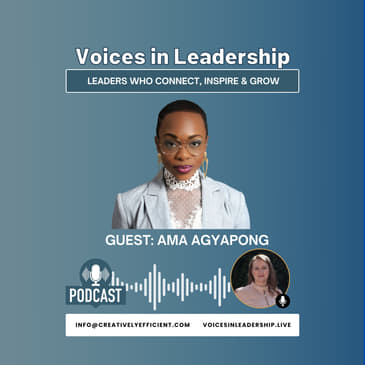


Discover the secrets to mastering inclusive leadership through feedback with our special guest, Ama Agyapong, famously known as "that inclusion lady." Imagine transforming your workplace culture by harnessing the power of feedback to boost productivity and engagement. Ama takes us on her personal journey from being an outsider to becoming an expert in creating feedback-driven environments. Her unique insights from her time as an EEOC investigator reveal the incredible impact of effective feedback on team dynamics and organizational success.
Explore the nuances of communication that foster an inclusive atmosphere. We discuss valuable tools like the DISC assessment, helping to tailor interactions by recognizing individual work styles. Ama shares practical techniques and frameworks, such as the Socratic method and the five whys, to elevate questioning skills, particularly in technical fields. Expect to learn strategic ways to avoid defensiveness and promote open dialogues, enhancing collaboration in your teams.
In our final segment, we delve into actionable strategies for impactful recognition and appreciation. Ama introduces frameworks like the "Listen, Validate, and Formulate" method and the IRTI model to ensure feedback is not just heard but transformed into growth opportunities. Highlighting cultural and generational differences, we discuss transitioning from traditional leadership roles to more coaching-focused approaches. Through personal anecdotes and expert advice, Ama illustrates how conveying belief in a person’s potential can inspire tremendous growth, leaving you equipped to foster a nurturing environment for your team. Join us to uncover these transformative insights and become a catalyst for positive change within your organization.
Transcript
00:03 - Dr. Angela J. Buckley (Host)
Welcome to Voices in Leadership, where leaders who connect, inspire and grow come to share their stories. Live. I'm your host, dr Angela J Buckley. Join us as we explore authentic leadership, gratitude and the power of connection through powerful conversations with inspiring voices. Let's inspire, uplift and elevate leadership that truly makes a difference together. Hello, hello, hello and welcome to another episode of Voices in Leadership. Today I have in the studio Ama Agapong, that inclusion lady, and she is a feedback expert. So, as we are preparing for Q4, one of our least favorite things to do and get, one of the greatest gifts that we can give our employees is feedback. So I've invited Ama to join us today and give us her expertise on what it looks like to be excellent at giving feedback. So, amma, welcome. Thank you for joining us.
01:15 - Ama Agyapong (Guest)
Thank you for having me. Angela, so excited to be here with you.
01:20 - Dr. Angela J. Buckley (Host)
Amma, we've been chatting what maybe a year and a half, two years sort of back, and forth.
01:25 - Ama Agyapong (Guest)
I mean, we're like LinkedIn BFFs, you know.
01:29 - Dr. Angela J. Buckley (Host)
I'm good with LinkedIn BFFs. There's no status symbol for that, but we should be, I know. So, Amma, let me just really quickly read your bio. It's this one opportunity where you get to sit and bask in your glory, but you gave me a nice quick one. So Emma is the known as that inclusion lady. She is the CEO of Inclusion Enterprises. A dynamic and award winning speaker, trainer, coach and certified EEOC investigator. She has over 15 years as a senior HR and leadership expert and an MBA in global management. She helps organizations drive inclusion by building feedback-driven cultures that strengthen productivity. Retention and engagement. Emma, these are like words music to my ears. My dissertation was on engagement and retention, and what do employees want in order to stay, so I am welcoming a different perspective on the same questions, so thank you for joining us today.
02:40 - Ama Agyapong (Guest)
Absolutely, absolutely Can't wait today, absolutely, absolutely Can't wait.
02:46 - Dr. Angela J. Buckley (Host)
So my first question always is how did you get here? How did you end up on?
02:58 - Ama Agyapong (Guest)
this journey of inclusion and feedback. And yeah, let's just start with that. Yeah, so incredible question. By the way, thank you for asking.
03:03
I always love to reflect on like, how did I even end up here? And I'll say it's twofold One at the end of the day. Like I'm a girl from Miami, so I love culture. I've been just completely immersed in culture my entire life. Like my name is Ama right. Like it means born on Saturday in tree, which is a Ghanaian language, but it also means she or he or she loves in Spanish.
03:28
So when I talk about, like my cultural, that is how I've lived my entire life. But I also know in the workplace, you know I've been from the financial industry to retail consulting and at many points I didn't always feel like I belonged and at many points I doubted myself a lot and so, way past inferiority complex, it was like I'm told I'm too direct, I'm told I'm too aggressive, I'm told I don't relate to people and all of these things that will allow you to doubt yourself and, as a result, I started projecting that on my team. So like I have a keynote where I talk about confessions of a horrible boss, because I was once a terrible boss where I was internalizing all of these insecurities and then just vomiting it out on my team. And so eventually I had to, like, get my act together or I was going to lose my job, because obviously you know, things suffer when your team is suffering.
04:27
And so that's how I got to how important inclusion is and really finding my leadership brand, which feedback is a part of that. And then the last thing I'll say is being an EEOC investigator, I'm able to see all the lawsuits and claims and things, and oftentimes, especially in non-selection cases which non-selection cases are those where people aren't selected for promotions Oftentimes I'll say nine times out of 10, feedback is the crux. Feedback is the one thing that could have helped with this complaint. So I know that was a long answer to your question, but it's been a myriad of experiences that got me to where I am today, but I would say being an EEOC investigator dealing with my own insecurities and having my journey of leadership really made me sit in inclusion and feedback.
05:23 - Dr. Angela J. Buckley (Host)
So thank you for sharing that. Where do you start with feedback? How does that first of all, where and how, like when? But then, secondly, how do you build that into the overall workflow for busy managers?
05:43 - Ama Agyapong (Guest)
Yeah, and I want to make sure I'm clarifying your question. When you're asking the when are you asking when should one give feedback, or when did I decide feedback was super important?
05:57 - Dr. Angela J. Buckley (Host)
Okay, so moving forward. Yes, when should managers start looking at feedback? When should they start looking at improving their feedback? So, physically moving forward with that.
06:09 - Ama Agyapong (Guest)
Okay, yeah, so managers typically don't get trained on how to give feedback. Everyone gives feedback, everyone does, whether it's explicit or implicit. You're giving it in one way or another, whether through nonverbals or verbals. However, it's important to make sure your feedback is actionable. And so what I give feedback, the moments in which you give feedback, the intent behind your feedback, how you like to receive feedback Like that should be as soon as you're taking over a team, whether you're inheriting a team or you're building your own team. So, again, feedback starts right away when you're reflecting one. If your feedback is effective or not, I think you can do two things. You can survey it, you can observe it, see what your team's productivity is like, see what the results are like, and then also asking your team a well-wrapped gift, which is feedback, and you give them the opportunity to improve. That is the ultimate sign of respect and inclusion and acknowledging that people are capable of the unlimited.
07:38 - Dr. Angela J. Buckley (Host)
So can you give an example of actionable feedback? I will say, having spoken to the few women that are engineers in the world that I walk, many of them have been given the feedback of you should smile more or you're too assertive. Are those actionable feedbacks or what are we really talking about here?
08:00 - Ama Agyapong (Guest)
No. So women studies show that women are like 60% more likely to give personality-based feedback. And can you take that to the bank? No, you cannot. Can you get promoted off of that, maybe?
08:11
So when I'm saying actionable feedback, it's really someone walking away with actions to implement, like you're understanding actions to implement and you have examples to learn from, and so I have a framework called the GIFT framework, because feedback is a gift. Obviously, the G stands for gain permission, the I stands for identify the facts, the F stands for framing the impact and the T is for trigger collaboration. So let me break that down for a second. When we're talking about actionable feedback, which women often don't get it, people of color often don't get it, and high performers often don't get actionable feedback. They're just getting great job. When you gain permission, you are alerting the brain hey, you're about to get feedback.
08:59
Okay, and so when you're identifying the facts, those are the points, those are the specific points you want to talk about as to what you've observed, the trends, you've seen the results of the project, how you've seen someone show up, but what's so important about identifying the facts is we're getting away from labels. Labels such as that was unprofessional, labels such as that was too assertive, labels such as that was not nice, right, you can't. The brain can't learn from that. Those are blur words. And then typically we start to have the ums and the huhs and the kind ofs and we'll talk about upgraders and low graders and low context and high context cultures in a bit. But just at its basic form, you want to give data that someone can recall, because, due to positivity bias, when someone tells us we don't do something, we think of all the reasons why we do it. Okay.
09:50
And so once you're giving the data, you need to couple that with the impact. People need to know the impact of their actions. So if someone's unreliable unreliable to you, angela, can mean something different than unreliable to me but if you're telling me you're not turning this project in on time, and now this is the impact of your actions I can't feel that in. It's very, very specific and very upfront. And then afterwards you always want to know what the other person heard, what the other person's feeling, what the other person has experienced, to iron out any misunderstandings right there in the moment. So it's very, very important that you are giving data, you're giving impact and you're giving examples to learn from. Which is the data and then action to actually go take after the conversation.
11:09 - Dr. Angela J. Buckley (Host)
Okay, so many organizations in an attempt to kind of create positive culture fit, without it being exclusive.
11:17 - Ama Agyapong (Guest)
Yeah. So when you think about the how, I think it's also important to understand the person sitting in front of you, and so the how could be collaborative, and that's what that T is for the trigger collaboration. In a lot of ways, it's important to gain buy-in from the person sitting across from you, especially if you're a leader, and so how to accomplish something is certainly a two-way street, because they might see something you don't is certainly a two-way street because they might see something you don't. However, if there is a specific way, you need to get it done, and I love the DISC assessment, because the DISC tells you the type of work style that person is. So, like I'm a D, I'm a hard D, nothing else right. Like you don't have to tell me the how, just tell me the goal and I get empowered and excited about how I'm going to do it.
12:05
But you might have another work style, like an S or a C, that wants to know the nooks and the crannies as to how, because they want to know exactly your vision on how you want this to get done. Well, it's important you know that so you'll know what's a motivator or demotivator for the person standing across from you. But if, for all else fails, you must give the how. Okay, it is important that you give the how and the why. Give the why this needs to be done this way. Give the why, the bigger picture. So then someone doesn't feel you're being condescending or treating them like a child or being micromanaging, they're understanding your approach and the reason behind your approach. So did I answer your question though?
12:52 - Dr. Angela J. Buckley (Host)
So a little bit. Yes, I think again back to right, like you started off with saying, that women often get that 60% kind of personality type feedback. When the feedback is a little bit more personality and you're the receiver, how do you guide the person into maybe more actionable feedback Got?
13:17 - Ama Agyapong (Guest)
you Okay, so it's important to ask those clarifying questions. Obviously, I have a framework for that too, but it's really important to ask clarifying questions. Obviously, I have a framework for that too, but it's really important to ask clarifying questions. So thank you for telling me I need to smile more. Do you mind telling me the impact to the team, the impact to you, the impact to the overall project of me not smiling more, right? Or can you clarify how that shows up or lands for you when we are having a conversation? Because that again when I talked about we want to get away from labels and get more into behavior, the smiling more is just like the label. The nice is the label. We need to get below the surface to understand the why behind it. Why is this bothering you? Oftentimes it's just bias, but that's a whole nother conversation.
14:10 - Dr. Angela J. Buckley (Host)
But asking those open-ended, clarifying questions so you can start more of a conversation is what you do and you'll rarely hear me say every time, but every time you just want to ask more clarifying questions rarely hear me say every time, but every time you just want to ask more clarifying questions If you're a person, so my world is a lot of engineers and get it done, a lot of D's in the world and they do not always train open-ended questions in engineering programs because in fact, we want answers right like let's get it done. So where does a person go to learn how to even ask some of those open-ended questions? Where, what? What's a tool that they could help improve those skills?
14:57 - Ama Agyapong (Guest)
yeah, I mean you need a coach, right. So hey, y'all, I can help you with that. But if you want to just do a Google search, I love the Socratic method. The Socratic method is all about asking those open ended questions. To get deeper into the into the answer, you can do the five why's. The five why's is why, why, why? Five times you typically get to the basis of it. But one thing I know about engineers, especially because my brother is one, by the third, why he's a bit annoyed. Okay.
15:25 - Dr. Angela J. Buckley (Host)
So we actually teach five whys in problem solving no-transcript.
15:33 - Ama Agyapong (Guest)
It's very much a thing. It helps with problem solving, it helps with the design, it helps with, you know, understanding biases Like the five whys is very important. But I would say, before you start asking the five whys, sometimes give the reason behind you asking all of these questions, especially if you don't have the relationship with the person. But if you're like, okay, I don't really have time to do the research, that's fine. Think about the who, what, when, where, why, right, and so that is going to help you. How did you come to that conclusion? Do you mind telling me why, not just the why, but do you mind telling me why you decided to do this? Where were you when you experienced this interaction with the person? The who, what, when, where, why and how is going to help you get to more of those open-ended questions if you don't want to do more research into the different approaches.
16:26 - Dr. Angela J. Buckley (Host)
It just triggered a memory. When we do coaching, facilitation, training, why? Often puts people on a defensive, and so we say tell me more Yep. Or how did you come to that conclusion? Right, like those are probably phrases that work as well.
16:44 - Ama Agyapong (Guest)
Yes, I made a mistake with that young younger in my career in the beginning part. Someone was doing something and I don't like excuses. I struggle with it.
16:53 - Dr. Angela J. Buckley (Host)
So I've gotten better, but typically you don't like it.
16:55 - Ama Agyapong (Guest)
Right, like, find a way we're going to get it done. And they were giving me some excuse as to why they were doing something. I was like, why, right Like, with the face, the attitude, and that's when I learned, if I'm going to ask why, I need to couple it with something. So do you mind telling me why you did this? Tell me more, give me more insight on what your vision was. You did this. Tell me more. Give me more insight on what your vision was Like. All of these are more open ended questions, so people don't get defensive because, again, we want to keep them in the prefrontal cortex, the more rational part of their brain. We don't want to trigger them and they feel like they're in a threat phrase and unsafe. And then putting them in the amygdala that's the fight flight. Freeze, that's not good for anyone. That's the fight flight freeze.
17:37 - Dr. Angela J. Buckley (Host)
That's not good for anyone, ok, well, thank you for sharing that. And so, once people have learned how, or they've asked some of those clarifying questions, can you remind, remind me what the F stood for in gift?
17:58 - Ama Agyapong (Guest)
Oh yeah, framing the impact. So, framing the impact, can we talk a little bit about that? So right, so yeah, let's talk about it. Yeah, so it's very important for the receiver to understand the impact of their actions, the impact of not getting something done, the impact of cutting someone off in a meeting, the impact of missing a step or not communicating with every stakeholder, because that is typically either the with them, for them, so what's in it for them, or it's giving a larger scope as to the part they play in this overall game of work or winning or life, and so I would say the impact is just as important as the data point, because that is the glue that allows them to understand the importance of the conversation.
18:55 - Dr. Angela J. Buckley (Host)
Okay, okay, and then we move on to tea. Let's talk about tea a little bit more, so that seems a little fun.
19:04 - Ama Agyapong (Guest)
It is because this is when you want to make sure the other person even heard what you're saying. Like Angela, how many times have you had a conversation with someone personally or professionally, and then, after you've said your brilliant words, they heard something completely different?
19:22
Like you've been like I need you to complete this. Oh, you're just saying I'm just not good at anything Like what? How did you hear that? Right Like. And so it's really important to hear this and iron this out in the beginning, and I think this is a great moment to talk about a few cultural things. So you mentioned I have my MBA focused in global management. With that I learned all about multinational companies and organizations. This is when you understand how to communicate in different cultures, that cross-cultural communication where you have high context andext and low-context cultures.
20:02
Now this is from the global scale but this is also with American culture, because we are not monolithic, and so when you're talking about low-context cultures, those are like German culture, dutch culture, american culture, like very direct and straight to the point, whereas high-context cultures, when you're thinking about like Asian cultures, especially Japanese culture has the highest context culture and American culture is the lowest right. Us culture, rather High context is. You need to read in between the lines yeah, and they're looking at what you're not saying. So what if you have someone high context and low context having a conversation? You're not sure if the understanding and the action is agreed upon before you leave.
20:44
So that is the importance of the trigger collaboration, because that is one uncovering something you might not have seen. So asking the question of you know, I want to know how this is landing for you. I just said a lot, or is there something I'm missing? Want to know how this is landing for you. I just said a lot, or is there something I'm missing? Please tell me if there's any obstacles or barriers that I'm unaware of that prevented you from getting this done right.
21:05
Or you're asking an open-ended question of what you just hear me say. I want to make sure you're hearing what I'm saying and interpreting it with my intent, so tell me everything you just heard, and this is allowing you to stop and let them give their perspective, which you can glean a lot from that. Or this is the moment where you're gaining buy-in on what the exact actions are going to be moving forward, like what you want to see, what they can do moving forward to get closer to success, and so, with what performance evaluations around the corner? This part is huge, because you want them to know and you to know the actions they're going to take after this conversation.
21:50 - Dr. Angela J. Buckley (Host)
I'm going to throw a little curve ball at you.
21:52 - Ama Agyapong (Guest)
Oh please, I love those.
21:54 - Dr. Angela J. Buckley (Host)
Have you experimented at all with like plod or any of the tracking AI type things that do note taking for you? Because, specifically, when there's negative feedback going on constructive criticism right, building a person up they don't always feel that it's constructive, that's real. Right, building a person up, they don't always feel that it's constructive, that's real. And so the emotions will preclude you from absorbing what's being said. And then there is definitely, to your point, a lack of understanding. Even if the words are coming out, it may not be absorbed at that moment. And some people are processors my child, I know 24 hours later he will have processed everything we said, but in the moment I can't expect him to give it back to me. It's there's just silence, right? Have you experienced at all somebody using one of those trackers and giving that feedback at the end, where both people then can go back and review it together as a way of really triggering that collaboration? And then now you have a I'll just say, a neutral third party that's trying to understand what's happening between the two interacting parties.
23:17 - Ama Agyapong (Guest)
I've had some clients do that just from a note-taking perspective, not necessarily to add an additional layer.
23:26
I think it is similar to sending a recap or follow-up email on everything that was discussed right, and so I do think that's very important with the after and so, after using the conversational gift framework, you definitely want to follow up with some type of documentation, just to make sure you all are on the same page. But the importance of triggering collaboration, whether that person has anything to say or not, that is a sign of humility and vulnerability in the conversation, because you are essentially telling that person my perspective might not be the only perspective, and I want to create a space for you to share yours. That is the purpose of it. The other purpose is to make sure you all are walking away with a shared understanding of what the action is, because remember, that's the point of the gift framework is to give actionable feedback.
24:23
But, whether they shut down or not, or processing or not, you are creating a space and giving the opportunity for them to share something, because you're saying my perspective isn't king or reign supreme.
24:38 - Dr. Angela J. Buckley (Host)
Because you're saying my perspective isn't king or reign supreme. Okay, okay, I was just wondering if there were some tools to help with people who are slightly more delayed in their processing or take a little time to reflect before they give feedback.
24:52 - Ama Agyapong (Guest)
Right, so Before you're talking about the receiver Receiver yeah. So I honestly don't like if you're sending a recap email afterwards there, there are really no tools that you need besides you responding with what you heard. And if in the moment you're like I'm still processing, then you say that I'm still processing.
25:15 - Dr. Angela J. Buckley (Host)
Then you say that I'm still processing?
25:16 - Ama Agyapong (Guest)
can I circle back tomorrow? That is fine, but I don't want us to overcomplicate this because then that creates analysis by paralysis and then people aren't having the conversation. It's very simple You're just opening up the conversation for someone to respond. If they don't have a response, right then and there, that's okay. You still did your part by creating the space and that person who's receiving can say I'm not sure what I'm thinking right now. Or I'm still processing or I need to circle back and have this conversation. But that is the importance of having it either face-to-face over the phone or virtually either face-to-face over the phone or virtually Got it Okay.
26:03 - Dr. Angela J. Buckley (Host)
Okay, so you said you had another framework after a gift, what happens after a gift?
26:07 - Ama Agyapong (Guest)
So after a gift, that's the giving. So the gift is just focused on giving. After the giving, you want to follow up with a recap email. But again, when I talked about having the one-on-ones of people or explaining what your approach is, you definitely want to tell people that this is your process. So I have the conversation. I usually recap with an email just to make sure we're on the same page and then we can go do the same, right?
26:33
But when I said I have another framework that's for receiving the feedback. So that's listen, validate and formulate. So you, who's receiving the feedback, you know there are different steps to listening and paraphrasing and clarifying. And then, with the validate piece, you're acknowledging what that person's telling you and acknowledging their perspective, and the formulate is creating the plan. And so, even if someone gives you completely trash feedback, you, who wants to develop yourself, can still create a plan, co-create a plan, so you all can know what the next steps are. So if you don't understand, like, if you're like I don't even agree with this ask questions to clarify exactly where that person's coming from.
27:23 - Dr. Angela J. Buckley (Host)
OK, OK. Also, I wanted to ask you a little bit about the structure of corporate level feedback Quarterly, half a year, once a year? Regular basis Is there more formal, less formal feedback? What's the ideal for situations like that?
27:44 - Ama Agyapong (Guest)
Yeah, I think, once a month. For sure, if you can do biweekly, that's perfect. But if you get past once a month giving someone feedback, I think you're missing the mark, because generationally we are in a time where Gen Z is getting feedback all the time. I mean, think about it. You post a picture that, like that's the type of feedback, right? Those comments, that's the type of feedback.
28:13
And so our brains are conditioned to get more constant feedback, more immediate gratification, and so having conversations with your team regularly, bi-weekly, monthly is ideal, and when you're having those conversations, the gift framework works, personally or professionally. But again, you always want to have the conversation with an action in mind, unless you're just getting to know your team. So that's a different type of conversation. It's very necessary to understand, like you know what don't I know about you that is not on a resume, right? Like what element of your brilliance am I under utilizing? Like you want to get to know your team on a deeper level. But if this is going to be goal oriented or about productivity or behavior, then you want to always give the data point and always give the impact so they know the purpose of the conversation. But yeah, every two weeks to once a month is that ideal sweet spot.
29:08 - Dr. Angela J. Buckley (Host)
Okay, so structured. I'll just say, having lived in the corporate world, I meet with my team every week or every two weeks, and so there is an element of feedback, but documented HR style feedback that really only happens twice a year, maybe four times a year, depending on the organization. That tends to be more formal. How is that so? You just said meet with them and, yes, giving feedback. But again, so I'm to all the people that are like the HR directors, hr leaders that are in organizations of different sizes how do they go, how do they manage from that corporate level I have to have documentation to the team level of yes, I also need to manage my team. What does that look like? That scale?
30:06 - Ama Agyapong (Guest)
Yes, so when you send that recap, that is a level of documentation.
30:14
This is not a recap you need to copy HR on. It's just a recap for shared understanding. However, from an EEO perspective, that's documentation that also supports different decisions. Right, because you're telling a story, you're finding, you're building a pattern or a trend, and so that's first layer. Send the recap of a conversation when we're getting into performance conversations. Okay, so we have the recap. That's either every two weeks or every month, just for shared understanding. Then you have performance conversations. So some companies like Netflix don't even do performance evaluations because feedback is regular. But if you are a company that does performance evaluations, that is going to be documented. So some companies do that, either by what you call it, twice a year or once a year. That is your form of documentation. When you are also having corrective conversations, ok, that should be documented. But in that conversation with the person you need to let them know this is going to be documented and I'm going to send this to HR. That should not be a surprise. So corrective conversations, performance conversations, formal performance conversations should be documented.
31:31
And when you are having just regular feedback conversations. Sending recaps are very important. Yes, it is less formal, but it also supports you just in case those conversations escalate to be more corrective and where you have to loop HR in. So hopefully I answered your question.
31:53 - Dr. Angela J. Buckley (Host)
It does. It does so the level of formal, where HR is looped in, versus, okay, I manage my team, I give my members feedback. Obviously, documentation, documentation is documentation and it belongs and I won't say public like the general public can see it. But if it needed to be reviewed, it's available to be reviewed.
32:16 - Ama Agyapong (Guest)
It's definitely available. Yeah, I was an executive HR leader right for Fortune 50 company. I don't want to see every documentation you've had with your team. You're a leader right Like handle that. Have a folder with your team, all of those other things. Where I want to start seeing it is if it's progressive disciplinary action. That is when I need to start seeing it. As an executive HR leader or you know someone under me, my director, needs to see it, because now we're looking to see for liability purposes, making sure it's fair and consistent. We're also keeping track to see if there is a pattern or trend happening that's going to lead progressively to maybe termination. But typically these feedback conversations are for talent development, for personal development, and that HR doesn't need to be in the loop for all of those things before yourself, you need to have a recap, you need to have documentation, you need to keep a folder. Even if it's for positive stuff, because you are, you have a file for that individual.
33:21 - Dr. Angela J. Buckley (Host)
Okay, and so if you're a young manager, the supervisors, I'll say when they have 100 people they're not hitting their employees every two hours or every two weeks Feels like every two hours, but managers generally have four to maybe 10. If you have a really large team, right that you would be meeting with on a more regular basis, so those individuals that's usually the time where you would start that folder and start all of that tracking. That would be a good time to learn a more effective way to provide feedback.
34:00 - Ama Agyapong (Guest)
Yes, but I will also say for supervisors with a team of 100, we're not letting them off the hook either, and so they are not going to meet with every single person every two weeks, but they should have a methodology. So here's an example. You run a list of your team. This is for supervisors, new supervisors. You run a list of your team. Let's say you have 100 people on your team. Well, of those 100 people, how many people can you meet with, either per day or every other day, to get through everyone within a month or two months, or your goal might be I want to meet with every single person within the quarter you schedule that in.
34:38
Also feedback doesn't have to be a formal sit down and they're in your office. You can have a walking chat, you can go where they are. You can meet not during lunch because that's paid time off, but you can meet, you know, during, after a certain project is done. But with supervisors I see this the most Supervisors who have a large team say I don't have time because I'm doing the work and managing the work.
35:03
But you can absolutely. I just used an upgrad upgrader which I'm going to talk about. You can most definitely um schedule the time to meet with each person, let them know how you're doing, see how what they need from you, how you can support them and give them updates on what you think about their performance okay, so and what's?
35:24 - Dr. Angela J. Buckley (Host)
what's a quick way for them to really give that kind of feedback right, like if you're walking and chatting and then you need to document as well what's is? Can they almost use like a checklist style or something? Is there anything that can help them with that on a regular basis?
35:44 - Ama Agyapong (Guest)
The documentation. Part of the conversation. Part.
35:47 - Dr. Angela J. Buckley (Host)
So the answer is yes to both.
35:49 - Ama Agyapong (Guest)
really, Okay, yeah, so you're probably tired of hearing this. But the gift feedback. So you're walking up to someone. I'm saying hey, angela, I want to chat with you real quick about the bottleneck with the assembly line. Can we walk over here and chat real quick? Okay, I ran the report and I saw that um at five o'clock and at two o'clock.
36:12
This is our low time, when you know, loading the truck, um, as you know, when we do this, we make the driver a little late, we make the driver late with deliveries and that starts to impact our engagement scores, our survey scores, and it also can delay sales. That's the impact. So then we get to trigger collaboration. You know, is there something I'm missing or something you need help with so we can get this back on park? I mean, that just took two minutes, right, and then the person's going to tell you what they need. Oh, I'm understaffed. Oh, I didn't even realize this. Oh, this person keeps coming in late and we have bottom performance.
36:51
And now we have the opportunity to talk about the action, like OK, so I hear you saying we're understaffed. This is our goal. So within the next two weeks, what can you see yourself doing to help improve these numbers. Ok, perfect, I'm going to check in with you in two weeks. So that is the conversation. Okay, now you have different softwares out there. That, and of course, I'm not thinking of one right at this moment, but I think ADP has one, there's another one for, like, smaller companies.
37:19 - Dr. Angela J. Buckley (Host)
Maximo has one Yep.
37:21 - Ama Agyapong (Guest)
It's quite a few and have apps on a phone where after the conversation, you just notate that under that person's name, like had a conversation with Angela, committed to, you know, putting certain people in place and reviewing the numbers in two weeks at this date and time, right, like. Literally that takes three minutes to put into your phone and now it's notated for that person and then later on that day you can send the recap to that person on the floor if they have an email. They might not even have an email address, but you still have the documentation. So having a framework allows every conversation to stay the same, with the same structure, which is inclusion and equity, and then having a phone or something that you can notate it and email it to yourself or keep it in an app then allows your documentation to be on point.
38:10 - Dr. Angela J. Buckley (Host)
Okay. So making sure that people have access maybe not necessarily a phone, but at least a portable device that is accessible to the corporate Wi-Fi can really streamline some of that reporting Absolutely Okay. Streamlined some of that reporting Absolutely Okay. So do you have any other things that you want to add specifically to the feedback part of this conversation, Because we're going to move on to gratitude here in a?
38:37 - Ama Agyapong (Guest)
second Okay, so when we are giving feedback and I said this earlier, but I want everyone to hear me let's try to stay away from labeling behaviors so labeling as unreliable, unprofessional, assertive, all of those things do not give people something to walk away with. Harvard has done studies on this, pew Research has done studies on this, gallup has done studies on this. It's brain science behind it. Give very specific actions, the data point and then the impact. The other thing I'm going to say is, when we are having conversations, we often do upgraders or downgraders and then it confuses a person or it can make someone very defensive. So what upgraders are is words preceding or following negative feedback, and so, like I said, absolutely I use upgraders a lot because preceding or following negative feedback, and so, like I said, absolutely, I use upgraders a lot because I'm super dramatic.
39:30
Well, that is strengthening the point. So if I tell someone that was absolutely inappropriate, think about how strong that feels versus. These were the actions. This is the impact. What can we do Because this can't happen again, right? Or we might do down graders where it softens the blow. So you know, when you cut Angela off in the meeting, it's a bit rude and it can come off a little off-putting, so I just wanted to have this conversation. You're not truly telling them the impact of their actions either.
40:09
So you also want to avoid downgraders, which is why it's important to focus on the action and the impact, without giving extra words, because that can trigger something in the person receiving the message. And then the last thing I'll say is whatever your process is, whatever your process or approach to giving feedback, this is a great time going into Q4. We're going to go into these Q4 sprints. This is a great time to reconvene with your team and just talk about what the expectations are again and what your approach is going to be in this last quarter. So you either may be hearing from me a little bit more, or you might hear from me a little differently, or we're going to keep going the same way we are, but I know we can get this done and I want to touch bases with you. So those are the last two things I'll say last two things, I'll say Okay, you're fantastic.
41:11 - Dr. Angela J. Buckley (Host)
So one of the things that I heard as I was listening to you and I've been trying to talk more to younger generational leaders as well, asking them what they need in the influx of hyperbole in youngsters right, and I'll say that that was true for me as well. So I don't know that it's this generation and so people really like to label the different generations. I just think it might be the influx of just being young, right, like we all did different things when we were younger, but hyperbole in conversation, and so those upgraders and downgraders are built into their everyday sentences. So learning how to even identify them, that awareness, part of that, might be a skill that a young leader needs to even start identifying.
42:09 - Ama Agyapong (Guest)
Yeah, what's interesting? I agree with you, and what's interesting is a lot of adult like not adults, a lot of tenured people don't realize they do it because it is linked to cultural nuances and so if you're not studying cultures, you're probably not aware, and so that's why it's great to tune into conversations like these or read or connect with people, and the thing is that vulnerability and leadership is so important. So having a conversation and be like I just realized I use upgraders a lot and it might come off a bit strong, right, and I want to stop doing that. So can you be my accountability partner? Like if you hear me saying things like oh my God, I totally would die or this was absolutely inappropriate.
42:59
Like call me out on it, please, cause this is something I'm working on. When you share with your team something you're working on and you're releasing the veil of perfection, it invites them to do the exact same thing. But I'd be remiss not to acknowledge the importance of social media and how we need those instant boosts of dopamine and that so, so. That is very important to know as a leader, because now, when I was coming up, if you didn't hear anything, that means you're doing fine. That does not work anymore. It's just like Gallup did a study that the identity of a leader has changed. So, instead of a boss, you're more of a coach now. You're helping people come to a conclusion versus just telling them what to do. So times have changed for sure.
43:56 - Dr. Angela J. Buckley (Host)
I used to have a manager who talked about groundhog management. You popped your head up. That was it Like if you stayed below ground you were good, but if you popped your head up it it was a 50 50 of what you were going to get. And so you are right, it is very different, like the people are wanting more engagement, they want that feedback, and I think it's for the better, because now you can look at continuous improvement, you can ask those questions. You really have an opportunity to move forward together as an organization.
44:28 - Ama Agyapong (Guest)
One hundred one hundred percent and even think about how we're like raising kids now versus how we might have been raised or previously. Like now. It's more collaborative conversation. It's more partnership, it's coaching. It's asking your five year old what their opinion is, what they want to eat. Like that was not the case, exactly so. These are the people that are in our workplaces, and so that continuous improvement, that constant conversation, that back and forth gaining opinions of others is incredibly important.
45:03 - Dr. Angela J. Buckley (Host)
Amma, thank you so much for sharing and talking about upgraders and downgraders, really talking about the gift and that framework. I find frameworks to be so helpful for people. Do I just do an upgrader? But it really like it helps people categorize and helps them. Those mnemonics are helpful, which you have done such a nice job of helping me lead right into the spirit of acknowledgement. So, thank you, oh, thank you, and we are going to talk now about a person in your life who has helped you along your leadership journey. And when we talk about giving the it's feedback, but giving that positive thank you, we talk about being very specific and you're going to make this easy because you'll have to be practiced in some of these questions. I ask you so, thank you, but being specific, making it personal, that means tying it back to the character and something that that person had to really engage with in order to give those actions, those specific things that helped you.
46:18
I is for impact, r is for relevance. So when we talk about the difference between those two, we talk about the impact being, truthfully, metrics in the organization and the R, with the relevance, is talking about values and characteristics, those softer things that may not be as easy to measure. I is for inclusive and that really means like making it public. So sometimes giving those public acknowledgments also encourages the team members to see what good looks like. Many times I ask people do they know what good looks like in their organization and they don't have a vision.
47:01
By giving this gratitude statement publicly, you are creating an opportunity for other people to see what is valued in the organization. And then T is timely, similar to SMART goals, right? Let's really focus on the neuroscience and the closer as possible, as close as possible to the event that something took place, we can really snag those emotions and magnify them. Not always possible on big, long projects or like today is a retrospective, but if you adopt this framework on a regular basis and apply it within your teams, you can positively shine a light on what is good and and allow the team to to migrate in that general direction. Right, so that is the spirit of. So who are you recognizing today?
48:00 - Ama Agyapong (Guest)
Oof, I know you're asking for one person, but I've got to give two, so I have learned how to do this by being a parent. So I'd be remiss not to just even mention my son, because I've learned that positive reinforcement gets me much further and when it is timely, when it is relevant, when it is inclusive and directly related to his character and things that he's done, I see a better result right. So he has forced me to practice. But the person that I saw do this often was her name is Cherie Knowles. She's the CEO of HRKS, or HR Knowledge Source, and she's actually the person that got my start in consulting. I felt like a leader, saw me and saw what my actual talents were and how those talents showed up regularly.
49:07
She did an absolutely incredible job of also understanding what recognition and acknowledgement looks like to me versus what's standard for everyone else, and I think that personalization is where the inclusion piece comes in as well. So yeah huge kudos to her.
49:25 - Dr. Angela J. Buckley (Host)
Okay, so we're going to like craft the thank you statement together, oh fun. So using the S specifically, how did she see you, recognize you, or what did that look like in actions for you?
49:42 - Ama Agyapong (Guest)
Yes, so she would reach out to me and you know either email me or call me about the way I handled a difficult client. She noticed that I felt insecure about my direct nature and so in moments that she saw me working on it and choosing different framing or allowing a person to speak a little bit more, or something like that she would acknowledge that because it was in alignment with what my personal goals were.
50:15 - Dr. Angela J. Buckley (Host)
Okay.
50:16 - Ama Agyapong (Guest)
So I would say she circled back. She circled back and acknowledged my behavior or action in a moment or a result that I yielded right after the thing happened think two things on personal what do you think that interaction cost her, or and or?
50:47 - Dr. Angela J. Buckley (Host)
how do you think that that really reflected on her?
50:49 - Ama Agyapong (Guest)
personal values. So what it cost her was time. Okay, that's for sure, because she's a busy woman, she owns a large company, so she took the time to even acknowledge me or notice me and all of those things. And then as far as personal values, so we share the same faith, like we're both believers, and so with that, we believe in leading with love, leading with gratitude, and that her approach very much aligned with her personal values and her faith, that her approach very much aligned with her personal values and her faith.
51:31
Okay, good, thank you. And impact how did that have an impact on your career? So what's funny is when I first started with her firm, I was straight out of corporate. I was a stay-at-home mom for all of four months and I was just trying to stay in the background so I would be a part of a project.
51:49
I wouldn't lead a project Slowly but surely, from all of that encouragement, I went from being second or third or fourth to now leading the project, being the relationship manager okay me confident to trust in my skill set even more because I don't know about you, but leaving corporate america sometimes you can be a little beat up and you need to like just you know, re-establish, um. So it went from that to I. Now I've launched my own firm right. So that positive reinforcement planted seeds of even more confidence and more validation to take more of a leadership role.
52:28 - Dr. Angela J. Buckley (Host)
Yes, okay, and how is that relevant to your personal values or the values of your current organization, the one that you own right now?
52:41 - Ama Agyapong (Guest)
Yeah, so one of our core values is honesty and transparency, as well as authenticity, and so I think all of those align.
52:50 - Dr. Angela J. Buckley (Host)
Okay. And then inclusion and timeliness are the two right that they're just right. Now we're public, and timely is it's a retrospective. Remind me of her name, sheree sheree. Okay, so would you like to try to summarize that all in a sentence, or do you want to have me give a go?
53:12 - Ama Agyapong (Guest)
I'm gonna have you give the go it does get easier. You see what you just did. You triggered collaboration there.
53:21 - Dr. Angela J. Buckley (Host)
Good job Okay. So today, cherie, I would like to thank you on behalf of Amal for seeing her, for spending the time and the energy to give her feedback out of your very, very busy day, to give her feedback out of your very, very busy day. Recognizing in the moment when she was working on continuous improvement, working on improving certain skills that you knew were near and dear to her, you saw her and you gave that feedback and you encouraged her. This allowed her to move from the shadows to the center stage and allowed her to launch her own business truly and effectively and successfully. We know that this cost you in time and energy, but it also highlighted your personal commitment to honesty and transparency, which is also tied to the values that Amma brings forward in her own organization the Inclusion.
54:33 - Ama Agyapong (Guest)
Enterprises. I got it.
54:35 - Dr. Angela J. Buckley (Host)
And so thank you very much for supporting her development, thank you very much for supporting her goals and helping her align her skills to her dreams. Without that continuous improvement and without that continuous support, perhaps she wouldn't be exactly where she is today. So thank you very much for all the time and effort and love that you poured into Amma.
55:04 - Ama Agyapong (Guest)
That is incredible. I love that.
55:08 - Dr. Angela J. Buckley (Host)
Oh, yay, so you mentioned earlier your son and of course, when I started doing this, I also practiced on my son and at a certain point he was like on my son and at a certain point he was like Mom, you don't have to do the whole thing every time. He knew this is so many he's like. You can just say thanks.
55:30 - Ama Agyapong (Guest)
So I did learn from time to time like tune it back. Yeah, I. So I have a seven year old and so I use the gift feedback framework, but for the positive with him, I mean, I use it for the negative as well. So I'm like when you did, do you have a moment to speak? When you did X Y Z, it helped mommy with X Y Z. You know how do you feel right now. That's a trick collaboration, and so probably when he's older he's going to say the same thing.
55:56 - Dr. Angela J. Buckley (Host)
So I want to say I started with him. He's 17 now, so I also started five or six when we were really like starting to do some of these things and practicing positive feedback and positive reinforcement and just even like tying shoes, like he was able to tie shoes but he didn't want to tie his shoes. And I'm like dude. It stresses me out, like I see you and you have tripped from time to time and when you tie your shoes every time without me nagging you, like you make my day more relaxed. And he was like mommy, you don't have to do it every time, so it's coming.
56:42
But I'm also going to say keep doing it anyways, because they, they learn too and they certainly do. So if he could puppet that, I would not. I would not cry.
56:50 - Ama Agyapong (Guest)
That's awesome. Thank you for sharing that.
56:52 - Dr. Angela J. Buckley (Host)
So, amma, how can people get ahold of you?
56:56 - Ama Agyapong (Guest)
Yeah, so you can find me on LinkedIn. Amma Ajapong, that inclusion lady, you can find me on LinkedIn. I'm an Agipong, especially if you need to navigate a situation like that's. That's important and I'm definitely here to help, okay.
57:27 - Dr. Angela J. Buckley (Host)
Well, welcome everyone. Please feel free to reach out to Amma. I will warn you if you're trying to type on your phone, it will auto correct. So double check if you're trying to search for her. So that will help you a little bit and I speak from experience on that. So thank you for your patience with my auto correct. It has been such a pleasure to have you on and thank you very much for sharing your framework and sharing your time today.
58:01 - Ama Agyapong (Guest)
Absolutely. Thank you so much, angela, just for your support and your partnership over this past year or so. It's incredible to have a thought partner like yourself and if I could leave anyone with lasting words, if you are giving feedback by the sandwich method, like throw that sandwich away, ok, it confuses the brain, please stop. I know Americans are taught to lace negative feedback with positivity, but what you want to lace it in is your belief in that person's ability to improve, your belief in that person's ability to exceed their insurmountable and that is when we know it's coming from a genuine place. So build those relationships, have those conversations and practice a framework so you can see some improvements.
58:47 - Dr. Angela J. Buckley (Host)
And, on that note, thank you once again for joining. This is another episode of Voices in Leadership and I look forward to speaking with you next week. Thank you for joining us on Voices in Leadership, where leaders who connect, inspire and grow share their stories. I look forward to welcoming you back to our next conversation. In the meantime, visit wwwvoicesinleadershiplive to access show notes, links and to subscribe and stay connected. And, in the spirit of gratitude, let's remember to thank one person near you Until next time. This is Dr Angela J Buckley, signing off.