
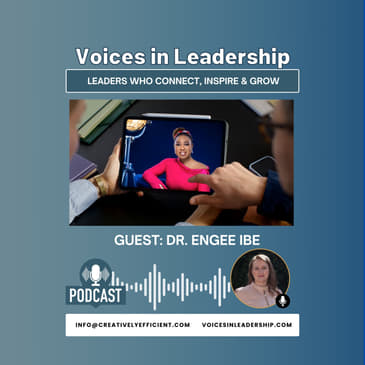

Dr. Engee Ibe, a leading voice in wellness and internal medicine, shares her inspiring journey on Voices in Leadership. Known for her innovative "Prescribed Living" concept, Dr. Ibe discusses her transition from practicing medicine to coaching high-achieving women through burnout. With over two decades of experience, she reveals the unique strategies she employs to help women reclaim their energy and identity, all while managing the demands of her own family life enriched by pets and personal wellness pursuits.
Listeners gain insight into the art of balancing a multifaceted career with personal well-being as Dr. Ibe candidly discusses the challenges and rewards of juggling a medical career, coaching, and family demands. She emphasizes the importance of physical fitness as a cornerstone of self-care and describes how a personal trainer has been pivotal in her own life. Dr. Ibe also sheds light on the power of coaching to transform lives, offering new perspectives and guiding clients, especially those in mid-life, toward clarity and purpose.
The episode also explores themes of mentorship and gratitude, spotlighting the story of Dr. Engee and her journey through medical residency with the support of an empathetic mentor, Dr. Foreman. Through this narrative, we examine the profound impact of compassionate leadership and the role of mentors in personal and professional development. The conversation culminates with a heartfelt reflection on the significance of expressing gratitude and how shared stories can inspire and foster growth. Join us as we unravel these powerful themes and more, encouraging listeners to connect and express appreciation to those who make a difference in their lives.
00:02 - Dr. Angela J. Buckley (Host)
Welcome to Voices in Leadership, where leaders who connect, inspire and grow come to share their stories. Live. I'm your host, Dr Angela J Buckley. Join us as we explore authentic leadership, gratitude and the power of connection through powerful conversations with inspiring voices. Let's inspire, uplift and elevate leadership that truly makes a difference together. Hello, hello, hello, Welcome. Today we have Dr Engee in the house and I'm going to just bring her up on stage and then, while she smiles so sweetly, I'm going to read her bio. So she smiles so sweetly, I'm going to read her bio. So hello, hello, hello, hello, Welcome.
00:55
Thank you for being here and joining us today in this episode of Voices in Leadership.
01:01 - Dr. Engee Ibe (Guest)
Thank you for having me.
01:08 - Dr. Angela J. Buckley (Host)
Let me just do a quick intro. I'm really excited to have this conversation today. So Dr Engee Ibe is a compassionate board certified internal medicine physician and a vibrant wellness and lifestyle coach. She ignites transformation. As the founder of the prescribed living With over 20 years of experience, she passionately empowers high-achieving women to reclaim their energy, identity and joy through intentional living as a devoted wife and mother of three, family is the heart of her purpose. Her enriching retreats are where the magic truly happens holistic wellness, personal growth and deep connections. Whether she's guiding women to pivot with purpose or embracing her own balanced journey, dr ibby lives the inspiring mantra living well is the best medicine. So, Dr. Engee , welcome. Thank you. I'm Super excited to have you here today.
02:07 - Dr. Engee Ibe (Guest)
Yes, I'm happy we could make this happen. I'm so excited to talk to you. I enjoyed our conversation. I'm glad we can get to continue.
02:16 - Dr. Angela J. Buckley (Host)
Yes, and so many of us don't know for the people who are listening probably don't know our connection. We are both members of the Global Women's Leaders and GWS, and we were down in Tampa together, right, and that's really where I got to know a little bit more about who you are as a person, instead of just what you do, and so today we're going to talk quite a bit about maybe your journey into leadership, maybe the experience of burnout, and then partly how you recovered and the things that you're offering to people going forward to help them recover from burnout as well.
03:01 - Dr. Engee Ibe (Guest)
Yes, sure, I'm excited. So let's go ahead, let's go ahead and let's get started.
03:08 - Dr. Angela J. Buckley (Host)
So first of all, can you tell me why did you choose prescribed living?
03:16 - Dr. Engee Ibe (Guest)
So, as you rightly introduced me, I'm a physician and I'm used to writing prescriptions. Yes, in the hospital it's been years of writing medications, but I realized that something else was missing and it was from my own life, which was how I came about the word prescribed living, which is beyond the medication, the wellness. Basically, if we can prevent, you know, getting to the point where we need medications and if we do need medications, there are other things that can help us live even with those medications and make our lives better. And that's how I came about that and, yes, and yes, that's the summary.
04:05 - Dr. Angela J. Buckley (Host)
So you've been practicing in Texas for the last 20 years, is that correct?
04:11 - Dr. Engee Ibe (Guest)
Well, not in Texas for 20 years. So I've actually been a physician for 21 years, but I've been in Texas now for 13 years. I got out of medical school, I had to do residency. That was in Atlanta, Georgia, and then, after residency, I moved over to Houston, Texas, in 2011. So I've been here since 2011.
04:30 - Dr. Angela J. Buckley (Host)
Okay, and you have, is that?
04:32 - Dr. Engee Ibe (Guest)
five children. I know, If you count my dogs they're five. I have two dogs, but I have three human beings.
04:40 - Dr. Angela J. Buckley (Host)
Sometimes our fur babies count. They often are just as much trouble mine.
04:47 - Dr. Engee Ibe (Guest)
I told someone, yet I was like. No one told me that I was adopting new kids, like they are forever babies. This was if you listen carefully. They're probably by the background waiting for me to finish. So yes, I have five but three three kids.
05:02 - Dr. Angela J. Buckley (Host)
Mine is not allowed to bark when he's in the kennel, so he is put away right now. He's been out all day and I'm like, sorry, sorry, in the kennel. You know the rules no barking for the next 45 minutes,
05:13 - Dr. Engee Ibe (Guest)
that's
05:13
good, I need to get that for mine two of them so good,
05:18 - Dr. Angela J. Buckley (Host)
and what kind of dogs are they?
05:20 - Dr. Engee Ibe (Guest)
um, they're poodles. They're actually from the same kennel. Yeah, two of them.
05:24 - Dr. Angela J. Buckley (Host)
I have a poodle too, oh okay really not mine he's really my son's dog. Um, we needed a water dog. We needed a dog that could swim. Oh, nice.
05:34 - Dr. Engee Ibe (Guest)
It was the kids that wanted the dogs and somehow it became. It's now more of mine because they're so attached to me, but it's always always warm in the house.
05:45 - Dr. Angela J. Buckley (Host)
Yeah, yeah, yeah, you, you probably remember to feed them, walk them. And even so, he knows he'll tattle on my son. I'll say, go take a walk. And he'll go upstairs and wait. And if my son doesn't get off the computer right, he'll come down and whine at me and he'll like his whole body language. I'm like "dog paddling like, but on the other hand I'm also like kid, go walk the dog, like that's your job. Yeah, yes it. It has not made my life simpler, but they're. They're fun and warm and loving for sure they've made.
06:22 - Dr. Engee Ibe (Guest)
they've probably made your, he's probably made your life richer, oh absolutely yes, and finding that balance is important, right?
06:31 - Dr. Angela J. Buckley (Host)
Yes, yeah, so okay, you talked about why you've called it Prescribed Living and your medical journey, and you're in internal medicine, right? Internal medicine, yes, okay, and um, so how do you go from internal medicine to burnout coach?
06:54 - Dr. Engee Ibe (Guest)
Okay. So, um, I'll say that my training prepared me to be burnt out and this, and that's not not it's. It's in a good way, in the sense that you know, we, you go into medicine really compassionate, um, you know most of us, I'd say, uh, empaths. So we go in and all we think about doing is helping and, and if you meet many times I'm sorry to say this it looks like we put the work before ourselves and, and I did that, I did that and I actually had to go through burnout a couple of times before I recognized what it was. Ok, I lost my dad when I was still in training and At that time I lost my dad six weeks after I had my second baby and the very next day I was at work and I continued that. I thought I was okay, it was going to help me take my mind off the debt. But I had a six-week-old baby and I just continued and at some point I realized that I wasn't enjoying what I was doing anymore, but I just tagged it to. You know the loss, right, that was majority, um, majorly what it was, but I didn't think about that at that time. All I know is that I started questioning if I was on the right path, but I still continued because I wanted to be done with residency. And then the mindset was still the same, which was go, go, go, do what you have to do, take care of your patients and you'll be fine. So I still went on with that mindset that I'll be fine Until 2020, when 2019, 2020, when the word passed. So I say, the first time, my word passed the first time, when I lost my dad and this was 2019, 2020 was the whole world. But while it post for the whole world, it didn't for me.
09:02
And I have to add that one of the ways that I, you know, keep myself going is that I travel a lot. I love to travel. Everyone that knows me, that's my next thing. So, prior to COVID, when I work a little bit, then I like I work and then I go, I go on a trip and then I come back and I'm fine. But with the world stopping and I couldn't travel, I worked some more because there was that demand and you know we had either we had more sick patients or we had colleagues that were sick very much with something that was totally new. It wasn't even something I really learned in medical school I knew I knew of the virus, but it was totally new to us. So, you know, every day it's like the recommendation changes. So we were moving around with a lot of fear.
09:50
Yes, I had that. I had that mental torture going on, and then I had the physical demands of the job itself, and then I didn't have my escape, which was my travels. And so by the time the world opened up a bit, I I was done with everything and everyone. I just wanted to run away. And then that's when I realized what was going on.
10:14
Sure, during the period of COVID, I really questioned my choices, my life choices as a whole, and that was when I discovered coaching. Okay, yes, I went into. I realized that I needed to figure out what I wanted and how I was going to continue. If I had to continue medicine because I really loved being a medical doctor taking care of patients but I just told myself something had to give at this point. If I had to continue medicine, I had to figure out a way to go about it, or otherwise I was going to step out completely. And so I got my very first coach. And when I started working with a coach, it was like it was a mind-blowing experience. It was a lot, it was a lot of enlightening and I just told myself it was like I had. It was in a new world. I was like, okay, all I kept saying was okay, okay, so I can do this. And I think that experience just made me realize this was something a lot of people needed to know.
11:29 - Dr. Angela J. Buckley (Host)
Sometimes what we're going through is so that we can help the next people behind us right.
11:35 - Dr. Engee Ibe (Guest)
Yes, and that was exactly what happened. I got a coach, worked with the first coach, the second coach and then I started talking to people about it. I went to coaching school because I love the fact that I could even self-coach and also maybe help the people around me. And then it just blew up from there.
11:54 - Dr. Angela J. Buckley (Host)
Good Congratulations. That's exciting. Thank you. It's exciting to be able to help. We'll get more into some of that later. We'll get more into some of that later. So what exactly? When you said coaching, you started coaching and you started helping other people. How did you start that journey, how did you start those conversations and when exactly did you incorporate your business?
12:30 - Dr. Engee Ibe (Guest)
So it was really a trial and error, and I say this because the coaching school that I enrolled in I had to practice. I had to. So I reached out to friends and classmates and I said, you know who needs coaching and? And a lot of them signed up and I had a group. It was I started off as a group and this was I was doing it as a practice and I was.
12:53
It was, um, funny because I at that point thought I was still practicing, but to show you the power of what we do, a lot of people in the group, you know, got results and that powered me to do the next one. So I did the first cohort and all the reviews and the results that you know people in the group were getting just was the encouragement I needed, was the answer I needed that I was in the right path and that people needed this, and so I went for a second one and then a third one. So that's how I got into it, and that was the same year, 2021. That's when I got incorporated. Of course, the world opened. I went back to medicine, because I still love being a doctor, and so I was doing the medical, I was taking care of patients, and then I was also doing the coaching.
13:46 - Dr. Angela J. Buckley (Host)
Okay, and so? And what is your work-life balance looking like now? Are you still full-time medicine, part-time coaching, part-time, part-time with three kids? Like I can just tell you, even with one kid, it's a time suck, right, like how are you balancing life?
14:07 - Dr. Engee Ibe (Guest)
So I'll say I'm full-time everything, because for me they all happen at the same time. It just depends on which one needs me more at which time. So sometimes it looks like it's more, it's downtime, it's more kid time. I mean, the kids are in the picture all the time, but there's some seasons is more demand from them, some other seasons is more demand from medicine, and then some other times is more demand from coaching, and so what I do is I have them moving around in seasons.
14:35
Most of my coaching are group coaching or the retreats. So when I'm not doing that, I work more in the hospital. I also work as what I call medical director, physician advisor. That's what I am, so I do. That also is part of my position in the hospital. So I sometimes, when I'm not doing a lot of the heavy coaching, the retreats, I'm doing more of the hospital, and when I'm not doing the hospital, the kids are always in the picture, and sometimes summer is a lot of travel for us as a family. So it's a hundred percent. It is what makes me whole.
15:15 - Dr. Angela J. Buckley (Host)
Yes, did I see that you recently started a more intense workout routine as well?
15:25 - Dr. Engee Ibe (Guest)
So I've actually been doing this for a while. Yeah, I have a personal trainer shout out to Kelly and I and, yes, we do work out it's, it's my a lot of my, it's my me time, my escapes. The only time I have to myself is with my personal trainer. Okay, but I've been doing this for a couple of years. Yes, okay.
15:43 - Dr. Angela J. Buckley (Host)
Okay, okay, but it looks good. Looks like you're doing all of the things. I see some of the pictures once in a while. Thank you, yes.
15:52 - Dr. Engee Ibe (Guest)
I, it's, it's everyone really should, it's? It made a huge difference. You know, I realized as I was getting older. I've never been the athletic type, honestly, but I went on a trip and I went to the people on the trip most of them were 10 years younger than me and we had to hike and I was one of out of 10 of us but only two of us that could complete the hike and I was like, oh, okay, I'm stronger, so this made a difference. And so since then I've just been on it. I'm like, okay, this is what I need to keep this trend going. So, yeah, good, good.
16:26 - Dr. Angela J. Buckley (Host)
Well as an athlete right Like I cheer you on over here. So I need to do a little bit more again. I had a personal trainer probably only for a year and a half, because I've always been part of teams and I've had some high quality coaching and I'm actually I have a certification as a trainer oh wow, in my extra certification collection. So I've never I seldom spend a lot of time with a personal trainer but, to your point, when I did, it was so peaceful to take that burden of what should I do today, even though I technically have all the qualifications, it's nice to let somebody else make those decisions for you and you just follow the system and the science. Yeah.
17:16 - Dr. Engee Ibe (Guest)
Yeah, what I say is that if there's any area of your life that you really want to step up, improve, if you can't afford it, you need a coach. If it's a trainer, that's you know exercise coaches, what he is or what they are, and you get one. If it's if it's you know life making changes with a job, you get a business coach or what coach. So you need someone else to see life outside of what you can see and push you beyond what you can push yourself.
17:48 - Dr. Angela J. Buckley (Host)
That's. That's a great statement, right? Like, if you want to grow and you want to grow quickly, the coach is the best way to go. Yeah, that that I can recommend in every aspect of life, every aspect of life, every aspect of life, every aspect of life. That is a valid statement. Yes, yes, so okay. So, speaking of coaching specifically with your cohorts, what does coaching look like for your cohorts? Like, what are they looking for when they come to you? And then we're going to lead into some of your retreat experiences as well.
18:26 - Dr. Engee Ibe (Guest)
Okay, sure. So I think the the age, the most of my clients, the people I've worked with, they are usually four within the same age range five to 55. And so the questions are usually along the same line. It's a lot of them coming just like I did at. You know, you get to a point you're like what next, is this? It, that's the most common question I have. So people wanting more and not knowing how to having the clarity or confidence to proceed. And also, you know, most times you find out that people start asking those questions, sometimes when you know they're at a point where they're doing, they're questioning what they're doing, or they're feeling, you know, burnt out, and then they're like this can't be it, there has to be something more. So that's the most common theme of my clients. And so I find people that just lack clarity.
19:24
And you know, the truth is like I called it, the prescribed living. We are whole being. It's once how you do one thing is how you do every other thing. So if you're able to start untangling that one piece, you find out that you're able to fix the other pieces. So they come in thinking maybe this is the only issue. And then we start finding out that, you know they need to also take care of their health. They need to sleep better, they need to take you know, eat better multivitamins, things like that, and that's why I called it um, the prescribed living. And, above all, we all need people Most of us, especially the clients that I have that are like me, maybe immigrants. They move from another country, they find out that they need a community and that's why I went for the retreats, because I enjoy the bond that comes with sisterhood and then I end up having a lot more sisters beyond my three sisters in the process.
20:20 - Dr. Angela J. Buckley (Host)
That is interesting that you say that I advise a social cultural group.
20:28
Many of them are not, I'll say, recent immigrants, but they have been in the country or the families have been in a country for some time.
20:36
And it happens to be. It just happens to be that during the COVID period, the person that's the president of the club is for their daytime job that actually earns money, they're an undertaker, they run the local funeral homes, right, and we had quite a few people that we lost during that time period and it was so incredibly difficult because you are, we've created a community and we were not able to come together closely, right, and we had many in-depth conversations on how important it is to create a community and how important community is to the grieving process and to the healing process and the honoring and celebrating of life, and, yeah, that that hit home very powerfully during that time period Particularly. Again, I would not say that these are heavily migrating communities now that are in that, but they have like a history of overseas coming in, and so it's so interesting how important community is creating that community and then during particularly the COVID time period, how heavily hit we were.
22:00 - Dr. Engee Ibe (Guest)
Yeah, I think COVID period it really shed the light on how we need people and I think with every day now we realize, with ai and all this stuff, one thing I tell people, one thing that we can't take away is the power of human connection. It doesn't matter what you do and how, what you use all the, you know ai, and you still need that human touch connection, even if we're not together. And so that's why I love the retreats, because it brings me back to the fact that we need each other, especially as women.
22:34 - Dr. Angela J. Buckley (Host)
Yes, yes. So you're giving me some other work related ideas now, so tell me what the retreats look like for people.
22:45 - Dr. Engee Ibe (Guest)
Oh, it's a lot of pampering, a lot of it's. Yeah, it's like I said. The ages are usually the same 35 to 55. A lot of them have either family or a lot of work, high achieving women, work, commitment. So it's I just call it a rest and reset Conversations around how we can live better, live in alignment um, things that can make us feel better, feel in alignment with ourselves, is what happens there. So I love to take, I love to travel, so I love to look for locations that are, that are appealing to the eyes and to the mind and to the senses, and when we go there it's a lot of recharge.
23:26 - Dr. Angela J. Buckley (Host)
Just, you know, feed our soul, feed our mind, feel our body okay, so is each retreat similar or are they all completely unique experiences? They're all unique experiences, okay, and how many do you host a year?
23:43 - Dr. Engee Ibe (Guest)
so far just one. Okay, probably would start shooting for two, but so far, and that's because we have to have that balance.
23:51 - Dr. Angela J. Buckley (Host)
It is true Again three children and two fur babies. Right, like we have a full-time medical career. Yes, yep, I understand, I do, okay, so how do people find out more about your retreats?
24:07 - Dr. Engee Ibe (Guest)
So I usually have them up on social media. I'm on Facebook with my name NGEbay. I'm on Instagram, ngebaymd, the same with LinkedIn, ngebaymd, but my website is NGEbayMD, wwwngebaycom, so it's all my name.
24:25 - Dr. Angela J. Buckley (Host)
It's always your name, okay, so find you there. We'll make sure we get all that in the show notes as well. Thank you, and so do you have one coming up?
24:36 - Dr. Engee Ibe (Guest)
Yes, I do in August, but this is a one day. We actually it's part of our global women we have the talk and tech in Houston and then I'm going to have a one-day. This is a mini one-day retreat on August 8th and 9th, but I'm warming up for the big one in Dubai with the Global Calm in November.
24:55 - Dr. Angela J. Buckley (Host)
Oh, so you're going to do rest and reset in Dubai, yes, yes, okay. Well, if anybody out here listening has not been to Dubai or, in general, the UAE, highly recommend it is an absolute experience.
25:13 - Dr. Engee Ibe (Guest)
Yes, it is Dubai. My kids will say Dubai is one of their best countries and I've been there over and over and I have to agree. It's a beautiful country, so it is a good place to take for, especially for anyone that hasn't been there.
25:28 - Dr. Angela J. Buckley (Host)
they will love the experience for sure the first time that I was there, we were racing for team usa and and you know, you're like, you hear so many things in the us, right, and so we're like, uh, we're going to this country and we're going to be racing through the streets in very tight clothing because it's there's no controlled racing. Where we are it's controlled but it's not like a stadium or where you have like the public can come and see at any point. So there were definitely concerns for people racing in skimpy clothing through, you know, miles and miles of roads. So, but I will say that the experience was wonderful. Everyone was very kind. Sometimes we need to get out and see for ourselves and not just hear what other people have to say what time of the year was this?
26:22 - Dr. Engee Ibe (Guest)
It's pretty hot over there, so how did you guys?
26:24 - Dr. Angela J. Buckley (Host)
Thanksgiving weekend, the United States contingency, the North American contingency, was not pleased with the weekend choice, but even so, to your point, the water temperature was 91 degrees Fahrenheit and the air was easily 86 to 90 something Like it was incredibly hot. It was not a fast race. It was a race as fast as you can and do not collapse, like you were really focusing on self-preservation. The athletes that had good thermal management were the athletes who did well.
27:07
Oh wow, it was very hot and we were swimming through a lot of jellyfish oh, that was an experience I actually I actually looked at my watch, because every time I saw one I was like, ah, like little scream you could kind of see in my watch, like I would sprint up a little bit, so I did not get stung, but you could see them as you were swimming along.
27:33 - Dr. Engee Ibe (Guest)
I have, oh no it was hot, it was so hot.
27:37 - Dr. Angela J. Buckley (Host)
You know, november is actually one of the best times there yes, that's why they do it, but we were racing under orange and red flags. Yeah, those are like safety warnings.
27:47 - Dr. Engee Ibe (Guest)
Right for temperature yeah, I've been there in the summer I mean what I call july, june and it was pretty. So that's why I also like the idea of the retreat in november, because that's one of their best weather.
27:59 - Dr. Angela J. Buckley (Host)
Yes, yes yep, I mean we were all happy to be out of midwest weather, don't get me wrong but we were also like I was literally in the hot tub. I would go to the hot tub and do like leg lifts and squats and then I would go jump in the pool and swim and then come back and like heat up again and then go back and swim to intentionally try to get acclimated to hot weather, hot weather. And I did a lot of sauna work, like planks or something to try to prepare yourself for some heat going into a race like that.
28:33
Those are long races. You're not just sprinting right, you're out there for a while in the sun. Yes, yes, ma'am, but my point is regardless of my racing experience, the UAE is well worth the visit.
28:48 - Dr. Engee Ibe (Guest)
Yes, I totally agree.
28:53 - Dr. Angela J. Buckley (Host)
So join us. I think I'll be there as well. I'll definitely be there for the speaking for Global Con, so join us in. Where are we going? Dubai? Okay, so I have another question for you, this you said that you um part part of your role at the hospital is also managing other doctors and advising, right, yeah? Can you tell me a little bit about your management journey, your leadership philosophy? How do you interact? Like? These are highly skilled individuals, right? How are you helping with feedback and supporting their journeys as well?
29:37 - Dr. Engee Ibe (Guest)
Okay. So my role is actually as a physician advisor and, yeah, I work with the physicians and I work with the care management team. It's more of a role that helps streamline the process of getting the patient safely discharged, safely taken care of and safely discharged. It's a role that was created for a physician because we understand what it means to work with the other physicians who are actively taking care of the patients. So when I'm doing this role, I'm not actively taking care of patients, it's more administrative role. So I wanted to get um explain that because I'm dealing with patient.
30:18
Um, physicians that I understand are in a really high tension. Yes, patient, um, you know, emotionally sparked in terms of taking care of patients, and so this is one of the ways um, yes, or I get from them. At that point I have to separate myself as a being from them. Coaching helped me with that, and the same thing with the staff, the care team. Now, typically you also have to be a really great diploma when dealing with the physicians, because they have ownership of those patients and you're here not actively taking care, but having an input on what has to be done. So sometimes it's almost like a charge situation where we have people trying to say I'm the boss here, so allow me to do what I'm good at doing.
31:25 - Dr. Angela J. Buckley (Host)
I'm the boss here.
31:26 - Dr. Engee Ibe (Guest)
So allow me to do what I'm good at doing. That's where the leadership, training and the coaching comes in, because we are a team. It's all about the patients and that's my daily reminder. It's all for what's good for the patient's own good, what's best for the patient. A lot of communication expectations.
31:55
I said from the beginning that's what I do.
31:56
Um, I'm respectful of their time, I'm respectful of the fact that they own these patients, but I know that from experience, when it comes to certain requirements for getting the patients safely out of the hospital, that I do have that training and experience. So I I have learned to communicate that to them in a non threatening way, in a collaborative way, and it's it's helped me a lot in. You know, I go in more with the educating process aspect. Okay, yes, more like educating them on what's missing, what needs to be done, and many times, if not all the time, they are pretty appreciative, they're open. I find them more open when you're not just telling them what to do, but you're telling them why it has to be done, um, in a non-threatening way, especially your colleagues, and that that's what works for me all the time. And then, once people understand why something is being done you tend to have. Not only do they do it at that time without a lot of resistance, but then subsequent times. It makes your life easier and your work better as well flow better.
33:18 - Dr. Angela J. Buckley (Host)
Okay, and so then the next thing that I have a question on is do you have a particular philosophy that you adopt? I know that you said right, you understand handling it with diplomacy Not a word that I use very often, but it's a good word but is there any like particular leader that you have studied that you thought would be an interesting model for you?
33:53 - Dr. Engee Ibe (Guest)
Have I studied a leader? I'll say yes, a couple, obama's wife for one. Yes, michelle, she's excellent.
34:03 - Dr. Angela J. Buckley (Host)
And also in health care right, like she really started in in health care kind of activism. Yes, yes.
34:12 - Dr. Engee Ibe (Guest)
And I think one of her common statements is you know that everyone remembers, of course is, when they go low, you go low. You go high, like don't go low, low, um, you go high, like don't go low, um, but in when it comes, I just love her style in the sense that she is a leader that inspires people. Um, people follow her not because of what she tells them to do, but because of what she is doing. So she's an inspiring leader and that's, to me, is, um someone that I look up to. What I do have a philosophy, and this is based on my own life philosophy, and you know my coaching philosophy is I lead with vision. I believe you lead with vision. Vision for me is is what puts everything in perspective. So, okay, irrespective of where I find myself, whether it's um at home or in the hospital, or in coaching, I have my vision, which is backed up by my value. So, lead with vision, serve with integrity and empower with intention. That's my, that's my Bold thing. Yes, my office, if you have.
35:20 - Dr. Angela J. Buckley (Host)
Yes, yeah, put it out there. Put that out there Right, put that right out in the world.
35:26 - Dr. Engee Ibe (Guest)
Yeah, put it out there. Put that out there Right, put that right out in the world.
35:32 - Dr. Angela J. Buckley (Host)
Yeah. So lead with vision, serve with integrity and empower with intention is what I see. Absolutely, that is a great little trio to support. Right, I love a three legged stool as my. They are my friends. Yeah. So as you've gone along, has there been a person in your life, in your journey, academically or professionally, that you would like to thank and acknowledge for their support along the way? Definitely.
36:07 - Dr. Engee Ibe (Guest)
And this one. Actually, once you ask this question, I'm like if I have to talk about Dr Fulmer and I probably will cry, okay, that's, we're all here for the emotions. Good, I am a happy crier, that is okay, I do love Dr Fulmer and I you know it's funny because I haven't heard or seen her in years. But, dr Foreman, you probably don't know what you did.
36:30 - Dr. Angela J. Buckley (Host)
Well, we're going to tell her today, we're going to practice the spirit of acknowledgement today.
36:37 - Dr. Engee Ibe (Guest)
She was my attendant in residency and, like I said, I experienced, you know, what was going to be a happy moment, but then it was suddenly backed up with a really sad moment. You know, having a baby in residency is not the easiest thing to do. It's a happy moment, but it's really if you have to say, if you ever have to say, something was wrong. But it's not. Of course, there's never a wrong time to have a kid, but it was heavy on me and then I lost my dad shortly after. So I I was at a really bad place. I was. That was a time I told you the wall, my wall, stopped. I didn't know whether to continue. I didn't want to continue. She was there, she saw me.
37:24 - Dr. Angela J. Buckley (Host)
Good, nice, okay, so we're going to gonna, we're gonna practice the spirit. So she saw you. So the spirit starts with specifically like what are the specific actions that she took that demonstrated to you that she saw you? Oh, and you can just pick one, are you? Oh, you can just pick one she had.
37:53 - Dr. Engee Ibe (Guest)
She was always open to and accommodating, like she was, everything is like. As long as I needed her, she was available. I didn't even have to ask. Nice, yes, she encouraged me so much, even for when I thought I was doing nothing. I think she understood what I was dealing with at that time. So she, she just created that space and I just rode with it.
38:33 - Dr. Angela J. Buckley (Host)
So availability is literally one of the themes that we talk about in likable leadership, and it matters being present when someone needs you, right, so okay, so she specifically was present and available for you. Yes, and what do you think she had to overcome in order to make that space for you? How was that? What were the challenges that she would have seen or experienced in making space for you?
39:02 - Dr. Engee Ibe (Guest)
Oh, what were the challenges she would have seen. Of course it's her time. She had to create the time. I'm sure she's a busy physician herself. She must have had her own family. She would have had to sacrifice time she could have used for something else personal, to be there. For me most importantly, I think, is the acknowledgement of you know she, if, if I have to use sorry, your question was what did she have to give up?
39:39 - Dr. Angela J. Buckley (Host)
Right, yes, what were her challenges in supporting you?
39:43 - Dr. Engee Ibe (Guest)
Her time supporting you Her time she had it. Dr Foreman had to be. You have to talk about someone that's really humble, because I was just a resident. She was an attendant, she didn't have to do any of that.
39:59 - Dr. Angela J. Buckley (Host)
You know, yes, she, she humbled herself to do that and I don't take that for granted and that reflects on her values too, of humanity, right, like it reflects on who she wants to be and where she put her energy. Yes, so those are the S's and the P's the specifically making yourself available, the P, the personalizing it to her, and the things that she put into you, right overcame to put into you. And then we talk about the I, which is the impact. How did her being available impact your career? And when we talk about impact, we're talking specifically numbers like Did it help you get through residency more quickly? Did it help you get more sleep? Did she? Those kinds of things like what is truly an impact of her support?
41:06 - Dr. Engee Ibe (Guest)
yes, she definitely helped me complete residency, not just in time but completed, because I could very well have stopped. I had a colleague going through almost similar thing and it took a year off. But Dr Foreman was a strength. She held my hand and just helped me. You know, keep going, and I owed the completion of my residency on time, in a timely manner, to her.
41:35 - Dr. Angela J. Buckley (Host)
That's, that's fantastic. And then, when we talk about the R for the spirit, it's the relevance, the values of the organization. I don't know what hospital you were at, but I'm sure that they have a mission statement.
41:51 - Dr. Engee Ibe (Guest)
Yeah, this was actually so. This medical school was Morehouse School of Medicine in Atlanta, Georgia. Okay, and the hospital itself was Grady Memorial.
42:00 - Dr. Angela J. Buckley (Host)
Oh, yeah, I know the name, yeah, so how was her action reflective of the values of the?
42:10 - Dr. Engee Ibe (Guest)
hospital. Yeah, so Grady Memorial is actually a hospital in Atlanta that serves the underserved. So it's, it's. It speaks a lot about compassion, because you're dealing with people that probably cannot pay you back. And that's the same thing she did. I probably can't pay her back I mean, I don't even think I can for considering what she poured into me. And so it aligns with the value of the school, the hospital. It was more of compassion, care, compassion, leadership. Yeah, she, she mirrored that value.
42:45 - Dr. Angela J. Buckley (Host)
Okay, and so the other two letters of spirit are inclusive, which is what we're doing by making this public and then timely. So ideally we leave these off like as close to the event as possible. But here you are in your career, and so I think, if I can summarize, can I put some? Can I try to put what you've all said into a few sentences? Yes, please. So, dr Foreman, right For FOR. Okay.
43:24
So, dr Foreman, thank you so much for supporting Dr Engie as she went through her residency in a very difficult time.
43:34
She had just lost her father and she had just had a baby. This is an incredibly emotional time period that requires dedication and a lot of time in the workplace, and it's very difficult to be away from family during that time, and you provided presence and energy and a safe space for her to work, to be present and to mourn, while also being joyful at the same time, bringing her full self to work. This has had an impact because she was able to complete her residency in a time period that was designated, as opposed to taking time off like many other colleagues were forced to do, time off like many other colleagues were forced to do. This reflects the values of the organization of Grady Memorial because it is a compassionate care that serves the underserved, and it allowed her to model not only you in her work going forward but also continue to bring forward that servant mindset in her leadership now today as a doctor. Thank you very much for all of that support back then. It has carried forward all of these years as a leader and a burnout specialist today.
45:04 - Dr. Engee Ibe (Guest)
I mean I couldn't have said this better. I can't believe you took my words and made this with Dr Foreman. She said it to the team, thank, you.
45:13 - Dr. Angela J. Buckley (Host)
They're your words, all your words. This is the power of really walking through the spirit of gratitude and sharing out with the world the people that have supported us. I'm always mindful. Is it Winston Churchill who said if I've seen further than others, it's because I stood on the shoulders of giants right?
45:37 - Dr. Engee Ibe (Guest)
Yeah.
45:38 - Dr. Angela J. Buckley (Host)
How can we not move forward without thanking the people that carried us this far and truly, ng, you are creating that legacy for the next generation of doctors, for all the people that you're supporting with your retreats and, of course, your children. Thank you, would you like to say anything else? Yeah, would you like to say anything else?
46:07 - Dr. Engee Ibe (Guest)
yeah, take a pause, it's okay.
46:19
Oh yeah, I yeah okay I didn't know we were gonna go there. Yes, we are going to go there, yeah, because, honestly, I'm glad that you brought that up and I think it's a practice that not just me and everyone you know take the time to acknowledge people that offer their shoulders as giants for us to stand and see what's ahead. So, drman, she summarized it. Thank you, and it's not just dr foreman. I've actually been very fortunate to have had a lot of mentors, um, that have carried me, and that's why, um, I do what I do now. I have an ngo woman involved. I it's.
47:01
This is my second year of empowering women back home in nigeria, um, and training them on different skills and just having them, you know, be able to, you know, create their own life that they want, because once you're financially stable, it helps you to create something out of your own life.
47:21
So the reason I do that is because I've been favored and blessed enough and by virtue of having mentors that have held my hand. Dr Foreman, inclusive and and my advice or my request, anyone listening is we, we, we are not meant to be on this journey alone. This journey is for us and other people, and if there's any way that you can hold one person's life. It's this is 12 years, 13 years actually. No, what am I saying From residency? It's 14 years after, and I'm talking about Dr Foreman and I still emotional. It tells you that we don't know the impact of what we do. The tiniest thing could make or break someone's life. So if you have an opportunity to hold someone's hands and empower them in any way words, time, space, financial, any way you can, please do it, because then we're all contributing and making this place a better place.
48:32 - Dr. Angela J. Buckley (Host)
Thank you. Thank you, dr Engee. Thank you for sharing your time today, thank you for sharing your vulnerability with us today as well. And thank you, dr Foreman, for putting her on this path and continuing to be her shepherd, thank you. Thank you for having me my pleasure. Thank you for joining us on Voices in Leadership, where leaders who connect, inspire and grow share their stories. I look forward to welcoming you back to our next conversation. In the meantime, visit wwwvoicesinleadershiplive to access show notes, links and to subscribe and stay connected. And in the spirit of gratitude, let's remember to thank one person near you Until next time. This is Dr Angela J Buckley signing off.