
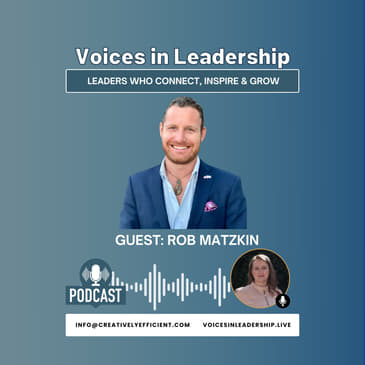

Rob Matzkin, a veteran in leadership development and behavioral transformation, joins us to share his transformative journey from the family glass business to becoming a distributor of architectural glass and metal. Rob's story is not only about professional growth but also about navigating the intricate family dynamics that come with a family-run business. He candidly recounts the challenges of maintaining harmony and the pivotal moments that led him to pursue a different path. Our conversation reveals how influential resources like Landmark Education and Tony Robbins' programs inspired Rob's personal growth, emphasizing the importance of shedding ego and fostering trust to become a more effective leader.
Amid the chaos of modern leadership challenges, Rob brings to light the significance of managing burnout through routines and focus. Drawing on Nobel Prize-winning research, he discusses how emotional decision-making often guides rational analysis and how structured task management can alleviate stress and cognitive overload. By minimizing interruptions and prioritizing significant tasks, leaders can achieve a state of flow, enhancing their productivity and satisfaction. Rob's insights provide a roadmap for those seeking to transform burnout into a breakthrough, focusing on routine and sleep as foundational pillars for peak performance.
The episode also explores the art of embracing chaos and finding purpose. We discuss the importance of deep work and the impact of flow on burnout, alongside the necessity of thriving amid the uncertainties of entrepreneurship. Rob shares his bespoke approach to client interactions and marketing strategies, revealing how entrepreneurs can adapt to rapid changes. Additionally, we celebrate the empathic leadership of individuals like Joe, whose contributions have been instrumental in shaping the Bond Summit. Her empathy, grit, and positivity resonate with the summit's core values, fostering purpose-driven business practices. The spirit of gratitude underpins our conversation, acknowledging the transformative power of purpose-driven leadership.
00:03 - Dr. Angela J. Buckley (Host)
Welcome to Voices in Leadership, where leaders who connect, inspire and grow come to share their stories. Live. I'm your host, Dr Angela J Buckley. Join us as we explore authentic leadership, gratitude and the power of connection through powerful conversations with inspiring voices. Let's inspire, uplift and elevate leadership that truly makes a difference together. Hello and welcome to another episode of Voices in Leadership. My guest today is Rob Matzkin, with the Rob Matzkin Group, and he is an expert in having leaders work from burnout through breakthrough and, in today's world of chaos, VUCA, unknown policies that are impacting our supply chains. Every CEO that I have spoken with has said I am challenged in keeping up, I am challenged in keeping up with my family and it is difficult to know where to turn to have safe conversations. So today, Rob, I think that the work that you're doing is going to have strong impact on so many of the listeners for Voices in Leadership. Welcome and thank you for joining us.
01:28 - Rob Matzkin (Guest)
Well, thanks for having me. It's great to be here. Appreciate you, appreciate you.
01:34 - Dr. Angela J. Buckley (Host)
Super glad to be a part of this conversation and just really focusing on helping people as they move through the challenges that are existing in today's world. So I just want to introduce you very quickly. Rob has the founder of 16 companies, he's had two exits and has really worked through focusing on leadership development, behavioral transformation and that decision making under pressure transformation and that decision-making under pressure, the impact and the shifts that he helps leaders achieve is moving from burnout through breakthrough, removing self-doubt and eliminating decision fatigue while moving your teams forward in power and in strength. So, Rob, I think these are critical topics for today, for today's audience, and so I would love to hear how you got started. My first question always is what brought you to the leadership journey and what brought you this far?
02:42 - Rob Matzkin (Guest)
Yeah, so long story short, I started in entrepreneurship from a very young age. It's always really been my career. I grew up talking business with my dad, who ran our family business at age 10. That's how we bonded in many ways. Growing up and in some cases still to this day, thought I was going to work in my family business. Turns out that would have been a well. Tried that for a while. That's hard up and in some cases still to this day, I thought I was going to work in my family business. Turns out that would have been a well. Tried that for a while. That's hard and I respect anybody out there who's done it. It's a bigger challenge than anybody else ever realizes until you try it.
03:19
And then in my 20s, building companies, I've made every mistake under the book. I was an awful leader. I was an awful boss. I didn't understand what wasn't working, what wasn't working with me, why people were responding to others and not me, or responding to my co-founders and not me, and started the journey of personal growth and development about 15 years ago with multiple different channels and paths, and realize that being a leader not only in business and my life and my family and my friends is well. Life gets a lot better and a lot easier when that's the case and you're aware of who you are and how you're being. So you know the way I look at leadership it's always a path of growth and development.
04:09 - Dr. Angela J. Buckley (Host)
I am a lifelong learner so I appreciate hearing you say it's always a path of development. What was the family business?
04:22 - Rob Matzkin (Guest)
So my great-grandfather fled the Tsar's army in 1903. His only skills at 17 was a glazer. He went into business with my great-grandfather I'm actually my grandfather in, uh, the early or mid 40s, and they were blazers. They were glass installers. My dad reinvented the business to be distributors of architectural glass and metal distribution. So it was construction distribution sales in the South Bronx of New York. So it was a really dynamic and interesting business with a lot of interesting characters as customers who never like to pay their bills on time.
05:01 - Dr. Angela J. Buckley (Host)
Oh yes, collections is probably the least fun part of business ownership, in my opinion. In my opinion, so we'll see.
05:13 - Rob Matzkin (Guest)
Invoicing is the most fun, and then finding collecting it on time that's the least fun.
05:19 - Dr. Angela J. Buckley (Host)
Yes, Ask me about that. Tomorrow Mid-month, it's time. So, Rob, okay, so you decided family business not so much for you, but that's also kind of statistically valid right, Like third generation is usually where we see the family exit from small business families right. Did anyone else in your family carry that on, or did everybody step out at that time?
05:49 - Rob Matzkin (Guest)
It wasn't as much as I didn't like the business, as much as the family dynamic, particularly with my uncle, was non-sustainable. Let's be polite and politically correct and not get into all the details.
06:03 - Dr. Angela J. Buckley (Host)
That's fine.
06:04 - Rob Matzkin (Guest)
Yeah, but you are not the only family business to have that conversation, right, let's be. Let's be polite and politically correct and not get into all the details. That's fine, yeah, but I can't.
06:07 - Dr. Angela J. Buckley (Host)
Family business to have that conversation Right, so yeah, yeah, yeah.
06:11 - Rob Matzkin (Guest)
So yeah, no, it was something that but his biggest blessing to be able to step away and chart my own path and and have that flexibility and ability and I would not have been the person I am today not even close and I would have been very much more high strung. So I'm really happy I'm not based in New York, I'm based in Florida these days as well, so there's a lot that I'm happy about and grateful about that. I was able to move on.
06:42 - Dr. Angela J. Buckley (Host)
Perfect. And so, moving on, when you are doing your development, you said, hey, 20s, maybe I wasn't the best leader. I'm going to say in my 20s, maybe even my 30s, I may not have been the best leader, and certainly not the leader that I am today. So how did you find your footing as a leader? How did you find that development and how did you come to developing that? Right now and I'm going to add one quickly to add to that, to really frame that context For the 20, 30-somethings who are leaders in development what should they be thinking about right now as they listen to your story?
07:27 - Rob Matzkin (Guest)
about right now as they listen to your story. So it started with with me with a conversation with a business partner and I was like in conversations and going how the heck does he do that? He just went. They were like solid no's and now they love him and they're definitely yeses. And you know I'm like what did he do? What's his magic, what's his secret sauce? And you know I'm like what did he do? What's his magic, what's his secret sauce? And it turns out it was who he was being.
07:50
My personal growth path started really. I guess it really started with how to Win Friends and Influence People when I read that in college and opening my eyes up, and then it was like Zig Ziglar's books for a while in my early 20s. But then where I really started to grow it was the work that Landmark does and Landmark Education Group with the Landmark Forum and a lot of their continuing education work, mixed with some Tony Robbins. So it really started with my personal growth as an individual and who I was being and how I was listening, how I was reacting and how I was receiving stuff. And it really just started with started from there and and just kept growing. I guess, if that makes sense, yes.
08:39 - Dr. Angela J. Buckley (Host)
So growth with intention is always of interest to me. So when you were looking for some of that growth, maybe you stumbled on the first book, or someone recommended that was the Dale Carnegie book, right? But then how did you move with intention?
09:00 - Rob Matzkin (Guest)
You know, I think that's the difference between having a PhD and me at the end of your day. Even not. I didn't necessarily have intention, I wasn't like, oh, I need to be this type of leader, I need to get this.
09:13
It was just I went down the rabbit hole on personal growth and I and I started trusting people around me that there was something bigger for me and available to me when I just got rid of my freaking ego, and so it was more of an ego death and that's. I think, what crops back up to me continuously is when I'm effective as a leader, my ego is not in the way, and when I'm, you know, not effective, my ego is probably showing up somewhere and it's more about me versus about the goal and the objective. So a lot kind of also fell into place because I was doing that work on myself and simultaneously just growing multiple different companies, or trying to sell a company at one point and then sell another one and grow another one and now growing multiple, and what it takes is always pushing me on the edge of that and leading whether that's leading teams, living remote teams, leading freelancers, um, leading agents now, um, right, and what it takes in my communication to do so and organizational processes. Does that answer help answer your question?
10:38 - Dr. Angela J. Buckley (Host)
it does, because you use two, two words that I like to key off of, if you don't mind. I have a model called likable leadership and it is built on trust development models, and two of the words that you said were you started trusting the people around you and perhaps in trusting others, then you also became more trustworthy. Perhaps you have to tell me that, if you feel that that was the way. But then also, you really talked about that active listening, or listening with empathy, which sends up the flag for me, about moving from microcontroller, mic-manager to someone who is truly managing the skills and the hearts of people, as opposed to managing their day-to-day tasks.
11:32 - Rob Matzkin (Guest)
Yeah, I mean, and that's, I think, really a great way to put it. You know, I was being interviewed a few weeks ago. Somebody asked me something completely different, but it inspired me that these words roll out of my mouth of, I think, how I'm being these days and it's how can I be vulnerable, how can I be myself, how can I be authentic and how can I be trustworthy? Right, and you know, I think those are my core principles of the way of being right now, of of how I'm showing up. I'm just, you know, my clients like working with me or say yes to me because, like nobody's ever spoken to me like that, you're just real and authentic and you're not trying to brush over anything and I'm, you know, I think one of the hardest things I had to deal with was how could I be direct but caring, or how can I?
12:28
just tell somebody what I'm thinking and tell somebody what there is to say, without all this mess, by being really direct and I'm just really authentic and clear of I'm not mad, I'm not upset, you're not wrong, nothing's wrong. We're going to fix this together and all that's implied, but this is what's so. This didn't cut it, this wasn't. This is what we needed to go. This is where we need to get to. And how do we get there together?
13:01 - Dr. Angela J. Buckley (Host)
It's a fantastic approach, Rob. So when you do that, are you also helping people move from that burnout state Like how are you identifying burnout? How are they identifying burnout?
13:26 - Rob Matzkin (Guest)
these days of. There's plenty of indicators and you're probably better at diagnosing burnout than I, but I mean, you're overwhelmed, you're stressed, you don't have enough free time, you're edgy, right, you're quick-tempered, whatever it is you're not feeling well, you're always down, you're always um, you're always tired, whatever those indicators might be for you. But you're not, you know, and you can make excuses on my diets off, oh, I'm just uh, whatever it is, but you, usually those things are just a few of the indicators um, that I'm hearing and, um, this might be on the woo side of things, but usually I could tell by their presence and way of being that something's off body stance right.
14:09 - Dr. Angela J. Buckley (Host)
Your body language tells you a lot about a person. I know it makes it. Even saying the words, I was thinking I should sit up more straight as I say it. But um, but you can see that energy right, like how people hold their body, even even the power people. Right, you said ego, you started out with ego, but you can see when that energy is run down. So, yes, many people do recognize that as woo. And yet one of the most interesting Nobel prizes for economics proved that people make decisions emotionally before they use the data, despite all of our will to rationalize.
14:54 - Rob Matzkin (Guest)
Yeah, we're going to judge a book by its cover. Right, it's in our nature.
14:59 - Dr. Angela J. Buckley (Host)
It is in our nature. So, Rob, okay, they say they're burned out out. You recognize that they're burned out. How are you moving them from burnout to breakthrough?
15:11 - Rob Matzkin (Guest)
yeah, I think it's, uh. I want to say I think it's simple, but uh, or simplistic. I should say not easy but simplistic, it's what is caught. It's usually especially for a business owner, business leader, it's going to be overwhelmed, right, it's going to be overwhelmed, and probably too many different packet switching, uh is usually what's going to happen, right, so, at a very basal level, right, it's, I'm going to be very rudimentary and one-on-one, but it's your routine, right, right, it's your sleep, right, and just those two things alone I'm probably going to be able to, you know, solve a lot of it. Why do I say it's routine?
15:52
It's how are you waking up, are you like, are you shocking your system with all sorts of adrenaline and endorphins, right, as you wake up? Are you having some? Are you a morning person or evening person, you know? Are you planning your day and you're putting your mind at ease? Are you meditating and calming yourself down, right, just at first half hour? I mean, even for myself, right, I see the difference in my anxiety levels. You know it's actually.
16:21
I'll just do a side note. One of the epiphanies I had this morning is and I'm in a very relaxed state right now there's nothing wrong, everything's under control for the first time in a while. Well, thank you. But it's this like micro week. But in any case, my mind last night woke up. I'm like, oh my God, I didn't put my gear away. And it's out in the middle of the thing. And I got to get up and I look, it's like three in the morning. I'm like, and then I'm like I'll deal with it. Even if I did, I think I did put it away, but it's fine, I'll deal with it in the morning. In the morning I'm like, no, it's away. Your mind is just spinning, trying to create problems for me and challenges. Why? I guess I need to go down the rabbit hole again, but sometimes it's really that simple.
17:08
But going back to the tactical right, it's how many packet switches are you going to do a day? And I think sometimes it's just as fundamental. As you know I forget which neuroscience book it was, but it's always stuck with me it's we could do so many big tasks a day and so many little tasks a day. What is a big task? It's a 20 to 40-minute task. It's a deep work task and a small task. We could do about 8 to 10 of those and we could do about 40 small tasks, about 8 to 10-minute tasks. Now if we get interrupted it counts twice, right? So, and maybe women are different, maybe this is the male mind, but I can't multitask and if I do it really gets taxed in me and I get that two o'clock feeling much earlier in the day, but like if I'm doing deep work focused on what I need to focus on without interruptions, I'm able to smoothly handle further out the day I'm able to have a much higher cognitive load and I think it's from that neuroscience background.
18:08
So, organizational structure the more structure you have, the more freedom you have. Those are just the very simple high level that are very generic. And then going in, it's like what are the biggest problems? What are the biggest anxiety producers? How do we actually solve them? Do we need different people? Most of the time we probably need more people and can't afford more people is what happens a lot of times or we can't train people quick enough or people aren't producing. So again, now I'm going into the actual, more specific, but it's figuring all that out right. But I guess, to really sum it up, it's let's assess where you're at, where your pain points are, what we can put in place where the quick wins are and then where we need to dive deep and go deep to actually relieve some of the burnout. So we actually have some room to build, some momentum to actually put some healthier things in place.
19:07 - Dr. Angela J. Buckley (Host)
So, Rob, you've said it a couple of times let's just talk about packet switching for some clarity. So some people probably have not heard that terminology in the past. Let's go down that rabbit hole for a second, please.
19:19 - Rob Matzkin (Guest)
Yeah, I mean, all it means to me is you pick up one task and you pick up another. You just switch gears. Right, it could be as simple as and I think the more violent the switch, I think what I mean by the bigger whiplash. It's like you go from talking to a loved one and putting yourself in one persona to like trying to solve, like a big, super taxing task, right, and I get a lot of people and maybe that's an extreme example because a lot of people families didn't pick that up. That's that's going to for me, like.
19:56
So I'm a flow junkie, right, and I'll explain why it's so important, right, so everybody thinks I'm an adrenaline junkie. I really just like being in flow, I just like being focused in the zone, and what I'm most productive, that's at work. I love doing it in my personal time and you could do that during meditation. I'm a big surfer, a big kite surfer, a skier, right, but all those things. But if I'm in the zone, that's where I am Now something happens, where it takes me out of that, it's hard for me to get back in it and it's abrupt.
20:33 - Dr. Angela J. Buckley (Host)
It's very abrupt, interruptive, and when it's abrupt it's even more impactful. So for me that's a packet switch. So yesterday I'm in a different location than I normally am and I went for a bike ride. It was supposed to be an easy, flat, same speed all the way through, but because I'm in a different location, I'm in a city, it's got hills, there's a lot of stoplights, the roads are a little sketch, so I can't even go fast on the downhills because there's potholes, whatever, To your point. It was a far more fatiguing ride mentally because there was not a second where I could just get in my drops, get in my arrows and just power through and just hold a steady pace. I will say I'm proud of myself.
21:14
I came up a hill like I went down a hill. I didn't even know it was there. It was 1.5 miles and I knew when I got to the bottom I was not where I wanted to be and I had no choice but to turn around and go right back up. But I my pace the whole way. You can see it's so steady on my, my tracker.
21:33
I held the pace all the way back up that hill for 1.5 miles well it was not easy right mentally to do that, because it's so different than when you just get to go in an open road and put your mind to it yeah, and your mind can get in, your mind could shut off and hit a cadence and everything else, and I think that's, um, the beauty sometimes of it.
21:55 - Rob Matzkin (Guest)
Like I've been doing a lot of, uh, deep work proposal writing this week and I and I was like man, I forgot.
22:02 - Dr. Angela J. Buckley (Host)
I actually kind of enjoy this.
22:03 - Rob Matzkin (Guest)
There's a, there's a different mindset versus just talking all the time.
22:08 - Dr. Angela J. Buckley (Host)
Flow is very it. It's powerful, it's deep, it's relaxed, and when people talk about I'll just toss this in here for a second when people talk about how time flies, it's because you know you're not checking in with the clock because you're in flow. That's how you know. When you're in flow is because you're no longer checking the time clock, and so it feels that time moves at a different pace, whereas if you're doing a chore that you don't want to do, you check the clock repeatedly, right, and so it feels like time is going at a slow pace. So how we experience time has a lot to do with how we experience flow.
22:54 - Rob Matzkin (Guest)
Yeah, I like that.
22:56 - Dr. Angela J. Buckley (Host)
So very, very interesting. So you're going to talk about how the flow is impacting burnout packet switching, switching from task to task and then prioritizing the big chunks over the little. Is that that next step that you are looking at?
23:17 - Rob Matzkin (Guest)
Yeah, that's definitely a fair statement, right it's where the quick? Wins, it's where the priority wins, and just going down all the rabbit holes from that, and sometimes everything I do is very bespoke, very individual, very customized right, and I'm really always I don't have a course that I run on this type of stuff it's always bespoke, it's not a training program and the way I look at things it's sometimes the pivots needed, sometimes the big shifts needed. I don't know. I won't know until I speak to somebody, but I know pretty quickly.
23:59 - Dr. Angela J. Buckley (Host)
Got it, yep, yeah. So, Rob, when you are looking for people, for clients, how are they finding you? What are they doing to have those conversations with you?
24:14 - Rob Matzkin (Guest)
Where am I finding people and what's my marketing strategy? Or in that sort of way.
24:19 - Dr. Angela J. Buckley (Host)
A little bit of that, yes, but also a little bit of how are they coming to you?
24:25 - Rob Matzkin (Guest)
Like sorry, can you just redefine that how? Like, in what methods are they? Are they emailing me or are they coming to me? In what state?
24:34 - Dr. Angela J. Buckley (Host)
Maybe which platform which state yes.
24:38 - Rob Matzkin (Guest)
Okay, like state of being, by the way, not state of being.
24:41 - Dr. Angela J. Buckley (Host)
That's what I meant.
24:42 - Rob Matzkin (Guest)
Yes, yeah, I mean people are coming to me, I'm speaking to people. I mean people are coming to me, I'm speaking to people, I'm having conversations with people on multiple different platforms. It's really the platforms that I'm active to at any given time. At one point it was tech talk and then I was like man, I'm not really feeling this one, but it's mostly LinkedIn. These days. It's mostly I start conversations with people on through a lot of introductions, through some email, through appearances like this.
25:09
I have my own podcast that I'm starting up that will be launching in the next month, so hopefully that as well. But the state of being people are coming to me is I'd love people to come to me earlier, but it's mainly that they're overwhelmed, they're frustrated, things aren't working. Um, you know, right now, with everything going on, as you, as you uh, so eloquently summed up in in our, in your intro is everything's in flux right now. Right, and I think I'm personally fortunate that my life is always kind of in flux that you, you know, one of the things is like oh, my God, everybody's. Like Rob, you're so lucky, you get to do this, you can do that, you get to travel, you get you can work remote and everything else, and you work independently and don't have a boss, I go yeah, it's great, except I don't know how much I'm making next month. I think I know how much I'm making next month. I don making in q4. I hope I'm making this. I might make that. Oh, it would suck if I did that.
26:09
you just get a paycheck, right but that's the story of us as entrepreneurs yes, right, and that's the uh, that's the beauty and the the the challenge of it. So I think all of us have been in flux, but especially right now, and especially if you're in an import, importing anything. But I heard um, I'm going on a little bit of a rabbit hole here, but I I heard a great quote that I've really embraced. There's two things that I'm really embracing right now, and one is we're going to be in a world of uncertainty, whether the existing president is president or not, no matter what happened. It was going to be an age of uncertainty for many different reasons for the next five to 10 years, and the only option I have is to thrive in uncertainty, because that is what it is. This is the dish we're being served, so we might as well thrive in it.
26:59
And with AI and the fourth industrial revolution and everything else that's coming and everything's getting quicker. So if we're not innovating, adapting, we can't just put our feet back up these days and cruise. So that's one thing, and you know the second thing that I think a lot of people worried about political climate, a lot of people worried about jobs climate, a lot of people worried about the economy, there's a lot to worry about. Where I'm standing in is I was listening to a great geopolitical scientist the other day and it's simply going in.
27:38
Every industrial revolution and I think we're all pretty agreeing now that we're in the middle of the fourth industrial revolution, but every prior industrial revolution, for 25 years after the start, there was huge economic growth, and I'm standing in it, and whether it's right or wrong if there's low economic growth, well, I can't do anything about it, and the best thing I could do is assume that there's going to be large economic growth and set myself up for success for that. So those are the two things there will be economic growth in the next 25 years, and we just need to thrive in uncertainty. And those two things alone for me have, you know, solved a lot of my anxiety problems, which is really what leads to burnout, right?
28:20 - Dr. Angela J. Buckley (Host)
So I was born in Minnesota and we have a saying that it's going to snow. You have a choice you enjoy to snow. You have a choice you enjoy the snow or you hate the snow. How do you want to enjoy your day, like regardless? The snow is coming, right, the complexity is coming. You can either just choose to thrive in it, go build a snowman and build a fort and have a little bit of fun, or you can stay inside and be miserable. Those are your choices, right? And if you do, you're not going to be earning the money. You'll be behind the times.
28:52 - Rob Matzkin (Guest)
Let's just like embrace that, the chaos that's coming, and and make the money, because the growth is there if you want to stay in the state of minnesota, if you want to stay in the entrepreneur Entrepreneurship train, or you could choose to move to Florida, like me, but basically retire right.
29:10 - Dr. Angela J. Buckley (Host)
But it's like I can't ski in Florida, Rob.
29:14 - Rob Matzkin (Guest)
What skiing is in Minnesota, love, I know.
29:19 - Dr. Angela J. Buckley (Host)
Lindsay.
29:19 - Rob Matzkin (Guest)
Vaughn came from Minnesota. I know you guys have good skiing. I lived in Vail for a long time, so I'm a little bit of a brat when it comes to skiing, but this is very true. No, but in all seriousness, we'll go back to your example, though. It's like if you're going to be on the entrepreneurship train, snow's coming. Choose snow, enjoy it. If you don't, okay, move to Florida, move to Arizona, move somewhere else and don't play. And don't play on that game. Maybe you have the choice and maybe you don't, but I think just the power of that choice is everything.
29:52 - Dr. Angela J. Buckley (Host)
It makes a difference how you engage with it. It's coming one way or the other. Yeah, so, Rob. Usually about this moment we move into the gratitude section of the voices in leadership. So have you brought a name of a person you would like to recognize today who has helped you on your entrepreneurial or leadership journey?
30:17 - Rob Matzkin (Guest)
You know, I remember you mentioning that, like two months ago when we first spoke. So I'm going to choose it in this moment. I didn't come prepared, which I actually think will be even more fun, and the question is who am I grateful for on my entrepreneurship journey? There's so many people who do I want to choose? Who has?
30:41 - Dr. Angela J. Buckley (Host)
had an impact that we can talk about. Some metrics and numbers.
30:53 - Rob Matzkin (Guest)
I'll talk about my business partner at bond summit, Joe Beneshu.
30:58 - Dr. Angela J. Buckley (Host)
Okay, and what did Joe do for you specifically?
31:05 - Rob Matzkin (Guest)
Joe's done a lot, you know she, so I'll just explain. So the Bond Summit we bring purpose driven entrepreneurs together for three days to really elevate who they are and really bring purpose into their lives right and purpose into the business and really help people that are already bringing purpose there. So I remember talking to Joe just as a friend and a friendly conversation, being like I had this idea, what do you think of it? She goes that's great. And I'm like great, could you help me create the content? She goes, yeah, I can help you do that. But then she took it to a whole nother level and became suggested that she become a co-founder. To a whole nother level and became suggested that she become a co founder and and what we did with this and where it's gone is just a completely different level and state of being and diligence. That something that I couldn't even fathom creating on my own, let alone what we're able to been able to do.
32:05 - Dr. Angela J. Buckley (Host)
Okay, and what did that cost her? Whether it's in time or reflecting of her personal characteristics, um in order to step up that relationship really is what I feel like you're describing.
32:21 - Rob Matzkin (Guest)
Oh, we've been through. We've been at this three years. We've been through the good, the bad, the ugly, the ugly, the stress, the anxiety, the sleepless nights, the dealing with my BS, dealing with the stress of pulling off the finances of a summit that wasn't going to go a specific way.
32:46 - Dr. Angela J. Buckley (Host)
There's been a lot wasn't going to go a specific way. There's been a lot, and how did that reflect on some of the personal characteristics that she exhibits or values?
32:58 - Rob Matzkin (Guest)
How did that reflect? In the sense that just redefine the question how did it impact her or how did it impact her value system?
33:09 - Dr. Angela J. Buckley (Host)
So when I say reflect on it, the activities that she kind of poured into you and poured into your partnership, they usually we see personal values come through in our behaviors. What were those personal values that shined as a result of her activities?
33:29 - Rob Matzkin (Guest)
Thank you for the clarification. So I mean who she is as a person, who she is as an empathic driven leader, who she is as a listener, who she is as just a ray of light and positivity and speaking the truth, and also always picking us both up and dusting us both off when things weren't so sunshine and roses.
34:02 - Dr. Angela J. Buckley (Host)
Okay, okay, and how did that have an impact? Thank you for that answer. And how did that have an impact on your career or on this company, this venture?
34:15 - Rob Matzkin (Guest)
Oh, I mean, there was a moment that without her and her leadership we wouldn't still exist. That's for sure. So just then, and without her and her leadership and her, you know, wanting to jump headfirst in this would have looked like a very different organization, with a lot less purpose and a lot less mission and sunshine.
34:43 - Dr. Angela J. Buckley (Host)
And what relevance so the mission? What are the values? Of you said it was Bond.
34:53 - Rob Matzkin (Guest)
Summit.
34:55 - Dr. Angela J. Buckley (Host)
What are the values, the mission and the values of Bond Summit.
34:59 - Rob Matzkin (Guest)
Now you're quizzing me yeah, no. So our mission is really how do we focus on bringing more purpose to business and how do we allow business to have a greater impact on the globe? And if we get behind some of the most impactful entrepreneurs, we can have a really big global impact. That's our mission and the values that we have is well, how do we be purpose-driven, thoughtful, caring leaders to really instill purpose in people's lives, to really go out there and make a difference on this world, not just make a buck.
35:51 - Dr. Angela J. Buckley (Host)
Did you say instill? Okay, so Was that a triggering word for you? I mean, I think people have to adopt it so we can put it in front of them, but they have to make the choice.
36:09 - Rob Matzkin (Guest)
They do, absolutely. I'm not trying to.
36:13 - Dr. Angela J. Buckley (Host)
Yeah, but we, maybe, we, we show them the way and show them the light and what possibility, what the possibilities are. I was just curious.
36:23 - Rob Matzkin (Guest)
Yeah, it's not necessarily a doctrine.
36:27 - Dr. Angela J. Buckley (Host)
It is showing away I think that's my language versus anything else got it, um, and okay, so the spirit of acknowledgement when we put together, we talk about specific, and so in this case, you were saying, um, she really like, led and was a ray of sunshine and took this organization to be more than maybe you had imagined it to be on your own. Personal was again she was demonstrating her sense of positivity.
37:03
I also heard an element of grit, of picking up, dusting off in in the low times and really pushing through to get back to those high times, and the impact is like there might've been a moment where you weren't going to be functioning together or functioning or pulling the summit off at all without her guidance and leadership. And again, ongoing positivity. And then the relevance to the organization of sharing what passion and what good can become of other leaders when they are engaged with the Bond Summit. And how do you support and have that positive impact in the world is the relevance of her work. Did I understand you correctly? So the spirit of acknowledgement? We talk about specific, personal, impactful relevance relative to the organizational values. And then inclusive, which is kind of like saying making these type of comments public or using it in front of a team meeting. And then timely. You can do this on a global scale, like what we're doing today, but you can also do a smaller version of it in team meetings, et cetera as close to the event as possible.
38:28
So that's the spirit of gratitude model. Can I try to like summarize everything for her? Remind me her name again, sorry.
38:41 - Rob Matzkin (Guest)
Joe.
38:42 - Dr. Angela J. Buckley (Host)
Joe, okay.
38:45
So, joe, on behalf of Rob, I would like to thank you for all of the energy, the positivity and the demonstration of grit that you have put into his relationship with the Bond Summit and the organizational relationship that the two of you have formed going forward.
39:12
You've demonstrated positivity, you've demonstrated energy, you've demonstrated the willingness to focus on the relationship as well as the organization, in order to support Rob in the development of the Bond Summit, to making it be something more than he ever imagined it to be and, in some cases, potentially even saving it from falling apart altogether. By doing this, you have had significant impact over the last three years on not just Rob and his career and the focus, but also the numerous entrepreneurs who have participated in the Bond Summit, as they have sought to learn more about leadership, passion, becoming the best version of themselves so that they can have a greater impact in the world, which, in turn, has been demonstrated by you and by Rob as a virtue of holding this Bond Summit on a regular basis. So thank you for your ray of sunshine, thank you for living your values day to day and putting all of that energy into Rob, your relationship as business partners and the Bond Summit.
40:34 - Rob Matzkin (Guest)
That's beautiful.
40:36 - Dr. Angela J. Buckley (Host)
Does that sound about right?
40:38 - Rob Matzkin (Guest)
It does.
40:40 - Dr. Angela J. Buckley (Host)
So do you have anything that you might want to add? Did I miss anything?
40:47 - Rob Matzkin (Guest)
Did I miss anything?
40:49 - Dr. Angela J. Buckley (Host)
I think it was pretty whole and complete. So, Rob, I've really enjoyed having this conversation with you today. If people are looking to get a hold of you, what's the best way for them to reach you?
41:03 - Rob Matzkin (Guest)
Yep, my name at Gmail, Rob Matzkin[at]Gmail and robmatzkin.com. Super simple, Rob Matzkin on LinkedIn. Really easy.
41:12 - Dr. Angela J. Buckley (Host)
And I will put all of the links maybe not your email, because then you'll just get spot spanned in the blog post that goes along with this episode. It will come out next, next week, and I thank you for your time and I am very excited to see more about what you're going to put out into the world and definitely learn more about the Bond Summit.
41:37 - Rob Matzkin (Guest)
Hey, thanks so much. Thanks for your time, thanks for having me.
41:42 - Dr. Angela J. Buckley (Host)
This is Angela Buckley and we are signing off. Thank you for joining us on Voices in Leadership, where leaders who connect, inspire and grow share their stories. I look forward to welcoming you back to our next conversation. In the meantime, visit wwwvoicesinleadershiplive to access show notes, links and to subscribe and stay connected. And in the spirit of gratitude, let's remember to thank one person near you. Until next time. This is Dr Angela J Buckley signing off.