
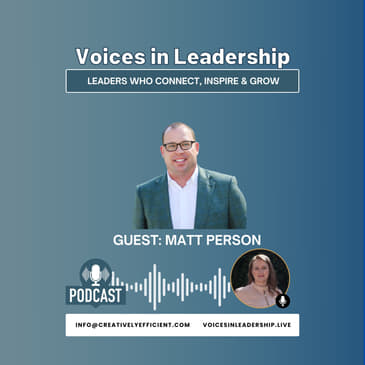


Can corporate culture be intentionally constructed to align with organizational goals, or is it an elusive concept that simply evolves? Our latest Voices in Leadership episode promises to enlighten you with insights from Matthew Person of Town Square Advisors. With a career that spans from the sports industry to investment banking and now to strategic advising, Matthew shares his valuable experiences and the lessons he's distilled in his book, "Culture of Alignment." Join us as we explore the Square Management System and the necessity of a bespoke cultural framework that resonates with a company’s distinct values and needs. Matthew's perspective challenges the conventional view of culture as an undefined ethos, providing a roadmap for leaders looking to foster a cohesive and purpose-driven organizational environment.
Furthermore, we tackle the intriguing notion of intentional versus unintentional culture. Matthew delves into how intentional cultural design can lead to streamlined operations and employee alignment, addressing the skepticism that surrounds this approach, particularly in vast, complex organizations. We discuss the risks of blindly emulating successful companies without grasping their unique cultural elements. This episode inspires leaders to move beyond mere imitation, advocating for a strategic cultural alignment that truly supports growth, engagement, and success across all levels of a business. Tune in to discover how intentional culture can become a foundation for achieving organizational excellence.
To learn more, see Townsquare Advisors
00:02 - Dr. Angela J. Buckley (Host)
Welcome to Voices in Leadership, where leaders who connect, inspire and grow come to share their stories live. I'm your host, dr Angela J Buckley. Join us as we explore authentic leadership, gratitude and the power of connection through powerful conversations with inspiring voices. Let's inspire, uplift and elevate leadership that truly makes a difference together. Hello, good morning, Welcome back to another episode of Voices in Leadership.
00:35
I have with me today in the studio Matthew Pearson from the Town Square Advisors, and I'm very excited to have Matt here. He's going to be talking to us about the square method of management so it's called the Square Management System and he has been really focusing on the culture of alignment, of course, a fun topic for myself, but also the importance of where growth strategy, m&a, private equity, these portfolio companies are working together in the background, and how is that all working together? And Matt has been working in this area now for over 20 years, focusing on investment banking, supporting those small equity firms or the owners of companies owned by equity firms, and there is a lot to be learned from his experience and the successes he's had over the years. So, matt, thank you for joining me today. Very much excited to have this conversation.
01:40 - Matt Person (Guest)
Good morning and thanks for having me. Very excited to be here and looking forward to our conversation on all things culture and organizational design.
01:48 - Dr. Angela J. Buckley (Host)
I love organizational design and I love culture, so I'm sure that we are going to have a lot of fun. So, Matt, before we get started, I always like to ask how did you get here? How did you get into this particular role? I mean, no, you've been doing it for 20 years, so fantastic. But what brought you from school into this level of consulting and in this position?
02:13 - Matt Person (Guest)
It's been something I've been naturally pushed into, so my career is a little bit of a multi-peg stool, so to speak. I actually started in executive management and operations in the sports industry on a whim of introduction. Ironically and it was not my intention I spent over 11 years running and building and growing small businesses effectively and learned all about how the interconnected nature of different departments influenced scale, saw what went well, what didn't go well to scale, saw what went well, what didn't go well and finally decided to move out of the grind of the sports world and flipped back into an MBA and then went into investment banking where I saw I was doing creation of enterprise value in the sports world. Investment banking is all about capturing that in a sell-side process and in that process you really understand where investors and buyers put value, and so it really helped corroborate all the things that you do organically to grow come together in a value capture and a sell-side scenario. Now I'm more involved in buy-side acquisitions and we have to value businesses ourselves Through the combination of starting Town Square Advisors, seeing how that's developed, buying companies, selling companies, growing companies. It's given me a unique perspective on all angles around how organizational design, how culture, how systems and processes influence growth and scale, and how some companies do it well and what happens when companies don't do it well. So that has pushed me there in terms of just being really interested in that, because it's been part of what I've been doing for the last few years.
03:46
The short story, though, on the book that I'm working to publish, called the Culture of Alignment, is an amalgamation of all those learnings.
03:52
That honestly, started as an interview question almost eight, nine years ago, where I was asked to answer how would you keep culture across five, six hundred employees, culture across five, 600 employees and the, and the role was to manage all those people, but they were in four different States and you know five different office buildings and how would you do that?
04:11
And my answer was just what I knew how to do from my sports tenure and the recruiter said you know, you should kind of do something with that. That's probably a more unique answer than you realize, which was a little surprising and humbling at the same time, and it stuck in the back of my head and, as I've just grown through my career, I've kind of tossed around ideas and I finally decided to put it together and make it actionable, in part because I felt like maybe it was time to actually help people with this and maybe right some of the wrongs that I'd seen over the years. So it's a natural evolution of just 20, almost 25 years now in career, from disparate points of view and excited to share more of the learnings.
04:48 - Dr. Angela J. Buckley (Host)
Well, I'll definitely be interested to hear different perspectives on culture culture alignment 500 in my world is small and it is challenging and when you start getting numbers of that size you have so many different micro cultures within that culture.
05:07 - Matt Person (Guest)
You do, you get fiefdoms. I call them mini squares, where the ways of doing, so to speak, the amorphous ways of doing, are left to each individual fiefdom, and that creates chaos.
05:20 - Dr. Angela J. Buckley (Host)
Yes, it does, and so can you tell me a little bit more about how the square method came to be? What's your thought process on that? What do my listeners need to know?
05:44 - Matt Person (Guest)
what I write about is how we actually got culture wrong, which is surprising to a lot of people, I think. At one point in my career I heard someone say culture is just this amorphous way of doing it. It's how things evolve, and I said there's got to be a better way for that. That's not true.
05:54
We can do better than just this phrase. You know, and should we? You know, how does it actually work? Culture to me, is not common size and it's not one way. And what's happened in society is we've gotten to oh, you want a best place to work. That's great. What are you doing? I'm going to copy that. And so we've taken a lot of attributes and amalgamated them into a couple of different high level bullets and then tried to copy that. And there's definitely a benefit from understanding what has succeeded in business, but it doesn't mean that it's going to work for you or for your company, and that's the error.
06:30
We've applied a one-way direction of culture. That's the company view and we've said to the employees hey, this is the best place to work, it should work for you and if it doesn't, that's on you Correspondingly when you do take a new job. Have you ever been with a hiring manager who said they have a bad culture? No one's ever said that. Right, I've never been in an experience. Everyone's like this is the best culture. We always have great culture. So there's no bad cultures, right, and new employees one of my favorite lines new employees don't start their first day disgruntled. Yes, they're always excited. So how do we take this believed common size best place to work approach with, hire and manage? You all think cultures are amazing at every company and employees are all excited to be there. And one statistic that I, in doing some limited research, kind of stuck out 50, almost 50 of new hires quit in the first 18 months.
07:21
So it's, it's obviously the ways of doing, this amorphous way of doing this, this we collective culture that's become a little bit, probably too broad. It doesn't work and that's really what started to prompt me to say, hey, how do we think about this differently? To me, culture is actually a two-way discussion between the employee and the company. And if your way of doing and I can get into what that is, that's most of what the culture of alignment is about is the ways of doing. If your way of doing as a person, if Angela's ways of doing, matches the ways of doing to a sufficient degree of the company, you're going to love it. It's going to be the best culture you've ever been a part of. And if your way of doing doesn't make you a bad employee and it doesn't make the company bad, it just means you're not a fit for each other and I think we have to start understanding. That's probably okay, right, it's not a scarlet letter on the employee.
08:14
So this system is an effort to then say okay, what are the ways of doing and how do we actually understand how to intentionally construct the business so that we know how to operate in a maybe a more streamlined and efficient way and inform and instruct our employees so that we have alignment. And that's where I call culture and alignment. When you align the individual and the person together, you have great culture. I'm going to stop there because I'm sure there's other points to be made around how this works, because probably the first thing everyone's saying is well, my company doesn't have one employee that has 4,000 or 400,000. How does that work across a huge number of employees? And that's a little bit why it's a square.
08:53 - Dr. Angela J. Buckley (Host)
Okay, well, that's interesting. So we do talk about in the culture development world, culture assessment world, like the difference between an unintentional culture and an intentional culture, and what you're walking people into, it sounds like, is this disbelief that intentional culture exists. And they say, right, that's what the amorphous statement refers to is that unintentional culture exists, whether you want it or not.
09:26 - Matt Person (Guest)
It does yes.
09:27 - Dr. Angela J. Buckley (Host)
As the business owner and the manager. Ideally, you're creating a culture that works for you and your management team and your employees. There's intent there.
09:39 - Matt Person (Guest)
Intentional. Intentional culture is is what we need to start shifting to, and not copying the best places to work Mantra, but actually understand Eat shirts and pizza.
09:50 - Dr. Angela J. Buckley (Host)
Everyone loves to eat shirts and pizza.
09:52 - Matt Person (Guest)
Exactly, and ping pong tables right, and so I think that's more of the point too is. So let's drill down and get away from that and actually understand what culture is and the elements. And get away from that and actually understand what culture is and the elements, and so, uh, if you better understand the component parts, then you can. You can apply that to your own accord and that's the key. Here there's an actuality. I am of the belief that there really isn't a bad culture. It's just your association with that culture that frames an opinion of good or bad. Um, and because there are people who don't like the wall street alpha worlds and there are some people who really love it and want to be there, and we need to understand that both sides are probably okay for those people yeah, what energizes you, or even okay for a time.
10:36 - Dr. Angela J. Buckley (Host)
Correct right like I probably would have loved some of that wall street alpha energy when I was in my 20s and 30s, but as a parent I don't have time for that kind of stuff.
10:49 - Matt Person (Guest)
No, it's very true, and more so in your stage of company. If you're a startup in a high growth stage business, there's probably a different approach to how you view culture than maybe a more mature business. A startup is probably going to have to evolve and allow for more fluidity and how they've designed the systems and the processes that make up their culture, comparative to a more mature business, moreover, something that's heavily regulated or has strong compliance factors, that's going to need what I call a heavy level of constraint, because if you don't have that, then there's obviously there's issues, there's harm that could be caused, and so you do need to understand the application of culture and the intentional design of processes and systems around who you are and where you are as your company.
11:33 - Dr. Angela J. Buckley (Host)
That's a fantastic point. So how do you get people started? They're going to join, they're going to work with you. They're like, hey, I have culture issues, but I don't know what that means. Where do you jump in? Or how do they find you?
11:47 - Matt Person (Guest)
Well, everyone can find me on townsquare-advisorscom. That's the website, and there's actually a free quiz that you can take, both as an individual or as an executive, and it's 10 questions to help you start to think about what culture really is. To me, again, it's an output. Culture is an output of systems and processes that are intentionally designed at least in good cultures are intentionally designed, and employees have to understand the unique partialities of their preferred working environment just as much as companies need to understand the intentional design of the systems and processes that they want to influence. Both parties are responsible for being more informed around their ways of doing so that a lot of times people feel like they have to chameleon themselves into a new environment and say, well, I'll just move away from what I prefer to do to survive in this company, because I need the job and that's tough right, and we've all been there, we've had to take a job, we've needed something before and you relax some of your preferences to get a good job. At the same time, if we were maybe able to make people more aware both companies, individuals and that's why I have a score. You knew your score and you knew the company's score around. You know how their culture was. You probably have a better idea of whether or not you fit, because the hiring process is an arm's length discussion. You only know so much. And again, you're going to get the best of the worldview from those hiring managers at the front end where culture goes awry. Why do almost 50% of employees quit in the first 18 months? It's usually because there's a little bit of a bait and switch between what they were told in the hiring process and what they experienced when they actually started working. And that's because the intentional design of the business is not mapped to the processes right. They haven't set the processes up, so the hiring managers are telling a different story than is actually occurring on the ground floor. And that's where chaos ensues with culture, and that's why people get frustrated and leave. And so when you so the point of the system, what is the square management system? What is culture? To me, culture?
13:42
I've coined a term called constrained independence. Constrained independence is the known degree to which an individual employee can action their own ideas In a unconstrained environment. Angela could go to your job on the first day and you would have an entire universe of things that you could do to do your job. But, as we've discussed, with regulations, with compliance or just product and service level quality, that is an impossibility because there is no way by which you would have that level of freedom. Imagine if all 10,000 employees had unconstrained capabilities. You could just do whatever you wanted, right. That'd be chaos.
14:21
In order to provide a desired level of product output for whatever industry your company's in, you have to constrain that independence. You have to put a box, or what I call a square around it, and the square management system is what are those four sides? Now that degree of constraint becomes the culture that you bounce around in as an employee, and it can be very small. You can have a heavy level of constraints and have less ability to actually action your own ideas, and some people like that. Interestingly enough, some people don't really want to have that much freedom and some people need a ton of freedom and they want to have all kinds of rights related to how they determine how to do their job. And so really, where culture comes in is getting enough of your employees into the same size box and also, as an employee, as a company, knowing what size box you really want to have and if you can get that done within a degree of a ratio of association. You have a great culture. You have a high performing culture. Why does that box matter?
15:18
Constrained independence gives employees empowerment because they can make micro decisions. Again, that's the point. They can bounce around inside the box, make their own decisions. That gives them pride, right? Everyone wants to feel like they've had an effect on the output, right, on the growth of the company.
15:31
You're creative, you can know what you can do. You don't have to just do one thing and be told you're kind of like hey, I did this right, so you can be creative. That leads to innovation. Uh, you're quicker if you know what's inside the box, then everyone else and then you can make your own. You know what you can and can't do. You don't have to ask all the time so you can sit there and go yeah, I'm off, I'm going, I'm doing, and you're a faster employee if you know everyone else is inside the box. They all trust each other. Trust breeds confidence, it breeds action and it creates loyalty, and loyalty creates a high, a longevity with staff. We all know hiring and training a new employee is way more expensive than retaining one, and so if you're able to get this box right and allow your employees to bounce inside of it? Man, do you have a high performing, high trust organization that's going to scale and be optimized? And that's the whole point of the entire book.
16:21 - Dr. Angela J. Buckley (Host)
Do you create intentionally different size boxes based on different roles?
16:27 - Matt Person (Guest)
You can, but they all have to attach to the mothership, so to speak. They have to have some association to the company. And I think that's. You know, what are the errors with constrained independence and incomplete box. You know, and that's where most companies go awry or a drift. So they might have said something, but then in actuality they're doing X and that happens slowly over time. That's where then that aforementioned hey, you said X, but you're doing Y happens.
16:52
Or the mini fictives, the mini squares where you haven't actually put the systems in place. And what happens then? The employees are left to frame their own view of constrained independence, and so you're going to get variances by department. Now the system is meant to start holistically, but can you use this to the department level or the team level? Of course, but you have to have some things that tie back.
17:11
An example of why you want to be careful around that there was a company I worked at for a while and the finance department had one way of doing and everyone had to go to work every day and go into the office every day, and no one else in the entire company did. Everyone else was free to come and go and go in whenever they wanted to. That created a degree of friction because employees were like wait a second, why is everyone else able to do this? And I can, can't? You had a different square and the head of finance was not willing to adjust. That was his view, and that's tough. You really need to have some commonalities there, especially when you have a hot topic around things like going to work and where you work and how frequently you have to go to the office.
17:53
So that's an example of trying to make sure that there's commonalities across the board. It's an example of trying to make sure that there's commonalities across the board.
17:58 - Dr. Angela J. Buckley (Host)
Well, I was kind of thinking, you know, if you have an engineering firm, some of these people prefer a certain amount of freedom in parts of their job, like it's naturally constrained. Because I'll just say, like we used to end conversations always with, is this a walk home Right? Like we worked on automotive and the question was is our customer safe? Is the issue that we're discussing today going to be something that they can walk home from? Or, if something goes awry, can they drive it to the shop to get repaired, right Like can we test it, can we sense what it is, et cetera.
18:38 - Matt Person (Guest)
Right.
18:39 - Dr. Angela J. Buckley (Host)
Like can we, can we test it, can we sense what it is, et cetera. Right, and so we needed some. There's there's a constraint. The constraint is consumer safety. And then the freedom question was a little bit more of would you put grandma in this car, would you carry your baby in this car? Right? So, and that was a step down from the importance of is this a walk home? And then and then there was freedom around.
19:04
I don't want to say freedom as in like it was just a free for all, but there was a prioritization of those questions of how do you adjust. There's always something to fix. But then if you looked at the marketing team or the communications team, their freedom was very different because they're a creative part of the same organization. So I guess I was thinking more like, when you talk about the job function, comparing a naturally constrained job, you have to be very constrained in engineering, right For the safety of your consumer, versus the communications or the arts and fun of rolling film and coming up with the ideas of what the consumer is going to emotionally engage with.
19:51 - Matt Person (Guest)
Right.
19:53 - Dr. Angela J. Buckley (Host)
So how do you align those types of things within your squares?
19:58 - Matt Person (Guest)
Yeah, I still revert back to, maybe to my answer. I think it's a great point that there are functions that are going to require a higher degree of freedom and ones that really can't right. You're right, finance they have to close the books in a certain period of time. There's only so many times you can do that, delay that, or you can't. I think it just still goes back to.
20:17
This is more of a common holistic approach by department, by function. You're right, there's gonna be some variances, as long as you tie it back to the main main role. So there are some things where, yes, the function is going to require, hey, we have to close the books in 10 days. That's just a part of this function. I don't know if that would materially deviate from the culture of the company, because that function specifically would have a different, just way of operating as long as there isn't a different means of communication or a different toning communication, or there isn't a different, and we'll get into the sides in a second. So, yes, you do need to allow. That's why it's a square, by the way, it's not. It's not one binary line, it's a box to balance it. There's going to be, there needs to be, there has to be differences between between functions okay, so tell me what are the sides of the square?
20:59
you have four, four sides, four sides yeah, four sides, ten elements to each one. Each element uh can have a high, uh, moderate or low degree of constraints. Uh, the the book actually uh details how you would implement each element to that varying degree so that you can understand how you would implement each element to that varying degree, so that you can understand how you would implement said elements. And it's not super granular but it's enough for you to understand how to deploy this. The key point I wanted to put forward in the book and you can actually go on townsquare-advisorscom to take the full 40 point methodology to actually take the quiz, to understand the Delta there. And the reason for that is it's not supposed to uniform so each side doesn't need to be the same, and I can get into how AI took the test and what they said in a second.
21:49
But what are the four sides? Identity, that's who you are as a company. That's your starting point, for obvious reasons. That's how your organization defines itself. It's your mission, your values, your beliefs. And the key question there is do our people know and our customers know what we stand for and why? And you'll be surprised sometimes especially as many years as I've been talking to companies that your mission statement may not actually match what you're doing as an output perspective. I call that product admission drift and it's probably the biggest problem in identity that that happens with companies side. Oh, go ahead, sorry no, that I do.
22:30 - Dr. Angela J. Buckley (Host)
People go out of their way to assess what customers perceive of their culture versus the actual culture.
22:42 - Matt Person (Guest)
Well, they should and most people don't, and that's the actual. The last one, which I was skipping a little bit to answer your question, but the last one is information, feedback, and that's how you improve as a company. And most people only do employee assessments and not enough of their own internal assessment of them with their customers. Right, nps scores, which I know people have varying degrees of belief in, but there's other ways to gauge your external assessment. Not enough companies gauge themselves and actually take a reflective look at what the clients are saying or the market's saying about them, and I think if they did, they'd probably have a better view on closing the gap in expectation and it feeds back. That's why I swear information feeds back to identity. To make sure that you haven't done the aforementioned shift, go ahead, sorry.
23:32 - Dr. Angela J. Buckley (Host)
Sorry. So I'm just thinking about corporate governance and the conversations surrounding USG. How does that is? Is that also playing in? Because we assess often like I work in manufacturing generally. So we use the five star for feedback on the product, but you're also suggesting a feedback on the product. But you're also suggesting a feedback on the customers, the clients, their, their vision of the culture that they're buying from as well.
24:10 - Matt Person (Guest)
Yeah, exactly, and culture manifests in a few ways. I mean, it is the healthy organization, whether or not you're on strategy, whether or not you are actually heading in the right direction, is a degree of input from the market, from your customers. There's different types of customers in a business, you know, depending on what they're buying from you. You know, one thing that happens frequently is when companies are trying to scale and they might publicly be stating who they are through their identity, and then they go acquire a business and it's a huge right, and so everyone's kind of confused like what are you guys doing? And they send out a press release and they try to make it make sense, but it, you know, heretofore is kind of it's a huge, it's like a shock right there's there's other, slower versions of culture drift where, over time, the company just gets further and further away from what they started to do.
25:00
They haven't set themselves up from a communication, from a logo branding. They're all connected, right. Your logo actually says a lot about who you are from, how it looks aesthetically. Right. That can age you or make you modern. We all are aware of many of the changes in brand design that might have not have gone well. Jaguar, speaking to you specifically, the maybe a logo rebrand that didn't quite work. So there's ways in which you know your identity feeds into that customer feedback. That's why it's all connected, uh, and companies need to be cognizant of how they're viewed in the market. Now you can't always listen to the vocal minority I think we all know that because that's you know, we'll make too many, too many decisions based on a small sum. But but understanding who's using your product, why they they're using it, how they view the use of that, product really should be something that you consistently moderate, and I don't think enough companies do that.
25:52
They only look at the employees when it comes to reviews, anyways. So moving on to number two, instruction. That's how we operate, that's a clarity and consistency of expectation. That's onboarding protocols, training systems, knowledge transfer in the system. You know there are some companies where the uh, the management team, they are strong uh advocates for training and development. There are other places that are like hey, it's osmosis, you're gonna learn on your own. If you want to go get credentials, you can pay for it yourself. That sounds simplistic but it's a big part of culture because you need to have an understanding of whether or not you want that. If you're looking for a place that's gonna pay for your continued credentialing and then you're gonna wanna have a company, that is part of that. Other places don't view it that way. So the key question here is our roles, our expectations, our processes. Are they clear and scalable? This gets into the heart of some of that conversation around fiefdoms. If you don't onboard and structure employees uniformly, you have the chance where you're going to grow fiefdoms. I know I say that there is no correct culture, that you set it up your way, but I am hinting a little bit that there is probably this is probably the number one spot where things go awry is that people don't accept their onboarding instructions and you get varying degrees of performance across the company.
27:05
Side three is intercommunication. That is how people interact. That's your hierarchy. That matters to some people flat systems versus more of a structured format. That's your meeting cadence. We're all obviously aware of all the conversation going around.
27:17
Return to work how often do you report? How many meetings do you go to? What communication tools are used? Some companies are very heavy into Slack, and there's a lot of interoffice chatter. Some places don't advocate for that. What's the tone like? Is it informal or is it formal? If you're very informal and you come into a very rigid structure, you might be off culture really quickly, and you come into a very rigid structure, you might be off culture really quickly. So the key question here, though, is is information flowing in a way that drives clarity and trust right? And so that's a key thing, and I'll explain how the system identifies that in a second.
27:48
The last one we talked about, that's information feedback. That's how we're improving. How do you measure performance? How do you share performance? How do you use performance feedback to evolve Feedback loops, performance reviews, other operating metrics. What are you tracking? Do we have recognition programs? Sometimes that matters, sometimes people don't care as much. It depends. Are you learning as a company and adapting fast enough to stay competitive? Now, that's more from a view of a executive building a company, but you can also apply all of these to you as an individual employee and better understand how you actually apply all of those elements to a high degree of constraint or a low degree of constraint.
28:24
The way this works is you can go on townsquare-advisorscom right now and take this just high level survey. Imagine if you had this done at your company and you gave it to this executive team the senior team, middle and your frontline and you will get an aggregate view. Each side that gets a score it's called an I score and those are summed to a square score and that will tell you where you sit on the spectrum of constraint. But more importantly, each side, because it's scored individually, will have its own degree of constraint and you will be able to tell very quickly if, for example, the executive team thinks your identity is real sharp spot on and your frontline doesn't, or if the frontline doesn't like the instruction process. You'll see the delta in the numbers really quickly. It's a great diagnostic tool. I actually use this to get into some of the other component parts of how this gets applied. This is very helpful in M&A and the reason for that is culture is probably one of the biggest areas where transactions go awry and the reason for that is you have different people doing different ways, Right, and then you merge them together and expect everyone to be happy. It doesn't work that way when you, if you know who you are as the acquiring entity and you know your constraint levels across the full spectrum. And then you, during the course of diligence, you score the target company. You're going to understand really quickly where the variances are and what you need to work on.
29:49
And I have definitely been in circumstances where companies was on the sell side when I was a banker, where they didn't buy the company and why didn't they buy the company? They walked, said no, we've done all of our assessment where this isn't going to work, and the reason why the company that we were representing was full, remote and they were full office and they said there's no way this is going to work because the people who want to work for at that point in time this is seven, eight years ago If you were fully remote, you probably didn't want to go to an office and they were going to have to require that and they were. And here's the important thing about the methodology you have to have the constitution to stick to what you said. You have to have the constitution to stay with a rigid box, with a box. That and this is this is the protocol.
30:30
So if you're going to acquire a company that's fully remote and force all those people into a fixed office space. All those people are going to quit and so they made a choice not to acquire the company on that basis and I think that's at the time was kind of like. That's interesting. It seems like kind of an odd reason to pass. I respect that decision more now than ever.
30:48 - Dr. Angela J. Buckley (Host)
Well, look at Amazon. Right, they call people back to the office and they struggle to actually find seats, or their employees moved to locations smaller locations that were more cost effective, locations, smaller locations that were more cost effective and then the call was to come back to the office, literally in their centers of excellence. And I've seen firsthand, because I know people, the struggles that that had that put on the organization, individuals who were either unwilling or unable or, like I think about myself, my son's a senior in high school. I am probably not moving across the country this year.
31:30 - Matt Person (Guest)
No.
31:30 - Dr. Angela J. Buckley (Host)
Next year, right Next year, fine, but this year we will be finishing this year somehow. But so if somebody else is in that same situation, they make, they have to make some very difficult decisions.
31:44 - Matt Person (Guest)
They do Exactly, and so I think the key part is this is actionable. I think I got frustrated, too, over the years, reading business books that were just this. I talked to a thousand companies, or I interviewed 500 executives, and it's this, here are the common traits, and I was like, yeah, but that that's great, but that doesn't mean it works for me. What about me? What about my opinion of what I think the company should be? How do I put that together? And that's what I want to get across here. This is about the executive team going. This is the way that we want to run the company, and, yes, it's not binary, it's a box, it's a framework, it's a degree of variance, of accepted mins and maxes, of ways you can behave, and then the and then associating those employees the same way. The most important person in this is, by the way, becomes the hr department, because they need to start then ensuring that they have people who fit inside the square. There's a couple rules here that I think are important that people understand. The first one I mentioned, which is just constitution having the constitution to stick to. This is the framework.
32:38
Part of that, then, is realizing that your square doesn't work for everybody and some people, when you restructure your business or you frame how your ways of doing it especially for those listeners who are executives have and they're coming into a company and they're like man, we have a churn retention problem, we're not producing and we need to make some changes.
32:54
Not everyone's going to fit inside your box, and that's okay, right. And not everyone you bring in and you hire or want to hire is going to fit inside that box and they may be an all star, but it's more damaging just like to go back to my sports it's more damaging to have the one guy in the clubhouse who might be the biggest home run hitter of them all, but if he's a team cancer, it's going to kill the whole entire team and you're not going to succeed, right? So you just have to have that awareness that this is a system that's designed to ensure that people fit inside the square and not everyone will, and that doesn't mean that you're a bad company and that doesn't mean that that's a bad employee.
33:27 - Dr. Angela J. Buckley (Host)
So you say HR, I think executive board, when you're replacing those CEOs, those COOs. It would be interesting to understand if or how, or have you seen it apply during that selection process. I'll say my experience has been the number one culture change outside of sales has been that executive level person changing and they come in and they want to make an impact. Right Like anymore everybody has to have their 90 day impact, one year impact and that's how they're measured immediately and the first thing they do is change, change. But are they sitting within and caring, especially if you already have an established culture?
34:15 - Matt Person (Guest)
Right.
34:15
Well, cultures change, and so that's a great question. And who sets the culture right? It's the executive team. I think there's two ways to look at this. If you're the board, if you're looking at this from a board perspective and you're bringing in a new CEO, my gut is, if you're bringing in a new CEO, there might be a reason that the culture should require a change. If you're bringing in a new CEO and the company is really sky high and it's just a retirement factor, then that board is probably going to say hey, the CEO we want to bring in, we're not expecting you to make a lot of changes, we want you to continue to keep momentum. So they should stay with a strong constitution around the culture that exists in the systems in place and probably wouldn't want them to modify to a very high degree.
34:57
Right, if the board is bringing in a new executive because there's a problem with the performance of the business, it would suggest that there probably is a culture problem. And you know, again, culture is a broad word but here it's really the output of all the systems and processes and it would probably suggest that that executive needs to come in and use the system to make the changes in the operating procedures and systems to affect a better outcome. So it just depends on the scenario in which the board is looking to replace that executive. That will allow you to understand how you should proceed.
35:27 - Dr. Angela J. Buckley (Host)
Okay. So, matt, we are at the time where we typically move into the acknowledgement process of this podcast. So I have a question Do you have anything else that you would like to share specifically on this topic?
35:46 - Matt Person (Guest)
I think, hopefully, I've laid out a very clear understanding of how the system works, the the elements of it and the attributes and why it works. You can learn more at townsquare-advisorscom if you want to take the free quiz or deep dive into all 40 elements and learn a little bit more yourself or how you construct a better company. I think the takeaway here is this is intentional. This is something that you'd want to implement at your company because you believe it's the right way to operate. It's going to achieve a better outcome from your staff. There is no right way to do it. It's about your company and your way of doing.
36:16
For founders, if you have a great IP but are kind of unsure about how do I actually build my company now that I have something great, this is going to give you a roadmap, a blueprint for the elements that you can work with your founding team on to then go build that company, and there's discussion points there around how you can use this. So it's meant to be actionable, it's meant to be iterated on and it's meant to be yours, and that's the key thing. I'm not trying to tell you how to run your company. I'm trying to give you the tools to run it your way, and that's the key point.
36:45 - Dr. Angela J. Buckley (Host)
When is your book going to be available?
36:47 - Matt Person (Guest)
Hopefully sometime in 2026. Written. Working with publishers trying to get some publicity around that, so hopefully next year we'll get that finished and out the door. Culture of Alignment is the book. You can reserve an advanced copy on the website.
37:00 - Dr. Angela J. Buckley (Host)
Okay, perfect. Thank you for sharing that, so are you ready?
37:04 - Matt Person (Guest)
I'm ready.
37:05 - Dr. Angela J. Buckley (Host)
Okay, so did you think of a person that you want to acknowledge or thank for supporting you along your leadership and development journey?
37:18 - Matt Person (Guest)
I do. I have one person in particular. It's my uncle. He's been a career CEO, a mentor to me in many ways, someone who I've reached out to for career guidance and life guidance, and he's also the person who really affirmed my love of cars. The short story is he lives in California, or did at the time, and had an old Corvette, a 67 Corvette Stingray, and I was about 10. He put me in the seat next to him and he looked at me and he said don't tell your mother. And he floored it and I was hooked on sports cars after that and for all the reasons I think a young kid would be. But he's been someone who has been instrumental in not just, you know, in talking and speaking with me, but also someone who's, just from a career perspective, is a very successful, multi-tenured, multi-stop CEO who I think very highly of.
38:11 - Dr. Angela J. Buckley (Host)
Well, thank you for your summary of him. So we're going to walk about the intentional culture development. We're going to walk through a method of intentional acknowledgement and gratitude statement. And so the SPIRIT is an acronym and it stands for specific, personal, impactful, relevant, inclusive and timeliness. We're not going to really go into the second INT today, because inclusive would be like doing it in a team meeting or in a town hall type thing, and timeliness is generally as close as possible. But because today's a retrospective perspective, we're here right. So specific. How did he specifically mentor you? What's a time or an event that he really supported you in that journey?
39:13 - Matt Person (Guest)
There's a few of them along the way. I think, if I had to aggregate it into one kind of commonality, is that, unlike a lot of people who want to give you what you want to hear, he told me what I needed to hear and, you know, kind of gave you, know the right, honest, you know, and sometimes it wasn't what I wanted you know, but it's what was the right, it was the right advice. And so the few times I the times that I've reached out to him and said, hey, what do you think here about my options? He's walked through it in a very pragmatic way, but it also very honest way.
39:53 - Dr. Angela J. Buckley (Host)
Okay. So truth teller, honest, saying what needs to be said, correct. Okay, and what do you think that cost him personally and how does it reflect back on his personal character?
40:10 - Matt Person (Guest)
Because he's my uncle. That could have cost him maybe a personal relationship, because sometimes it's hard to be open and honest and blunt with someone who's in your family. But I think what it says about his character is that he was willing to separate that and realize that the conversation we're having wasn't a family conversation. It was a professional and career and you know kind of different type of conversation. I think it says a lot about his ability to understand this scenario.
40:40
You know where he can be a friend in this area where he needs to be a mentor, and he understood the difference between the two things.
40:48 - Dr. Angela J. Buckley (Host)
My girlfriend has a talk called Feedback is a Gift, so it's a good one, right, right and then impactful. So how did some of his feedback truly, if you have metrics, some sort of metric, impact your career and your development?
41:09 - Matt Person (Guest)
Two very pointed ones. Coming out of business school, I was kind of stuck with what to do with myself, coming out of almost 11 years in the sports industry and had an opportunity to go into investment banking, but knew it was. You know it's a tough, it's a commitment, it's a lot of hours, it's a grind, and he had a very pointed opinion around the value of that career and the education and training and learning that would come out of it and where it would lead to long term. And I don't know if I would have entered into investment banking if it wasn't for his comments around that value. And so that conversation helped me frame a decision about where to where to proceed.
41:51 - Dr. Angela J. Buckley (Host)
And it worked. It was the right decision to make. Ok, excellent, thank you. And how does that tie back to the relevance? So the relevance is we talk about the values of where you are with your organization, where you are with your career, and what Town Square in particular is trying to show the world.
42:13 - Matt Person (Guest)
I think the relevance to the mentorship and maybe the decision points is what he's helped me frame is the understanding of the career guidance, helped me frame where value sits and how to create and capture value and how to think around, how variant experiences frame a better executive, and that helped me get to a point where I'm probably better able to provide feedback and advice to the council and or lead a company where I think I didn't understand the value, probably better able to provide feedback and advice and counsel and or lead a company, um, where I think I didn't understand the value.
42:46
You know. I thought, well, if you're, if you're going to be an executive, you just should be an executive. And he was like no, you need to get you know all these points of perspective so that you can apply them. Uh, and so the relevance there was understanding that, uh, maybe one, one line of career path might actually not be as beneficial as a broader view of the world. And so having you know, as I started the conversation, having multiple pegs in the chair from a business perspective has probably been more beneficial to me than anything else. But I didn't appreciate the value of that until I actually went through it.
43:20 - Dr. Angela J. Buckley (Host)
Okay, would you like to take a stab at putting all of that together in a succinct couple sentences, or would you like me to do that?
43:29 - Matt Person (Guest)
If you want to relay what you heard back, I can corroborate. I might suffer for the ability to consolidate that sentiment better than I just relayed.
43:39 - Dr. Angela J. Buckley (Host)
I find that it is easier for the other person to do it, so his name.
43:44 - Matt Person (Guest)
Phil.
43:45 - Dr. Angela J. Buckley (Host)
Phil, okay.
43:49
So, phil, thank you on behalf of Matt today for your years of guidance and honest feedback.
43:59
You were able to see Matt for what he needed at that time and you were willing to risk a personal relationship in providing that feedback, understanding that there is a difference between professional and personal, and you were able to take those steps and see and say what he needed to hear at that moment, and that had a significant impact on his career. It's launched him directly into what he's been doing with Town Square Advisors. It created a path for him that was more jungle gym than ladder, which intentionally created a powerful CEO with multiple perspectives and was allowing him to put together this culture of alignment and the systems that are there, because he's already gained so much of that experience and you were there for him when he needed feedback, when he needed support, and it reflects back on you as in your commitment to him, but also on what Matt and Town Square Advisors has been able to create and put out into the world. So thank you for your ongoing support and honest and open feedback.
45:19 - Matt Person (Guest)
Yeah, that's a great way to say it.
45:30 - Dr. Angela J. Buckley (Host)
So, matt, thank you so much for your time today. I really enjoyed hearing about the four sides of the square. And where can people go to find the assessment on your website?
45:38 - Matt Person (Guest)
Townsquare-advisorscom. The main page should have a link to the free quizzes, should have a link to the 40-point methodology so you can really drill down and get granular if you want to. It also has more information just around the philosophy, the approach, why it's valuable. You can learn a lot more there.
46:00 - Dr. Angela J. Buckley (Host)
So, matt, also, if they're interested in your book and getting on the waiting list, is there an opportunity there at your website as well?
46:07 - Matt Person (Guest)
There is. You can reserve an advanced copy on the website. If you go into, each page has different links in it, so you just peruse the website and be able to find a link to the reserve a copy of the book, take the quizzes, et cetera. It's all there.
46:22 - Dr. Angela J. Buckley (Host)
Okay, perfect, well, matt, thank you so much for your time today. I've really enjoyed learning more about the Square Management System. I'm looking forward to seeing your book when it comes out next year. And congratulations, good luck. Thank you for all the work that you're doing.
46:36 - Matt Person (Guest)
No thanks for having me. I always enjoy talking about this. It's something that I feel strongly about and, like I said, I want this to be actionable. The goal here is to get companies and individuals better aligned right. Let's get better working experiences for everyone. Let's get high trust, high performing organizations. I think this methodology will help people do that.
46:54 - Dr. Angela J. Buckley (Host)
Agreed. I'm excited and I'm going to keep my eye on you, so thank you. This is Dr Angela Buckley signing off from another episode of Voices in Leadership. If you would like to learn more about my guests or be a guest on the show, please go to voicesinleadershiplive and submit your application. Have a great day.
47:17 - Matt Person (Guest)
Thank you.
47:21 - Dr. Angela J. Buckley (Host)
Thank you for joining us on Voices in Leadership, where leaders who connect, inspire and grow share their stories. I look forward to welcoming you back to our next conversation. In the meantime, visit wwwvoicesinleadershiplive to access show notes, links and to subscribe and stay connected. And, in the spirit of gratitude, let's remember to thank one person near you Until next time. This is Dr Angela J Buckley, signing off.