
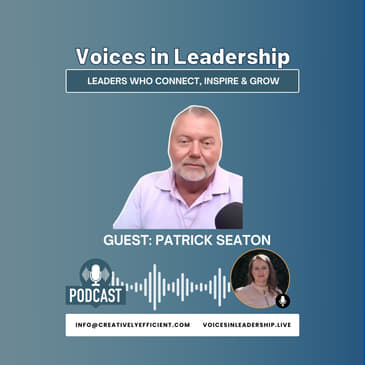

Unlock the secrets of effective change management and sales strategies in our latest episode with visionary Patrick Seaton. What if understanding the human brain could be the key to closing your next deal? Patrick, with his groundbreaking work combining neuroscience with sales, answers this question and more, sharing insights from his acclaimed book, "A Crocodile Brain Can Make or Break Your Sale." His innovative approach has inspired tools like "Ask Alex," a unique AI-driven platform that transforms how sellers navigate the buyer's journey, ensuring effective and empathetic communication.
Patrick also challenges traditional change management methods, offering a fresh perspective from his second book, "The Change OS." Dive into the structured approach he champions for facilitating change, emphasizing the crucial role of preparation and workforce engagement. Hear firsthand accounts from users like Earl and Donna, who have revolutionized their communication strategies using Ask Alex. This tool stands out by not just mirroring back user input but actively engaging with the receiver's perspective, providing constructive feedback that enhances the effectiveness of messages across various contexts.
Explore the practicalities and innovations of Ask Alex, an AI agent platform now integrated with Claude and soon with GPT. Whether you're an insurance agent perfecting your pitch or an entrepreneur refining your communication skills, discover how a 10-day free trial can open new pathways to success. Moreover, we highlight the dynamic partnership between Patrick and Alex in AI development, showcasing how their collaboration has not only sparked technological advancements but has also aligned with their shared vision of teaching and problem-solving. Join us as we acknowledge the power of innovation and the impact of thoughtful collaboration on business and personal growth.
00:03 - Dr. Angela J. Buckley (Host)
Welcome to Voices in Leadership, where leaders who connect, inspire and grow come to share their stories live. I'm your host, Dr Angela J Buckley. Join us as we explore authentic leadership, gratitude and the power of connection through powerful conversations with inspiring voices. Let's inspire, uplift and elevate leadership that truly makes a difference together. Well, hello and welcome to another episode of Voices in Leadership. I am here today with Patrick Seaton. We have known each other for maybe a year, working on launching businesses, looking at innovative sales techniques and, in my case, change management, process leaning and overall supporting of the aligning of people to processes. So, Patrick, you have really had an eventful year with the work that you've been doing year with the work that you've been doing.
01:07 - Patrick Seaton (Guest)
Why don't you tell us a little bit about it? Very eventful, I would say. Working on a new tool for sales, thought partnership, and also wrote a book on change called the Change OS, and both of them are really exciting. Both of them are really exciting Culminations of lots of work from the years past, but they are have been brought into today and it's just a lot of fun to talk about them and and share them with people.
01:41 - Dr. Angela J. Buckley (Host)
OK, so tell us a little bit about the book. So the book, the first book, was the kickoff for what you've been working on recently, correct?
01:47 - Patrick Seaton (Guest)
The first book I wrote came out in May of 2024. And that was a mixture of sales process and neuroscience, and that book memorialized work that I had been doing for nine years with a client on sales, and so the book is titled "'A Crocodile Brain Can Make or Break your Sale", and that showed how the buyer's brain works inside their buying process and how we need to communicate with them on a very different way, in a very different way than traditional selling. That book then got brought into Agentic AI and a platform that I call Ask Alex, and it is a plugin to Claude and soon GPT, where someone who is a seller but maybe doesn't like selling or maybe is not trained in selling like many solopreneurs and small businesses, micro businesses they can ask it anything sales process from A to Z, and also really focuses on the buying journey and how to help sellers guide a buyer. So that's the first book that turned into my Ask Alex, which is really fun. Just knowledge activation To me, that was the term that came out of it and how do you really get knowledge from a book?
03:24
Because I wrote a book, thinking my first. That was my first book. I thought, oh, I'm going to have a book, okay, but now what do you do with it?
03:32
Yes so it was very much a um how to. How to activate the knowledge when people don't even read the book, perhaps? How to activate the knowledge when people don't even read the book, perhaps, but they still can gain the knowledge and benefit from the content of the book. So that's book one. Book two came out this year, which is called the Change OS, and that is when I step back after 30 years.
04:07
I'm aging myself here, but after 30 years of working in the change space, I just have never been happy with the term change management myself, because it's one of those terms that everybody has a perception of. It carries a lot of baggage. People look at it as forced change, big, radical change, and I've never been in that space. My whole career has been in small incremental change group facilitation and I always called myself I do change facilitation, not change management, change facilitation. And I always called myself I do change facilitation, not change management, change facilitation.
04:47
And this year in the spring I thought you know, change management is just the scapegoat for everything that doesn't work right in change initiatives and everything has been thrown into what my analogy is For 70 years change management has thrown everything into the big junk drawer in your house. Anything and everything related to change is thrown into that drawer. It's unorganized, we can't find anything and when something goes wrong we blame the drawer for being messy instead of us for not organizing. I said it's about time that somebody took that drawer, emptied it out, organized it and figured it out. So I did exactly that. I took all the information I could find excuse me and organized it. More so on the life cycle of change and the various steps that go in that life cycle, so that we can have predictable changes with success. And it's not some magic voodoo art that only a few people know. It's very plain and simple, explained and really anyone could read it and understand it and say, okay, now I know how to drive change. So we can become change practitioners much easier through this blueprint.
06:27 - Dr. Angela J. Buckley (Host)
So one of the things that's interesting to me because I have had an opportunity to look through your ChangeOS is the real conversation around change readiness and, as you know, my PhD deals with how we're dealing with the workforce and engaging with them so that they are prepared and how that influences their willingness to stay in an organization. So can you tell me just a little bit more about how you're using that change readiness and really talking about the people during the change management part of it?
07:01 - Patrick Seaton (Guest)
Oh yeah, change readiness for me is the last step in the change life cycle it starts off with. So there are seven different steps and I'll go through them real quickly. Change management is at the top and it says what are we doing, why are we doing it and who's in charge? That's change management, redefined so that it makes it easier to understand what we're doing. Now it could be for a company, it could be for a department, it could be for a project, a team, whatever it is, but you still have that kind of conversation.
07:36
After that it goes to change preparation. We've got a great idea. Here's the initiative we're thinking about. How prepared are we as a company, as a department, as a team, as a whatever, if we were to do this? And we should probably be as prepared as possible for seeing the things that we can and get them in place. Then we come into change enablement and that is where the people come in. So we need to have the people driving the change. I'm a firm believer that change does not happen through mandate or announcement. It happens through conversations. So we need to have people having conversations with other people who are going to be impacted. So that's the change enablement. Let's get the people that we need or will need in order to drive this and move it forward after that we need to organize the people.
08:27
That's change activation. What are? How are we going to deploy them? How are we going to schedule them? Where are we? Where are we going to go all of that logistical stuff? At the after that comes change facilitation, and that's where all of the many, many, many, many tools and models and everything you think of go into the change facilitation, because that's our big toolbox. So now we have the people, we know where we're going to go. What do we need to use for tools to drive those conversations? After that it goes to change traction, which is, hey, let's go have the conversations, and all across the company, all across the organization, at the right levels, with the right people, and once we've had those conversations, we end up with change readiness. Okay, we've been doing all this work. Now, before we pull the trigger because some people think we're ready.
09:23
But let's just take a pulse check and see down the line, down the organization. Is everybody ready for us to pull it? Because what a shame it is when the organizers, the sponsors, the team say hey, we're ready to go, let's go, let's go and then three waves down, we missed people and it falls apart. So what we want for success ends up being not successful. And that is, that's, for me, where the change readiness. Are we really ready to pull the trigger and launch it and have everybody ready?
10:13 - Dr. Angela J. Buckley (Host)
So I guess one of the questions I have with that is what happens when you have these people who are truly resistant to change. Do you have methods within your ChangeOS and I thought I heard plans for ChangeOS to also become agentic somewhere down the road. Changeos to also become agentic somewhere down the road. True, true, how do people can they?
10:35 - Patrick Seaton (Guest)
engage with you, with the ChangeOS, to help overcome some of that resistance. Yeah, change resistance or people aren't? Well, let me just say I don't believe that people really resist change. I believe that people resist being changed. We make changes every day in our lives when we understand why, what, how it will benefit us, we're listened to, we have a say. We're not always against change. People think that but what people are against is when change is forced onto them.
11:19
And part of the change OS, when you get into the change traction with the tools and the conversations, you involve those people. Here's what it is Now. They might not like the change, but at least they have a moment and their space and their platform to say here are my concerns. Here's how this is going to impact me negatively or positively. And if it's negatively, what are we going to do? Because the whole idea of this change is not to create negative impact on people. Create negative impact on people, but an idea that started at 50,000 feet in the company and gets down to 500 feet very different and people see it different, different altitudes, different perspectives. So we need to involve them.
12:01
That has always been what I've advocated for. The people are the experts. They know what's working, they know what's not working. They can translate any new change into their world much easier, much faster, and just say it's good, but we need to think about this, this and this and what's going to happen when that and who's going to. You know, have we thought about this? And those are the questions that they have and those are the best questions to have. That is not resistance to change. That is really caring about the company.
12:36 - Dr. Angela J. Buckley (Host)
So tell me a time, Patrick, when you've been able to use this and seen the success of the system put together seen the success of the system put together.
12:50 - Patrick Seaton (Guest)
It has been when I was in corporate. I did. You know I didn't have it called the change at that point because it's there, but I had all of those conversations as I was using the tools for nine years in the company. Senior management never even knew, but I was using conversations across departments when we were having changes and having the right conversations with the right people, and people would come into sessions saying, oh, I don't know why I'm here, I'm so unhappy. And when they left they would say you know, this is pretty much the first time in seven years that I've worked in this company that anyone's ever listened to me, which is really a sad statement unto itself, but that's the reality, because the culture was not let's get the people in and give them that voice.
13:47
And so having those small conversations with five, six, eight people on a very specific topic and they get to say everything, it's safe. They can say this isn't working. This is one of the dumbest ideas I've ever heard of because of okay, well, maybe that's where we're going, so we've got to figure out a way to work with the dumb idea because we can't have it. We cannot just say we aren't going to do it. But that's the whole thing. It's how do you have those change conversations with the right people at the right moments and engage with them so that they understand and come along with you? So I don't, you know one initiative driven all the way through it for me, because each of these, these formulas work with a different level of the company or different level of the initiative. You know, the organizers are different than your change practitioners are very different than the frontline. So it's parsing and piecing what needs to happen when, so that there is an overall success.
15:12 - Dr. Angela J. Buckley (Host)
So, Patrick, it's been very apparent that you are very much attuned to the listening part of change management and I think that's one of the skills that you carried forward in Ask Alex and the initiative associated with your neuroscience-based selling. Can you talk us through? I know we went there and came back and we're here again, but can you tell us more about Ask Alex? What's the benefit, what's the strength? What are some of the case studies? You've had people working with it now for two or three months. What are they seeing?
15:51 - Patrick Seaton (Guest)
Yeah, they love it. The people who are using it absolutely love it because it is a thought partner for them. It gives them new perspectives that they might not see Now. You could say, well, that's just like GPT, it'll give you lots of different ideas, or GLOD or Gemini or Copilot. But the ideas and the thought partnership within Ask Alex comes from curated content and it's not allowed to just pull information willy-nilly.
16:30
So I'll explain ASCALS this way. Think of it as you have a library shelf and on the left side of the library shelf are a bunch of reference books. So those are my first book, the second book that I've published workflows, information, neuroscience all the reference books, if you will. On the right side is empty space where we put in the users company context, their thinking styles, their personality styles, information about them, maybe writing samples so it understands them. And then behind that are the agentic AI, the agents, and there are 10 or 11 in Ask Alex and each one has its own specific job.
17:25
So now the user goes in and types their question Now it doesn't have to be a prompt, it can just be random thoughts and questions, mix and match everything. And then Alex becomes the master librarian and says oh so for this question, I need this agent, or this part of the question, I need this agent. For this of the question, I need this agent. For this part, I need that agent. Then the agents say, oh, now I need to go and find information from the library books so it can pull exactly what's needed and curate and orchestrate the answer back to the back to the typist, the person typing. Here's the big change. I have many people saying, yeah, but I have my own gpt avatar and it thinks like me and it talks like me and it can write like me.
18:17
I say yes and are you selling to yourself? Because if you're writing to yourself, then yeah, that's great, but you're writing to yourself, then yeah, that's great, but you're not writing to yourself, you're not selling to yourself and so everything sounds perfect to you because you wrote it. Ask Alex always goes towards, takes the position of the receiver of information and how it's going to land on their brain. How are they going to interpret this? How are they going to react to it? Is their crocodile brain, lizard brain, reptilian brain, whatever the term is that people want to put? But the reactionary will that look at it as you're here to help me or hurt me? Do I understand this or is it too complicated? Are you a threat trying to steal my money, or are you really here to be someone who can help me thrive? And so it's always looking at it from that point of view, saying okay, get the message, but have to tell you this is not going to land well, because these are the words, these are the phrases you're using that are going to trigger them and not the trigger you want. You can also put in, you can take any kind of document, a proposal, a presentation. You can ask it to come up for questions for different meetings. What would be the best question so I can understand this client and what their problems are? It has just a variety of ways that it helps.
20:05
People have used it who are using it. One gentleman boy, he was really his name is Earl. He is really organized. Earl has his flight plans for his sales process. They are so organized. I honestly think that sometimes it says Earl, it's time to go to the bathroom. That's how tight they are in his steps. He has taken everything that he's written and put it into Ask Alex and adjusted it because everything was from him. He said this is the most incredible thing I've ever seen.
20:46
Donna who is using it. She has run her workshop information through it and when she presented a workshop people came up and said I absolutely love the way you worded this. Can we have this so we can use it internally and the people really appreciate that. It doesn't just placate to the person, it will push back. You don't have to ask it to push back. It will say yes, but and one of the things that people tell me when they're just using GPT and they're frustrated is that you can put in. You know the world is flat and it was, oh, what a novel idea. Oh my gosh, you are just so brilliant Because it always wants to please you, and that's not really helpful. So I've seen some of your coaching with some people.
21:44 - Dr. Angela J. Buckley (Host)
I've seen some of your coaching with some people. I've seen some of the feedback when you were using Ask Alex as you were demonstrating it, and I appreciated when you put multiple options in there and then you explain the strength of the different options or weaknesses, right, like here's option one, two, three and four. These have this type of a trigger depending on your client, and this is the one that would avoid all triggers based on the wording basing on the target market, right. I thought that was really powerful and I have to say I haven't seen that anywhere else. Plus, it had the explanation associated with it.
22:33 - Patrick Seaton (Guest)
Yes, that's one of the biggest things is that it doesn't just tell you you know well, without saying it. Just trust me blindly.
22:42 - Dr. Angela J. Buckley (Host)
Yeah.
22:43 - Patrick Seaton (Guest)
Here's the best thing Okay, but it asks Alex will always tell you here's the best, here's the best thing Okay, but it ask Alex will always get tell you here are the choices, here's why, here's the analysis, here's what you could do, and it usually gives three or four different options, which is really good. If you're going for this kind of approach. You know, if you want to be more of the problem solver approach, if you want to be the more empathetic person, if you want to be this, it will give you that, so you can pick the kind of person or portray the person you want to be with, whoever you're talking to or writing to, and it will always then say the best way for this approach is like this, the best way for that one is that. So it does that naturally. I mean the agents that have been created. I did not create them. I am not an AI agent builder, but boy oh boy, the gentleman who has created them is amazing, and so they work phenomenally well.
23:55 - Dr. Angela J. Buckley (Host)
So okay, I'm interested in Ask Alex. I come to you and I say what, how do I get started? What do you need from me? If I'm starting with Ask Alex.
24:08 - Patrick Seaton (Guest)
For Ask Alex. It's really easy. If you say you know I'd like to try it out, cool, just like you want to test drive a car, why don't you test drive Ask Alex? I say here's the one thing Right now, today, the 30th of October, because, for technicality speaking, claude is the AI agent or platform in which Ask Alex can be plugged into. Gpt is just about there. I think they're another week and a half or two weeks and then they're going to be right up there with Claude. So you say I'd like to test drive it.
24:44
Okay, here you go. Do you have Claude Pro? Yes, okay, let's schedule a call and I like to test drive it. Okay, here you go. Do you have Cloud Pro? Yes, okay, let's schedule a call and I'll give you 10 days free trial, walk you through how to use it, explain stuff. Every day you get a little email saying hey, did you know you could do this? Here's a challenge for the day Try that, play with it, and then, as it gets to the end of 10 days, the person can say, no, I don't want it. Okay, fine, that's okay. Or they say, yeah, I do want it, sign me up, and they can pay for a monthly subscription or an annual, and then they can just go to town with it. Here's the extra fun benefit for people is that if they refer five people who sign up, their original connection fee is waived for life. So now they've gotten it for free.
25:43 - Dr. Angela J. Buckley (Host)
So tell me a little bit more, because you were saying I can use my voice and put my kind of content in. I feel like there's more. Oh yeah, oh thanks, Thanks for bringing it up.
25:56 - Patrick Seaton (Guest)
Yeah, so Claude, laptop is just typing. You're typing on your laptop or your desktop, whatever it is, and everything comes back to you in written form, obviously. But Claude has a mobile app that syncs up with your desktop and on the mobile app the telephone, that's where we talk. So there's a little microphone and you can actually just talk to it and it transcribes your what you say and then analyzes it in the same way. So why is that so important.
26:34
There are certain things that we always write and there are things that we always say. So when we want to practice our messages that we leave in voicemails or our first opening line when we get on a call, we can do that through the mobile app and help tighten that up and clean it up and make sure we're not triggering. Because here's the reality we talk very differently than we write. When we write, we take a lot more caution and time, we think and rethink and we rewrite and we substitute. That's a luxury when you are just talking live, it needs to be. The ideal thing is you're more practiced, but it doesn't sound robotic or scripted. So how can you practice that side of your business and your delivery? But it's a great thing for the. Honestly, I have not even looked to see if GPT has a mobile app. They probably do.
27:44 - Dr. Angela J. Buckley (Host)
They do, but I haven't used it with a voice like what you're describing.
27:49 - Patrick Seaton (Guest)
Yeah, and so that that was. That's been one of the things that people have have really enjoyed when they're saying I just want my first 90 second speech To land well, ok, that's good. So practice it that way. Yeah, you can put it in, you can practice it and it will give you feedback.
28:11
You can. You can say your speech, record your speech and it will give you written feedback and analyze it just the same way. Well, you know this. These words and these phrases are triggering way. Well, you know this. These words and these phrases are triggering. So therefore, maybe that you know, here's some suggestions for how to do it. If you're trying to do, trying to accomplish a, b or c, got it.
28:30
So then then you can just keep going. So in one case use case that I have I'm working with the gentleman and we're we're um connecting with with insurance salespeople, and so we've created personas where the insurance agent can say hi, I'd like to have a call with Margaret, okay. And so the agent, margaret, kicks in and says hi, this is Margaret. Hi, margaret, I'm so-and-so from such-and-such and I would like to talk to you about Medicare for the year-end during the open enrollment, and then she will respond and the goal is I need to get information, I need to get enough so I can quote a plan for Margaret. So all of that, because insurance agents do it over the phone, it wouldn't make any sense to type everything because it wouldn't feel natural.
29:30 - Dr. Angela J. Buckley (Host)
Okay, oh, I like that yeah.
29:35 - Patrick Seaton (Guest)
So you use the desktop for your writing activities and you use the mobile for your verbal activity okay, that's cool.
29:48 - Dr. Angela J. Buckley (Host)
I didn't know about that part of it.
29:50 - Patrick Seaton (Guest)
That's awesome that is, it really is. And again, the verbal it will always respond thinking like the prospect I.
30:01 - Dr. Angela J. Buckley (Host)
I feel like it could be really valuable for entrepreneurs practicing their elevator pitch. Very much so I meet with so many small business owners and they're like yes, I have one. Okay, he's like let me pull it up, excellent, not the way it's supposed to work, right. So people have gone through the effort, but the practice and the ability to really make those statements cleanly in the least expected moment is important. I mean that is the point of the elevator pitch correct.
30:38 - Patrick Seaton (Guest)
Absolutely.
30:38 - Dr. Angela J. Buckley (Host)
So, having that honed in, and certainly throughout the years I have been to many, many exercises of writing the elevator pitch, so obviously mine has changed throughout the years. But really to have that kind of feedback where you're practicing it to different types of people I'm often cognizant that I should adjust a little bit, but I don't know how to. It would be helpful to have the different personas giving that feedback.
31:10 - Patrick Seaton (Guest)
Right. So you could say and it's not just the elevator pitch, it could be how you describe your company how you describe a product or a service and you could, knowing if I'm very data or process.
31:25
I am process, so I tend to by default, just because that's how my brain works. I usually give more information in the steps and how things happen. That's just the easiest way for me to describe it. But but, for some people they're like that's. I don't really care about that. I want to know, you know, how is it going to change my company for the next 10 years?
31:54 - Dr. Angela J. Buckley (Host)
Right.
31:54 - Patrick Seaton (Guest)
So for me to and I use Ask Alex a lot and I know what I should be doing, but you just get into autopilot.
32:05 - Dr. Angela J. Buckley (Host)
Yes.
32:07 - Patrick Seaton (Guest)
And so being able to say I know that my audience is going to be much more visionary, creative. They're going to be very people oriented, and that's not really my thing. They're very data driven. Help me so that I have good ways to connect with them and those four different brain styles, brain dominances, built into it. So it will say great, this is good. Or you give a presentation. Upload your presentation, okay analyze this yeah. Well, lots of data, lots of words, you're not really connecting with the people.
32:58 - Dr. Angela J. Buckley (Host)
Listen my presentations have workflows in them, right, and that may not be what people need, because I work with a lot of engineers, but when I start doing more entrepreneurial things, I need to adjust.
33:17 - Patrick Seaton (Guest)
Here's the thing Having workflows in a presentation is not necessarily a bad thing. It depends on at what point are you in the buying process when they're going to need that information.
33:26 - Dr. Angela J. Buckley (Host)
Correct.
33:28 - Patrick Seaton (Guest)
Because they will need it at some point, but do they need it at the very beginning? Do they need it here or do they need it down here? And that's also because Ask Alex has a process built into it that what do you need for a good first meeting? What do you need for those next meetings? What do you need to do when you're involving stakeholders, when decision makers, when you're trying to come up with the SOW, when you finally want to give a quote? It has that in there, so it doesn't say, oh, you need to make this really big presentation that's going to cover everything in one.
34:07
Say no, no, no, no, no, let's focus here First meeting what do you need to do to get to the next step? Let's focus on that. So that's why I call it the thought partner. Help me think through what I need to share with the people I'm talking to right now, in this interaction, in this moment, in my next meeting. Let's not solve world hunger in one presentation. Let's just get one little baby step down towards the road.
34:43 - Dr. Angela J. Buckley (Host)
Got it and you've been doing that with people. So, patrick, thank you so much for explaining to us how, how ask I almost said Patrick how Ask Alex works in the, the opportunities that it brings for people to learn really different perspectives, and where they are in that sales journey, in that sales process to helping helping their clients. I'd like to move on, if we can, to the gratitude section of of the hour and I'd like to ask you if you brought with you the name of somebody that you really wanted to acknowledge today.
35:31 - Patrick Seaton (Guest)
The person that I really need to acknowledge is Alexander Price.
35:36 - Dr. Angela J. Buckley (Host)
Okay.
35:37 - Patrick Seaton (Guest)
He's the German engineer and the agentic AI in my world guru. And even though his name is Alex, I did not pick Ask Alex for Alex. I chose Ask Alex because I wanted a gender neutral name so that people can think of bless. You think of Alex as male or female, and but Alex is is just an amazing German engineer. Railroad transportation got into AI very early, very early. You know when it was just coming out and you know that, and he's always always like five years down the road as to where this is going.
36:41 - Dr. Angela J. Buckley (Host)
And it's just.
36:42 - Patrick Seaton (Guest)
It's really fun to get in to conversations with him because he really has a good insight into where this can and will go Correct. And the fun part between our relationship is that I go well, you know what People aren't quite ready for that. You're talking Star Trek and we're still kind of back in the industrial age. So, but he without, without Alex and his genius. I ask Alex would not be there today. The book would be there, but no, it's because of him.
37:10 - Dr. Angela J. Buckley (Host)
Patrick, we're gonna walk through the spirit of acknowledgement method and craft a powerful thank you today for Alex. Okay, Okay, yep, let's do it so the spirit of acknowledgement. It's an acronym and the S stands for specific. So, specifically, what did Alex do for you?
37:37 - Patrick Seaton (Guest)
Brought knowledge activation to my content. Okay, through programming and programming the agent.
37:53 - Dr. Angela J. Buckley (Host)
Yep, yep, yes, okay. Through programming and programming the agent Yep, yep, yes, okay. And how did that? So P stands for personal, so how did his actions reflect back on his character or cost him in that development? So it's an emotional cost when we talk about that right, not just dollars.
38:13 - Patrick Seaton (Guest)
No, no, no. I think we both went into this and Alex, more so, went into this saying I just I want to try it out. You know, I need a guinea pig and I want to share this and really his willingness to work with someone who didn't know diddly squat about AI and agentic AI and just handhold and walk me through and really help me build something that maybe he didn't even know where it was going, but he was still there, he was still right by my side and we're okay, let's figure this out. So I really appreciate his willingness to invest time. I really appreciate his willingness to invest time in a project that we really didn't know where it would go and what it would do.
39:17 - Dr. Angela J. Buckley (Host)
Okay, so the P would be the exploration and the adventure associated with developing something new.
39:25 - Patrick Seaton (Guest)
Yes, yes, that's a great way Great summary Yep, yes, yes, that's a great way Great summary Yep, okay.
39:29 - Dr. Angela J. Buckley (Host)
And then I stands for impact. How did the work that he has done for you financially impact you?
39:41 - Patrick Seaton (Guest)
Financially impact.
39:42 - Dr. Angela J. Buckley (Host)
Or metrics of some sort, business metrics.
39:44 - Patrick Seaton (Guest)
Metrics of some sort, business metrics. Well, it gave me a new way to share my book in the nine years with the world and financially, as I'm now launching the trial versions and they're converting into the paid subscriptions and those trial versions have only been out for about two, three weeks that I've been talking to people.
40:15
that is starting to grow, albeit, you know we all want to go faster, but it is what it is and it will grow as it grows, and so all I need to do is make sure I get people, I talk to them, I explain it, I get them into the trial, and then the magic that alexander did with his agents and ask alex, it's, it's just a no-brainer for people well, I've been watching you through this launch and it is not a linear growth, so maybe not quite exponential, but you're on that early part of the curve at the moment.
40:53 - Dr. Angela J. Buckley (Host)
So we will see fingers crossed that you'll be exponential by January.
40:59 - Patrick Seaton (Guest)
Oh, I'd love that Would love that.
41:02 - Dr. Angela J. Buckley (Host)
I mean we're starting to see those numbers, right, patrick Yep yep, yep, yep, yep. Okay, so impact. And then the R stands for relevance, and relevance is talking about your values. How did the activity that he brought, the specific actions that he brought, to you, how does it reflect back on your values or your company's values it reflect back on?
41:27 - Patrick Seaton (Guest)
your values or your company's values Very strongly, because I have always been a in teaching, coaching, training, helping, problem solving all of those things to help someone else and the relevance is that this allows me what what Alex created through Ask Alex helps me help others on a much broader scale, because I love doing one-on-one coaching with solopreneurs and businesses.
42:00 - Dr. Angela J. Buckley (Host)
Yes.
42:01 - Patrick Seaton (Guest)
It's great, but that is very constraining. We become our own roadblock and having Ask Alex which it's funny, you said, I almost said Ask Patrick in some ways, because I wrote the book, literally typed there was no AI, it is me, and so you do have me and all of my knowledge on the sales process at your fingertips. So it is very relevant for me to be able to share and spread and help more people who struggle with sales.
42:39 - Dr. Angela J. Buckley (Host)
And that's their livelihood. They have to make it work Correct, okay. So the next I and the next T are less relevant to what we do here, because this is a little bit more of a retrospective Thank you. But the second I, in spirit, stands for inclusive and that means making it public. If you were in a team organization, it would be offering that thanks and acknowledgement in front of the team at team meetings, and t stands for timely, so is it close to the time of the event. So actually, in your case, this is a pretty good one. Um, do you mind if I summarize what you just said?
43:22 - Patrick Seaton (Guest)
absolutely, we'd love to hear it.
43:24 - Dr. Angela J. Buckley (Host)
Okay.
43:26
So, alex, patrick would like to thank you today for all the work that you have put into creating Ask Alex Together.
43:36
When you started, you weren't sure where the product was going to go and AI was still being developed.
43:44
Agentic AI was just a new frontier, was still being developed. Agentic AI was just a new frontier and you dug in. You dug your heels in and you explored what was available and created something that has demonstrated your personal values of creation, of vision, of strategy that supports the agentic knowledge and the knowledge activation that Patrick so greatly craved. He didn't want a book that was sitting on a shelf, he wanted something that was immediately available and accessible to clients to be able to use in those moments of need. And so the impact of your development and the timeliness of your development has been nearly exponential, so early days still in the financial growth of the organization. Innovative management tools, management tools, and it reflects back on that wish and goal and value that Patrick has always brought along in his organizational development of making sure that it wasn't just knowledge but knowledge being used, and this creates that pathway for people. So thank you for your energy, your dedication, the creativity and the vision in creating Ask Alex and looking forward to future opportunities.
45:18 - Patrick Seaton (Guest)
Wow, that was amazing. I can't wait for him to. I'm sure he's not on the live, but I can't wait for him to share the replay and have him hear that. I really appreciate that.
45:32 - Dr. Angela J. Buckley (Host)
So all your words, but it's helpful to use similar to some of the things that you do, right. It's helpful to have that method to summarize and put that back in a way that people can really identify what it is that drove the support.
45:52 - Patrick Seaton (Guest)
That's really powerful.
45:55 - Dr. Angela J. Buckley (Host)
Well, Patrick, I have really enjoyed speaking with you today. I've learned so much more about Ask Alex and also the Change OS. I am waiting with bite-fingernails for the Change OS agentic system. So let me know when you're ready for that, because that is definitely more my bailiwick. But in the meantime, if people are interested to learn more about you, how they find out about Ask Alex, where do they go?
46:28 - Patrick Seaton (Guest)
find out about. Ask Alex, where do they go? Best places is just through LinkedIn or pdseaton at innovativemanagementtoolscom, pd Seaton. But LinkedIn message and I can give you the link you can to sign up for that. You say, yep, I've got it, let's go and we get you connected. I have people connected within six hours from the time they raise their hand and they say, yep, I've got it, let's go and we get you connected.
46:48
I have people connected within six hours from the time they raise their hand and they say I have a space for a call, so take advantage of it please. 10 days for free. What do you have to lose? You have everything to gain.
47:02 - Dr. Angela J. Buckley (Host)
Patrick, so exciting to see what those next steps are going to look like. I will make sure to put all those links in the show notes and on the blog post that accompanies this broadcast. So thank you again. I enjoyed talking to you.
47:18 - Patrick Seaton (Guest)
Thank you have a great day.
47:20 - Dr. Angela J. Buckley (Host)
Thank you, you as well. Okay, thank you for joining us on Voices in Leadership, where leaders who connect, inspire and grow share their stories. I look forward to welcoming you back to our next conversation. In the meantime, visit wwwvoicesinleadershiplive to access show notes, links and to subscribe and stay connected. And, in the spirit of gratitude, let's remember to thank one person near you Until next time. This is Dr Angela J Buckley, signing off.